Before you book your wisdom tooth consultation, you want to know one thing: how much is this going to cost?
Also see our guide to dental insurance coverage for wisdom teeth removal, including deductibles, annual maximums, network status, and anesthesia coverage.
It’s a completely reasonable question — and one that’s surprisingly hard to get a straight answer on, because wisdom tooth removal costs vary enormously depending on where you live, what type of extraction you need, whether you have insurance, and whether you’re seeing a general dentist or an oral surgeon.
This guide breaks it all down country by country — the US, UK, Australia, and Canada — with price ranges for simple and surgical wisdom tooth extraction, insurance guidance, and practical strategies for reducing your out-of-pocket costs. If you are searching for the cost of wisdom teeth removal or wisdom tooth extraction cost, start with the country-specific estimates below; your dentist or oral surgeon can provide a personalized written quote after an examination and X-rays.
Quick Answer: How Much Does Wisdom Teeth Removal Cost?
Costs vary significantly by country and extraction complexity. In the US, expect $225–$600 per tooth without insurance ($900–$2,400 for all four). In the UK, NHS treatment costs £27.90–£332.10 total; private treatment runs £150–£500+ per tooth. In Australia, private fees vary by provider and procedure; request a written quote. In Canada, Canada Life gives illustrative estimates of C$200–$400 for simple wisdom tooth removal and C$500–$800 for complex surgery; fees vary by province and additional charges may apply. In all countries, impacted teeth requiring surgical removal cost significantly more than simple extractions.
What Makes Wisdom Tooth Removal Cost More or Less?
Before getting into country-specific pricing, it’s worth understanding the factors that most significantly affect what you’ll actually pay — because two people in the same city can receive very different quotes.
Type of Extraction
This is the biggest single cost driver. There are two fundamentally different procedures:
Simple extraction: The tooth has erupted through the gum and can be removed with forceps using local anaesthetic alone. Faster, less complex, significantly cheaper.
Surgical extraction: The tooth is impacted — fully or partially trapped in bone — requiring incision, bone removal, and often tooth sectioning. Requires more time, more skill, and in some cases referral to an oral and maxillofacial surgeon. Substantially more expensive.
Most wisdom tooth problems involve impacted teeth — which is why the higher surgical extraction price range applies to the majority of patients.

Number of Teeth Removed
Removing all four wisdom teeth at once is common — particularly when all four are impacted and the patient is already under sedation. Some practices offer a modest reduction for multiple extractions in a single session, though this isn’t universal.
 Read More: Early Signs of Impacted Wisdom Teeth: What to Watch For
Anaesthesia Choice
Local anaesthetic alone adds no significant cost beyond the procedure fee. IV sedation adds $200–$600 in the US; general anaesthetic (hospital setting) adds more substantially and may trigger separate anaesthetist fees.
General Dentist vs. Oral Surgeon
Oral surgeons typically charge higher fees than general dentists for the same procedure — reflecting additional specialist training and equipment. Complex impactions, particularly those near the inferior alveolar nerve, are almost always referred to oral surgeons regardless of cost.
Geographic Location
Within every country, costs vary significantly by region. Metropolitan areas, particularly major cities, consistently show higher dental fees than rural or suburban practices.
💡 Tip Box: Getting two or three quotes for wisdom tooth removal is completely normal and appropriate — particularly for complex cases requiring specialist referral. Most dental practices offer free or low-cost consultations specifically for extraction assessment.
United States: Wisdom Teeth Removal Cost
The US has no universal dental coverage system, so out-of-pocket costs and dental insurance benefits vary widely. Prices below are illustrative estimates, not a national fee schedule or a guaranteed quote. The American Dental Association notes that it discontinued its national Survey of Dental Fees in 2023 and does not set or recommend dental fees. Obtain an itemized estimate from your dentist or oral surgeon and confirm coverage with your insurer before treatment. See the ADA Health Policy Institute’s dental market information.
 Read More: Dry Socket: What It Is, How to Spot It, and What to Do Immediately
Price Ranges (Per Tooth, 2026)
| Extraction Type | Without Insurance | With Dental Insurance |
|---|---|---|
| Simple extraction | $75–$250 | $25–$100 (after coverage) |
| Surgical (soft tissue) | $225–$400 | $75–$175 (after coverage) |
| Surgical (bony impaction) | $275–$600 | $100–$250 (after coverage) |
| Full set (all 4, surgical) | $1,000–$3,000 | $350–$1,200 (after coverage) |
IV sedation (additional): $150–$500 General anaesthetic (hospital, additional): $500–$1,000+ Oral surgeon premium: Often 10–30% higher than general dentist rates
Dental Insurance in the US
Most employer-sponsored dental insurance plans cover wisdom tooth removal under “oral surgery” — typically at 50–80% of the allowed fee, subject to annual maximums (usually $1,000–$2,000 per year).
What to check before your procedure:
- Whether the extraction is covered as basic or major restorative (affects percentage coverage)
- Your annual maximum and how much has already been used that year
- Whether your dentist or oral surgeon is in-network (out-of-network providers may be covered at a lower rate or not at all)
- Whether sedation is separately billable and whether it’s covered
Pre-authorization: For surgical extractions, insurers often require pre-authorization — a written confirmation of coverage before the procedure. Request this proactively to avoid coverage surprises.
Reducing Costs in the US Without Insurance
Dental schools: Accredited dental school clinics perform extractions under faculty supervision at significantly reduced rates — often 40–60% less than private practices. Quality is generally high; the trade-off is longer appointment times.
Community health centers: Federally Qualified Health Centers (FQHCs) offer dental services on a sliding-scale fee based on income. Find your nearest one at findahealthcenter.hrsa.gov.
Dental savings plans: Membership-based discount plans (not insurance) like Careington or Aetna Dental Access offer discounted rates at participating dentists — typically 15–50% off standard fees.
Payment plans: Most oral surgery practices offer in-house payment plans or work with financing providers like CareCredit or Lending Club Patient Solutions.
United Kingdom: Wisdom Teeth Removal Cost
The UK has a significant advantage most patients don’t fully appreciate — NHS dental treatment, when available and eligible, provides wisdom tooth extractions at heavily subsidized rates.
NHS Pricing (England, 2026)
NHS dental treatment in England is organized into three charge bands:
| Band | Cost | What’s Included |
|---|---|---|
| Band 1 | £27.90 | Examination, diagnosis, X-rays |
| Band 2 | £76.60 | Includes Band 1 + extractions |
| Band 3 | £332.10 | Includes all complex treatments |
Wisdom tooth extraction under the NHS in England: When clinically necessary and provided as NHS dental treatment, extraction is generally included in Band 2 (£76.60 from 1 April 2026), which covers removing one or more teeth in a course of treatment. You pay the band charge once for that course, not separately for each tooth. Eligibility, referral pathway, and the treatment recommended are determined by the dental professional. Check the official NHS dental charges before booking.
Important caveat: NHS charges in Scotland, Wales, and Northern Ireland differ from England:
- Scotland: NHS dental treatment is free for all registered patients
- Wales: Free for eligible groups; otherwise similar band structure to England
- Northern Ireland: Different charging structure; check with your local practice
NHS exemptions: Free NHS dental treatment applies to: under-18s, full-time students under 19, pregnant women and those who gave birth in the last 12 months, people on certain income-related benefits (Universal Credit, Income Support, etc.), and NHS hospital dental service patients.
 Read More: Wisdom Tooth Extraction Healing Stages: What Your Socket Should Look Like Day by Day
Private Dental Treatment in the UK
If NHS treatment isn’t accessible — due to long waiting times, no NHS dentist accepting patients, or choosing private care — costs are significantly higher:
| Extraction Type | Private Cost Per Tooth |
|---|---|
| Simple extraction | £150–£300 |
| Surgical extraction | £250–£500+ |
| Specialist oral surgeon | £400–£800+ |
| IV sedation (additional) | £150–£400 |
Finding an NHS dentist: NHS dentist availability has been a significant issue in England particularly since 2020. Check the NHS Find a Dentist tool (nhs.uk/find-a-dentist) for practices currently accepting NHS patients.
BUPA, AXA, and private dental insurance: If you have private dental insurance, check your policy for surgical extraction coverage — most cover a portion, though limits and excesses apply.
Australia: Wisdom Teeth Removal Cost
Australia’s dental system differs from the US and UK models. Medicare generally does not cover routine dental care for most adults, although public dental services may be available to eligible patients. Private health insurance extras may contribute to dental treatment, subject to policy limits and waiting periods. There is no single nationwide private fee: dentists set their own fees, and the price depends on the tooth, complexity, provider, and setting. Ask for a written quote with the relevant item numbers before treatment. See Healthdirect’s tooth-extraction cost guidance and the Australian Dental Association’s fee policy.
Public vs. Private Cost in Australia (2026)
| Extraction Type | Public (Eligible Patients) | Private (No Insurance) |
|---|---|---|
| Simple extraction | Low/no cost | $250–$400 per tooth |
| Surgical extraction (GP dentist) | Low/no cost | $400–$600 per tooth |
| Surgical (specialist OS) | Low/no cost | $600–$1,200+ per tooth |
| All four teeth (hospital GA) | Low/no cost | $1,500–$4,000+ total |
Note: These are typical ranges for major cities. Regional and rural practices may differ.
Public Dental in Australia
Public dental services are available through state and territory health departments for eligible patients — primarily:
- Concession card holders (Health Care Card, Pension Concession Card)
- Children under certain age thresholds (varies by state)
- People with urgent dental needs in some circumstances
The significant catch: Public dental waiting lists in Australia are long — often 12–24 months or more for non-urgent extractions. If you’re in pain or facing active infection, emergency dental services through public hospitals can provide more immediate access.
Private Health Insurance — Dental Extras
Most Australians with private health insurance have “dental extras” coverage. Coverage for wisdom tooth removal typically falls under:
General dental: Simple extractions — covered at a percentage (often 60–80%) up to an annual limit Major dental: Surgical extractions and hospital admissions — covered at a lower percentage with higher waiting periods (typically 12 months before claiming major dental)
Key considerations:
- Check whether surgical extraction is classified as “major dental” under your policy — this affects waiting periods and benefit percentages
- Hospital admission for GA adds significantly to cost; check whether hospital cover is included and whether the oral surgeon is a preferred provider
- Annual limits on major dental are commonly $500–$1,500 — often insufficient for a full four-tooth surgical extraction
Medicare Benefits Schedule: A Child Dental Benefits Schedule (CDBS) provides up to $1,052 (indexed) over two years for eligible children aged 2–17, covering basic dental services including simple extractions.
 Read More: Wisdom Teeth Recovery Guide: Symptoms, Aftercare & Warning Signs
Canada: Wisdom Teeth Removal Cost
Canada’s provincial health plans generally do not cover routine dental care for most adults, although eligibility and exceptions vary. Wisdom tooth removal costs depend on province, tooth position, surgical complexity, anesthesia, and provider. Canada Life gives a general estimate of C$200–$400 for a simple removal and C$500–$800 for more complicated surgery; these are illustrative, not a national fee schedule, and additional anesthesia or facility charges may apply. Provincial fee guides are references rather than mandatory prices: see the Ontario Dental Association’s explanation and Alberta’s dental fee guidance. Ask your dentist for an itemized written estimate and submit a predetermination to your insurer.
Price Ranges in Canada (2026, CAD)
| Extraction Type | Without Benefits | With Benefits (Typical) |
|---|---|---|
| Simple extraction | Approx. C$200–$400 per tooth | Varies by plan |
| Surgical extraction (partial bony) | Approx. C$500–$800 per tooth for complex removal | Varies by plan |
| Surgical extraction (complete bony) | Complex cases may exceed C$800 | Varies by plan |
| All four (surgical, GA hospital) | $2,000–$5,000+ | $800–$2,500 |
Oral surgeon vs. general dentist premium: Oral surgeon fees in Canada typically run 20–40% higher than general dentist fees for equivalent procedures.
Provincial variation: Fee guides (recommended fee schedules published by provincial dental associations) vary by province. Alberta, Ontario, and BC tend to have higher fee guide rates than Maritime provinces.
Canadian Dental Coverage Options
Employer group benefits: The most common coverage source for working Canadians. Most group plans cover 50–80% of surgical extraction costs, subject to annual maximums (commonly $1,000–$2,500 per year).
Canadian Dental Care Plan (CDCP): As of 2024–2025, the federal government’s Canadian Dental Care Plan provides coverage for eligible Canadians — those without existing dental benefits and with adjusted family net income under $90,000. This covers children, seniors, and adults with disabilities, phasing in broader coverage. Check eligibility at canada.ca/dental-care.
Provincial programs: Several provinces offer dental coverage for specific groups — low-income adults, children, social assistance recipients. Programs vary significantly by province.
Dental schools: Canadian dental schools (University of Toronto, UBC, Dalhousie, etc.) offer extractions at substantially reduced rates under faculty supervision.
Hospital vs. Clinic: How Setting Affects Cost
In all four countries, where the extraction happens affects cost significantly.
| Setting | Typical Scenario | Cost Impact |
|---|---|---|
| General dental practice | Simple to moderate impactions | Baseline cost |
| Specialist oral surgery clinic | Complex impactions, nervous patients | 20–50% higher |
| Hospital day surgery (GA) | Very complex cases, children, medically complex patients | Significantly higher — anaesthetist fees, hospital facility fees separate |
Hospital-based GA extraction is the most expensive option in all countries. In countries with public healthcare (UK, Australia, Canada), eligible patients may access this at low or no cost through public systems — but waiting times apply.
In the US, hospital-based GA for wisdom tooth removal typically adds $500–$2,000+ beyond the surgical fee itself.
 Read More: Wisdom Tooth Extraction: Complete Guide to Procedure, Recovery, Food & Aftercare
Hidden Costs to Watch For
Beyond the extraction fee itself, several additional costs can catch patients off guard:
Consultation fee: Initial assessment appointment may be charged separately — typically $50–$150 (US/Canada/Australia) or NHS Band 1 (UK).
X-rays: OPG panoramic X-ray is usually required before surgery — $80–$200 in the US/Canada/Australia; included in NHS Band 1 treatment in the UK.
CBCT scan: Required for complex cases — typically $200–$500 in the US/Canada/Australia; may be included at specialist practices.
Sedation: Always clarify whether quoted fees include local anaesthetic only or sedation — sedation is almost always an additional charge.
Post-operative medication: Antibiotics, prescription pain relief — varies by country based on whether you have prescription coverage.
Follow-up appointment: Suture removal (if non-dissolvable stitches used) may incur a separate fee.
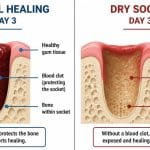
Complications: If dry socket or infection develops, treatment visits add cost. Dry socket dressing changes typically cost $50–$150 per visit in the US.
💡 Tip Box: When getting a quote, always ask: “Does this include the consultation, X-rays, anaesthetic, procedure, and follow-up?” Getting this itemized in writing before proceeding prevents surprise bills afterward.
Is It Worth Delaying to Save Money?
This is a question I hear regularly — and the honest answer is: sometimes, but not always.
When it’s reasonable to delay:
- The tooth is fully bony impacted, asymptomatic, and not pressing on adjacent structures — monitored annually, some of these never cause problems
- You’re actively arranging coverage (waiting for insurance to kick in, for example) and expect to proceed within a few months
When delaying costs more in the long run:
- Active infection — antibiotics manage it temporarily, but infection recurs until the tooth is removed, and each episode adds cost and risk
- Adjacent tooth damage — a wisdom tooth pressing against the second molar’s root causes damage that accumulates over time, potentially requiring costly treatment to the adjacent tooth
- Increasingly complex impaction — roots that aren’t fully formed are easier to extract; waiting until roots are fully formed and possibly divergent increases surgical complexity and cost
For a full explanation of what happens when impacted wisdom teeth are left untreated, my guide on shocking signs you’re ignoring impacted wisdom teeth covers the complications that develop with delay.
Questions to Ask Your Dentist Before Committing
Walking into a consultation armed with these questions helps you compare quotes accurately and avoid unexpected charges:
- Is this a simple or surgical extraction — and why?
- Does the quote include local anaesthetic, or is sedation separate?
- Are X-rays, consultation, and follow-up included in the total?
- Will this be performed by you or referred to an oral surgeon?
- Do you offer payment plans or work with financing providers?
- What’s the likely recovery time for my specific case?
- What complications should I watch for and are follow-up visits included if they arise?
For context on what to expect during the procedure itself before making financial commitments, my complete guide on impacted wisdom teeth removal surgery walks through every stage of the procedure so you know exactly what you’re paying for.
Summary: Cost Comparison at a Glance
| Country | Simple (per tooth) | Surgical (per tooth) | All 4 Surgical | Public/Insurance Option |
|---|---|---|---|---|
| 🇺🇸 US | $75–$250 | $225–$600 | $1,000–$3,000 | Dental insurance (50–80% coverage) |
| 🇬🇧 UK | £76.60 (NHS Band 2) | £76.60–£332.10 (NHS) | £332.10 (NHS Band 3) | NHS (free for exemptions) |
| 🇦🇺 Australia | $250–$400 | $400–$1,200 | $1,500–$4,000+ | Private health extras / public dental |
| 🇨🇦 Canada | $150–$350 | $350–$900 | $2,000–$5,000+ | Group benefits / CDCP |
According to the American Dental Association, dental costs vary significantly based on procedure complexity, geographic region, and provider type — making direct price comparison between quotes difficult without understanding what each includes.
The NHS provides current band charge information for NHS dental treatment, which is reviewed annually and subject to change.
Conclusion: Know Before You Go
Wisdom tooth removal is one of the most common dental procedures in the world — and one of the most varied in cost. The difference between a £76.60 NHS Band 2 extraction and a $3,000 US out-of-pocket surgical removal isn’t about quality — it’s about system, coverage, and complexity.
Understanding what drives your specific cost, what your coverage actually provides, and what questions to ask before committing puts you in the strongest possible position to make an informed decision — financially and medically.
If anxiety about cost has been delaying treatment, speak to your dentist about the financial options available before making a decision based on price alone. Complications from delayed treatment almost always cost more than proactive extraction.
For the complete recovery picture once you’ve made your decision, my wisdom teeth recovery guide covers everything from day one through full healing.
Frequently Asked Questions
Q: How much does it cost to remove all four wisdom teeth? In the US, removing all four wisdom teeth surgically typically costs $1,000–$3,000 without insurance, or $350–$1,200 with insurance coverage. In the UK, NHS treatment covers all four in one treatment course for £76.60–£332.10. In Australia, $1,500–$4,000+ for a full surgical removal under general anaesthetic privately. In Canada, $2,000–$5,000+ for all four surgically without benefits.
Q: Is wisdom tooth removal covered by insurance? In the US, most dental insurance plans cover wisdom tooth removal at 50–80% under oral surgery benefits, subject to annual maximums. In the UK, NHS coverage applies at Band 2 or Band 3 charges. In Australia, private health extras typically cover a percentage of surgical extractions under major dental. In Canada, employer group benefits commonly cover 50–80% of extraction costs.
Q: Why is wisdom tooth removal so expensive in some countries? The US and Canada have no universal dental coverage, meaning costs are largely market-driven and unsubsidized for most working adults. The UK’s NHS system provides heavily subsidized dental care, explaining the dramatically lower out-of-pocket costs for eligible patients. Australia sits in between — with some public coverage for eligible groups but primarily private-market pricing for most adults.
Q: How can I reduce the cost of wisdom tooth removal? Options vary by country. In the US: dental schools, community health centers, dental savings plans, and payment financing. In the UK: accessing NHS treatment where available, including checking exemption eligibility. In Australia: checking public dental eligibility, reviewing private health extras benefits for major dental. In Canada: checking CDCP eligibility, dental school clinics, and provincial assistance programs.
Q: Does wisdom tooth removal cost more at an oral surgeon? Yes — oral surgeon fees are consistently higher than general dentist fees for equivalent procedures, typically 20–40% more. However, for complex impactions (horizontal, deeply bony, close to the nerve), referral to an oral surgeon is often clinically appropriate regardless of cost preference.
Looking for dental care options? Call to discuss the advertised dental service.
Call Now