It’s 11pm. Your jaw is throbbing. You know something is wrong with your wisdom tooth — and your dentist doesn’t open until morning.
Or maybe you have an appointment booked for tomorrow, or in a few days, and you need to get through tonight.
Whatever your situation, this guide is written for exactly this moment: what can you actually do right now, at home, to reduce the pain and manage the infection symptoms until you can get professional care?
There’s useful, evidence-informed help available to you tonight. But before we get to it, there’s something important you need to read first.
Important Disclaimer — Home Remedies vs Dental Treatment
Why Home Remedies Are Temporary Bridges, Not Cures
I want to be completely honest with you at the outset of this guide, because it matters for your health.
Home remedies for wisdom tooth infection cannot cure the infection. They cannot drain an abscess, remove a bacteria-trapping gum flap, or eliminate the bacterial colonization around an impacted tooth. They are temporary pain management and symptom reduction tools — bridges to get you to professional care, not substitutes for it.
A wisdom tooth infection left untreated — even if symptoms feel temporarily managed — does not resolve on its own. The source of the infection remains. The bacteria remain. And without professional treatment, the infection will recur, often more severely.
Every remedy in this guide is intended to help you manage tonight, this weekend, or the gap between now and your dental appointment. Not to replace that appointment.
Signs You Need Urgent Professional Care Regardless
Before using any home remedy, assess whether your situation requires immediate professional care rather than home management. The following symptoms cannot wait:
🚨 Go to A&E immediately if you have:
- Significant facial swelling spreading toward your eye, neck, or throat
- Difficulty swallowing or breathing
- High fever (above 38.5°C / 101°F) alongside facial swelling
- Inability to open your mouth more than slightly
- Feeling severely unwell — confusion, chills, extreme fatigue
These symptoms indicate a spreading infection that can become life-threatening. No home remedy is appropriate in this situation — emergency care is.
If none of these apply and you’re managing localized pain and swelling while awaiting a dental appointment — read on.
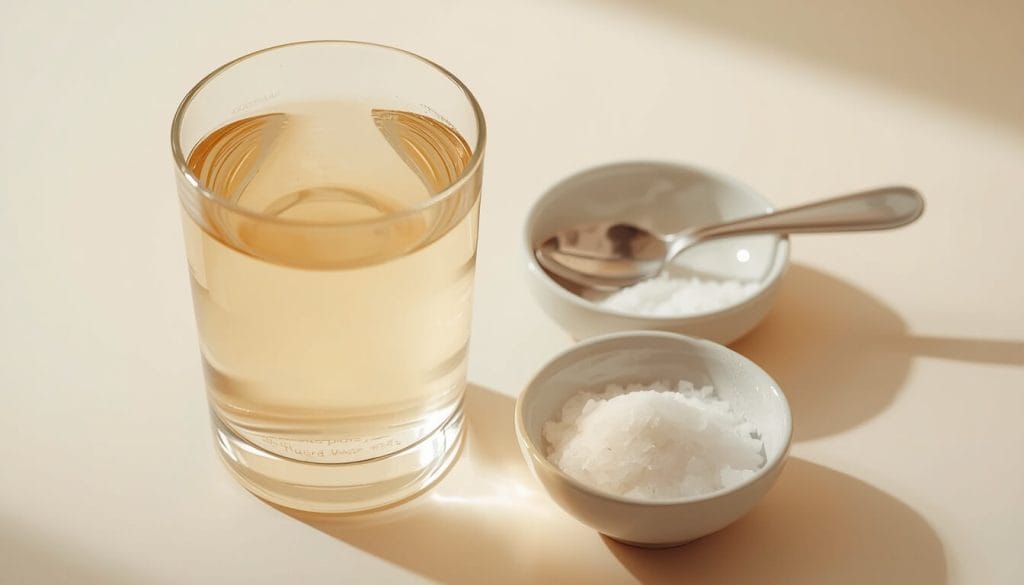
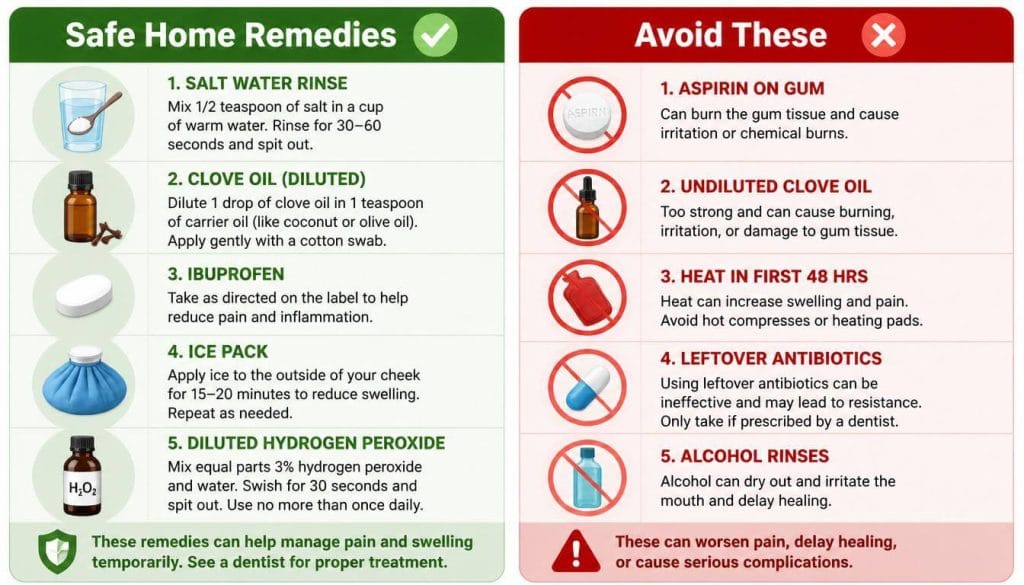
Salt Water Rinse — The Safest and Most Effective First Step
If there’s one home remedy that every dental professional would endorse without hesitation, it’s warm salt water rinsing — and it’s the one you should start with tonight.
Correct Ratio and Technique
The correct preparation:
- ½ teaspoon of table salt (not excessive — more salt does not mean more benefit)
- 250ml (approximately one cup) of warm water — warm enough to be soothing but not so hot it irritates inflamed tissue
- Stir until fully dissolved
The correct technique:
- Take a mouthful of the salt water
- Hold it gently in your mouth near the affected area for 20–30 seconds
- Swish gently — not vigorously
- Spit out completely
- Repeat until the cup is finished
- Do not swallow
The gentleness of the swishing matters — aggressive rinsing can disturb any clot or fragile tissue around the infected area and cause additional irritation.
How Often to Rinse
Rinse with warm salt water every 2–3 hours during waking hours when symptoms are acute. Before bed and first thing in the morning are particularly useful sessions — they reduce the overnight bacterial accumulation in the infected area.
As symptoms improve, reduce to 3–4 times daily and continue until your dental appointment.
Why It Helps Reduce Bacterial Load
Salt water works through two mechanisms:
Osmotic effect: The salt creates a hypertonic environment that draws fluid out of swollen tissue — reducing edema (swelling) and creating conditions that are inhospitable to the bacteria responsible for the infection.
Mechanical flushing: The rinsing action physically flushes food debris and some surface bacteria from the area around the tooth and the infected gum tissue — reducing the bacterial load that’s driving the inflammatory response.
It won’t eliminate the infection. But consistent salt water rinsing genuinely reduces bacterial burden, soothes inflamed tissue, and provides meaningful symptom relief — and it is completely safe to use as frequently as needed.
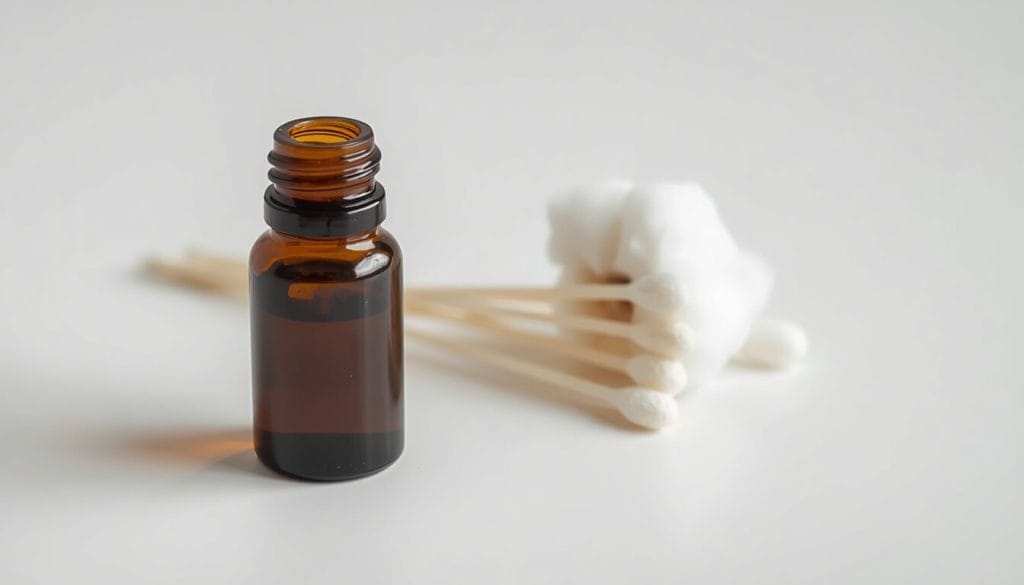
Clove Oil for Wisdom Tooth Infection Pain
Clove oil is the most pharmacologically legitimate natural dental pain remedy available — and its active compound has a genuine clinical basis.
What Eugenol Actually Does
Clove oil contains eugenol — a naturally occurring phenylpropanoid compound that has been used in professional dentistry for decades. It’s a component of zinc oxide eugenol cement (used in temporary fillings and dry socket dressings) and professional cavity liners.
Eugenol’s dental benefits:
- Anaesthetic effect — blocks sodium channels in nerve tissue, reducing pain signal transmission
- Anti-inflammatory — inhibits prostaglandin synthesis, reducing local tissue inflammation
- Antibacterial — demonstrates activity against several oral pathogens including Streptococcus mutans and certain anaerobic bacteria associated with dental infection
This isn’t folk medicine with vague mechanisms — it’s a pharmacologically active compound with measurable clinical effects. For temporary pain relief from a wisdom tooth infection, clove oil is one of the most evidence-supported options available without a prescription.
Safe Application Method
What you need:
- Pure clove essential oil (not clove fragrance oil — check the label for 100% Eugenia caryophyllata)
- Cotton balls or cotton swabs
- A carrier oil if your skin is sensitive (coconut oil, olive oil) — clove oil is potent undiluted
Method:
- Apply a small amount of clove oil to a cotton ball or swab — a few drops only
- Gently place or press the cotton against the painful gum area around the wisdom tooth
- Hold in place for 1–2 minutes — you’ll feel a warming or numbing sensation within 30–60 seconds
- Remove and spit out any excess saliva — do not swallow
- The numbing effect typically lasts 20–40 minutes
For sensitive individuals, dilute clove oil in a carrier oil at a 1:1 ratio before applying. This reduces the intensity while preserving the numbing effect.
Risks of Using Too Much
Clove oil is potent — and more is not better.
Risks of overuse or incorrect application:
- Chemical burn to gum tissue, tongue, or oral mucosa if applied too liberally or too frequently
- Irritation of already-inflamed tissue — counterproductive to what you’re trying to achieve
- Sensitization with very frequent use — some people develop sensitivity to eugenol with repeated exposure
Use clove oil as needed for acute pain episodes — not more than 3–4 times per day. If you notice increased irritation or burning beyond the normal warming sensation, dilute further or discontinue.
⚠️ Tip Box: Keep clove oil away from children. Do not apply to children’s gum tissue without specific guidance from a dentist. The concentration in pure essential oil is significantly higher than in products specifically formulated for dental use.
OTC Pain Relief Options
Ibuprofen vs Paracetamol for Dental Infection Pain
Both ibuprofen and paracetamol (acetaminophen) are appropriate for wisdom tooth infection pain — and used together in an alternating schedule, they provide significantly better coverage than either alone.
Ibuprofen is the superior choice for dental infection pain specifically because it is both an analgesic (pain reliever) and an anti-inflammatory. Dental infection pain is driven significantly by the inflammatory response — prostaglandins, cytokines, and tissue edema. Ibuprofen directly reduces this response, addressing the mechanism of pain rather than just masking the signal.
Standard adult dose: 400mg every 6–8 hours with food. Do not exceed 1200mg in 24 hours without medical advice.
Paracetamol works through different mechanisms — primarily in the central nervous system — and has no meaningful anti-inflammatory effect. However, used alternately with ibuprofen, it provides continuous analgesic coverage without doubling up on either medication.
The alternating protocol:
- 8am: Ibuprofen 400mg
- 11am: Paracetamol 1000mg
- 2pm: Ibuprofen 400mg
- 5pm: Paracetamol 1000mg
- Continue through the day as needed
This staggers dosing so there is always one medication active, providing more consistent pain control than either taken alone.
⚠️ Important: Always follow packaging dosing instructions. Ibuprofen should not be taken on an empty stomach. Do not use ibuprofen if you have a history of stomach ulcers, kidney problems, or are taking blood thinners without medical advice. Do not exceed recommended paracetamol doses.
Our dedicated guide on ibuprofen and Tylenol for wisdom tooth pain covers the alternating schedule and safety considerations in more detail.
Benzocaine Gels — Do They Work on Wisdom Teeth?
Over-the-counter topical anaesthetic gels containing benzocaine (brands include Orajel, Bonjela) are widely available and frequently used for dental pain.
Honest assessment for wisdom tooth infection specifically:
Benzocaine gels work well for accessible gum surfaces — they numb the mucous membrane they contact. For a clearly visible, accessible sore area on the gum, they provide reasonable temporary relief.
For wisdom tooth infection pain specifically — where much of the discomfort originates deep in the gum tissue, at the root level, or within infected soft tissue — topical gels have significant limitations. They can’t penetrate to the depth where the pain is generated.
They’re worth having on hand and applying to accessible inflamed gum tissue for supplementary relief — but they shouldn’t be your primary pain management strategy for significant infection pain.
Ice Pack Technique for Swelling
Cold application to the outside of the jaw reduces swelling and provides temporary numbing — and applied correctly, it’s one of the most effective immediate comfort measures available.
Correct technique:
- Wrap an ice pack or bag of frozen peas in a thin cloth (never apply ice directly to skin)
- Apply to the outside of the cheek and jaw over the affected area
- Hold for 15–20 minutes
- Remove for at least 20 minutes before reapplying
- Repeat cycle as needed during the first 24–48 hours
Important timing note: Ice is most effective for swelling in the first 24–48 hours of an acute episode. After 48 hours, switching to gentle warmth may provide more relief as the acute inflammatory phase passes — but check with your dentist before applying heat to an infected area, as heat can occasionally draw infection toward the surface.
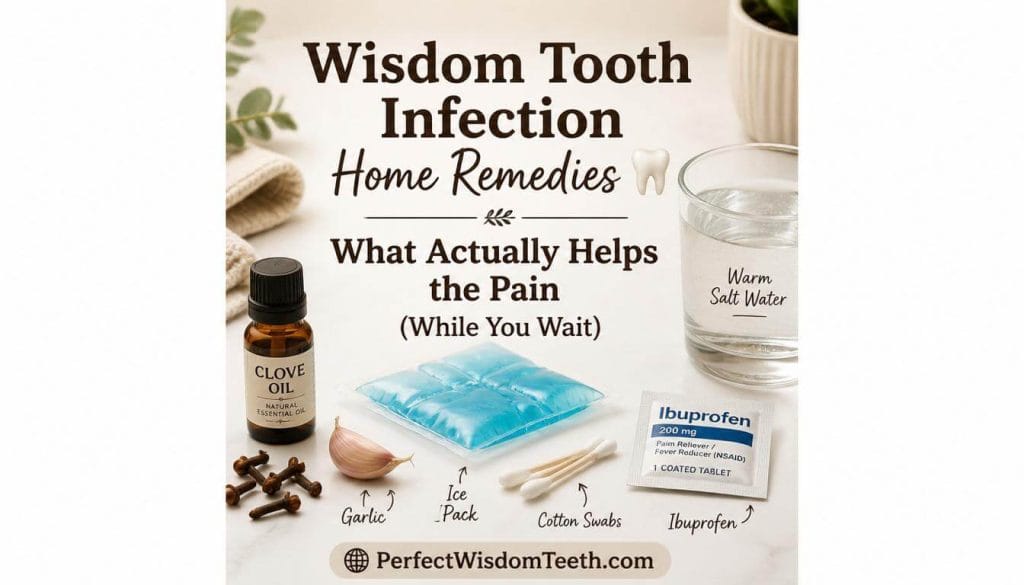
Other Home Remedies — What the Evidence Say
Garlic — Antibacterial Properties Explained
Garlic contains allicin — a sulphur compound with demonstrated antibacterial activity against a range of oral pathogens including some of the anaerobic bacteria associated with dental infection.
What the evidence supports: In laboratory settings, allicin shows genuine antibacterial activity. Some small clinical studies suggest garlic extract has meaningful effects on oral bacterial populations.
Practical application: Crush a fresh garlic clove to release allicin, allow it to sit for a minute, and apply the paste directly to the affected gum area. Leave for a few minutes, then rinse with salt water.
Realistic expectations: Garlic won’t treat a dental abscess. But as an adjunct to salt water rinsing, it may provide some additional surface antibacterial effect and mild numbing. The evidence base is limited but the risk is minimal for most people.
One consideration: The taste and breath impact are significant — something to factor in practically.
Hydrogen Peroxide Rinse (Diluted) — Safe Use
A diluted hydrogen peroxide rinse can reduce oral bacterial load and help keep the infected area cleaner between salt water rinses.
Correct preparation:
- Mix equal parts 3% hydrogen peroxide (standard pharmacy strength) and water — producing a 1.5% solution
- Swish gently for 30–60 seconds
- Spit completely — do not swallow
- Rinse mouth thoroughly with plain water afterward
Frequency: Once or twice daily maximum — not as a replacement for salt water rinsing but as a supplementary antiseptic step.
Important caveats:
- Do not use undiluted hydrogen peroxide — it will irritate and potentially damage oral tissue
- Do not use more than twice daily — extended use can disrupt the healthy oral microbiome
- If you experience increased pain or tissue irritation, discontinue
Turmeric Paste — Limited Evidence but Low Risk
Turmeric’s active compound curcumin has documented anti-inflammatory properties in laboratory and some clinical settings. Applied topically to inflamed gum tissue, a turmeric paste may provide mild anti-inflammatory benefit.
How to use:
- Mix ½ teaspoon of turmeric powder with enough coconut oil to form a paste
- Apply directly to the inflamed gum tissue with a clean finger or cotton swab
- Leave for 5 minutes, then rinse thoroughly
Honest evidence assessment: The clinical evidence for topical turmeric in dental infection is limited and preliminary. It’s unlikely to cause harm for most people, and the anti-inflammatory plausibility is real — but don’t expect dramatic results. Consider it a low-risk supplementary measure rather than a primary remedy.
One practical note: Turmeric stains intensely — it will temporarily stain your teeth and gum tissue yellow. Rinse thoroughly and avoid contact with clothing.
What to Avoid — Aspirin Directly on the Gum
This is one of the most persistent harmful dental home remedy myths — and it needs to be addressed directly.
Never place an aspirin tablet directly on the gum tissue adjacent to a painful tooth.
Aspirin is acetylsalicylic acid. Placed directly against gum or oral mucosa, it causes a chemical burn — literally burning the tissue with acid. This is painful, damaging, and counterproductive to healing. It does not provide meaningful pain relief to the tooth or surrounding tissue.
Aspirin works as an analgesic when swallowed and absorbed systemically — not when applied topically. Take it orally if appropriate for you, and never place it against oral tissue.
Other things to avoid:
- ❌ Heat applied externally in the first 48 hours — increases blood flow to the area and can accelerate spread of infection
- ❌ Poking or probing the infected area with fingernails, toothpicks, or objects — introduces additional bacteria and can disrupt protective tissue
- ❌ Antibiotics prescribed for a previous infection — never self-medicate with leftover antibiotics. This can mask symptoms without treating the cause, contribute to antibiotic resistance, and interfere with proper diagnosis
- ❌ Alcohol as a rinse — spirits applied to gum tissue cause significant irritation and the antiseptic benefit doesn’t justify the tissue damage
- ❌ Waiting indefinitely — every remedy in this guide is temporary. A dental appointment is the only appropriate endpoint
Your Tonight Action Plan
If you’re managing wisdom tooth infection pain right now, here’s your priority order:
- ✅ Assess emergency symptoms first — if any are present, go to A&E
- ✅ Take ibuprofen (400mg with food) immediately if not contraindicated
- ✅ Do a warm salt water rinse — start within the next 10 minutes
- ✅ Apply clove oil to the worst pain area using a cotton swab
- ✅ Apply ice pack to outside of jaw for 20 minutes
- ✅ Alternate ibuprofen and paracetamol through the evening and night
- ✅ Book a dental appointment for the earliest possible slot — first thing tomorrow
- ✅ Repeat salt water rinse before bed and first thing in the morning
Frequently Asked Questions
Q: What is the fastest home remedy for wisdom tooth infection pain?
The fastest combination for immediate relief is applying clove oil (eugenol) directly to the inflamed gum tissue with a cotton swab — this produces numbing within 30–60 seconds — while simultaneously taking ibuprofen 400mg for systemic anti-inflammatory pain relief. Follow immediately with a warm salt water rinse. This three-part approach addresses pain through topical anaesthesia, systemic anti-inflammation, and bacterial load reduction simultaneously.
Q: Does salt water actually help a tooth infection?
Yes — warm salt water rinsing provides genuine benefit for wisdom tooth infection symptoms. The osmotic effect of salt draws fluid from swollen tissue, reducing edema, while the rinsing action mechanically flushes bacteria and debris from the infected area. It doesn’t cure the infection but meaningfully reduces bacterial load and tissue swelling, providing symptomatic relief when rinsed consistently every 2–3 hours.
Q: Can clove oil cure a wisdom tooth infection?
No — clove oil cannot cure a dental infection. Its active compound eugenol provides temporary topical anaesthesia, mild anti-inflammatory effect, and some surface antibacterial activity — making it excellent for pain management while awaiting dental treatment. It cannot penetrate to the depth of a dental abscess, eliminate the bacterial source, or resolve the anatomical problem causing the infection. It is a bridge remedy, not a treatment.
Q: Is it safe to use hydrogen peroxide on a tooth infection?
Diluted hydrogen peroxide (equal parts 3% pharmacy-grade hydrogen peroxide and water) is safe for occasional use as an antiseptic mouth rinse — up to twice daily. It reduces surface oral bacteria and helps keep the infected area cleaner between salt water rinses. Do not use undiluted, do not swallow, and do not use more frequently than twice daily as extended use can disrupt the healthy oral microbiome.
Q: How long can I manage a wisdom tooth infection at home?
Home remedies are appropriate only for the short gap between symptom onset and a professional dental appointment — typically 24–72 hours at most. There is no safe duration for managing a dental infection indefinitely at home. If you cannot access a dentist within 48–72 hours, contact an emergency dental service. If emergency symptoms develop at any point (spreading swelling, fever, difficulty swallowing or breathing), go to A&E immediately regardless of how recently you started managing symptoms at home.
Conclusion
Tonight’s remedies are real. They work. They will help you get through until your appointment.
But they are not the answer — they are the bridge to it.
Salt water is your safest, most consistent tool. Clove oil is your most effective topical pain relief. Alternating ibuprofen and paracetamol provides your best systemic pain control. Ice manages external swelling.
Use them. Rest. And get to a dentist as soon as the appointment is available.
Your mouth is trying to tell you something needs professional attention. Listen to it.
Managing jaw discomfort through the night? Our guide on how to sleep with wisdom tooth pain covers the best sleeping positions and bedtime strategies — and our full article on wisdom tooth infection symptoms helps you recognize when the situation requires more than home care.
Looking for dental care options? Call to discuss the advertised dental service.
Call Now