
Updated November 12, 2026
Quick answer
What Is the Best Age to Remove Wisdom Teeth? If you're wondering whether it's the right time to get your wisdom teeth out — or whether you've already waited too long — you're asking one of the most common questions in dentistry. And the honest answer is: there is a best age, but it's not …
What Is the Best Age to Remove Wisdom Teeth?
If you’re wondering whether it’s the right time to get your wisdom teeth out — or whether you’ve already waited too long — you’re asking one of the most common questions in dentistry. And the honest answer is: there is a best age, but it’s not a deadline.
The short answer: The late teens to mid-20s (roughly ages 17–25) is generally considered the best time to remove wisdom teeth. The roots aren’t fully formed yet, the jawbone is more flexible, and healing is faster. But that doesn’t mean it’s too late after 25 — people get wisdom teeth removed safely in their 30s, 40s, and beyond. The right time is when your dentist sees a problem developing, whatever your age.
Why the Late Teens and Early 20s Are Ideal
Dentists usually recommend this window for a few practical reasons:
The roots are shorter. Wisdom teeth in a 17- or 18-year-old typically have roots that are only two-thirds formed. Shorter, less developed roots are easier to remove, and the surgery is usually simpler and quicker.
The bone is softer. Younger jawbone is more flexible, which means the tooth comes out with less force and less trauma to the surrounding tissue. As we age, the jawbone gets denser and harder, and extractions take more effort.
Healing is faster. Younger bodies heal faster — that’s true for wisdom teeth just like everything else. A 19-year-old typically bounces back in a few days; a 45-year-old may need a week or more for the same procedure.
Problems haven’t started yet. At 17–20, wisdom teeth are often still coming in. Removing them before they cause crowding, impaction, or decay means avoiding the problems entirely, rather than fixing them after they’ve already caused damage.
None of this means you should rush to remove healthy wisdom teeth that aren’t causing trouble. Many dentists take a watch-and-wait approach — if the teeth are coming in straight, there’s room for them, and they’re easy to clean, there’s often no reason to remove them at any age.
What Changes as You Get Older?
The older you get, the more the equation shifts — but it shifts gradually, not all at once:
In your late 20s: Still a good time. Healing is a little slower than at 19, but not dramatically so. Most people in their late 20s recover well within a week.
In your 30s: Recovery takes a bit longer, and the bone is denser. Surgical extractions (for impacted teeth) are more common at this age, because teeth that were going to cause problems usually have by now. Still very routine — thousands of people have wisdom teeth removed in their 30s every year.
In your 40s and 50s: The roots are fully formed and often curved or hooked, which can make extraction more complex. Healing is slower, and there’s a slightly higher risk of complications like dry socket or nerve irritation. That said, if a wisdom tooth is causing pain, infection, or decay at this age, removing it is still the right call — the risk of leaving a problem tooth in place is usually worse than the risk of surgery.
After 60: Extractions are less common but still done when needed. Your dentist will weigh the risks more carefully at this age, especially if you take medications like blood thinners or have conditions that affect healing.
The key point: age makes recovery slower, but it doesn’t make extraction unsafe. Your dentist will look at your specific situation — the position of the teeth, your overall health, your medications — not just your birth year.
Should You Remove Wisdom Teeth Before They Cause Problems?
This is the question that divides dentists. There are two schools of thought:
The preventive approach: Remove them in your late teens or early 20s, before they cause crowding, impaction, or decay. The argument is that surgery is easiest at this age, so why wait for a problem?
The watch-and-wait approach: Leave healthy wisdom teeth alone and monitor them with regular X-rays. Only remove them if they actually cause a problem. The argument is that unnecessary surgery has its own risks, and many wisdom teeth never cause trouble at all.
Most dentists today lean toward watch-and-wait for healthy, well-positioned wisdom teeth — and toward removal when there’s a clear reason: impaction, repeated infections, decay that’s hard to treat, crowding, or cysts. Cost and insurance also play a role for many people: removal is often cheaper and simpler when you’re younger and the extraction is straightforward, so if your dentist already expects problems down the line, sorting it out early can save both money and hassle later.
The best advice is to ask your dentist to show you the X-ray and explain what they see. If the teeth are coming in straight and there’s room, waiting is usually fine. If they’re impacted or pressing on neighbouring teeth, earlier is better.
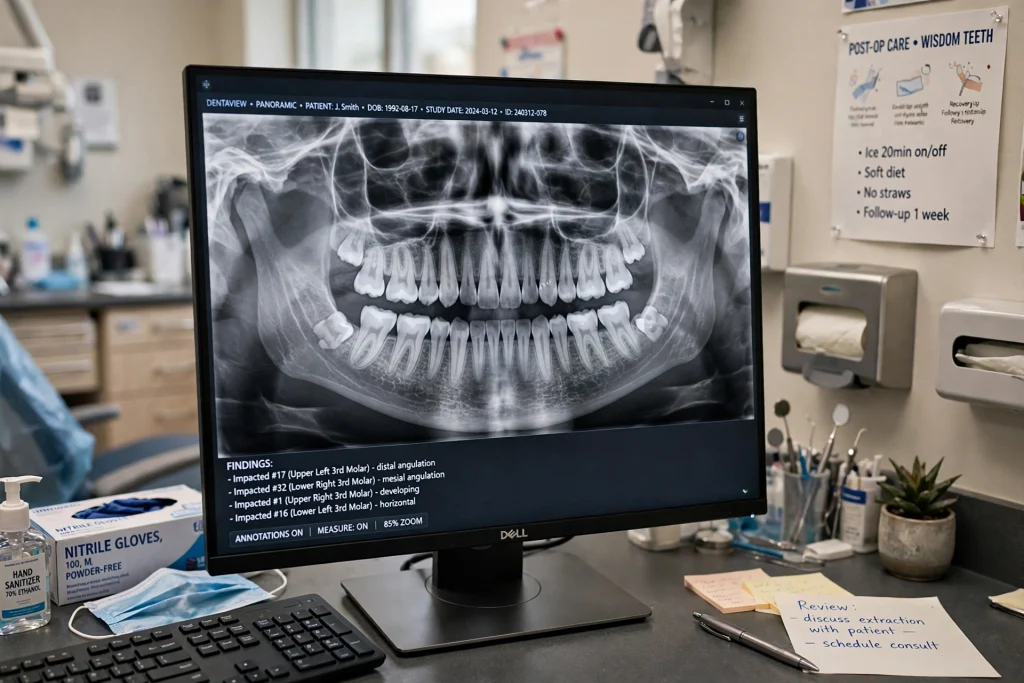
Signs It’s Time (Whatever Your Age)
Age matters less than symptoms. If you’re experiencing any of these, it’s time to talk to your dentist — whether you’re 18 or 48:
- Pain or tenderness at the back of your mouth that keeps coming back
- Swelling in the gum around a wisdom tooth
- Repeated infections (pericoronitis) around a partially erupted tooth
- Difficulty opening your mouth fully
- Crowding or shifting of your other teeth
- A bad taste or smell that won’t go away
- Decay or gum disease on a wisdom tooth that’s hard to clean
If you’re feeling anxious about the procedure itself, you’re not alone — and there are good ways to manage it. See our guide to managing dental anxiety before wisdom teeth removal.
Frequently Asked Questions
Q: What is the best age to remove wisdom teeth?
The late teens to mid-20s (about 17–25) is generally considered the best time — the roots are shorter, the bone is softer, and healing is faster. But it’s not a deadline. Wisdom teeth can be safely removed at any age when there’s a reason to do so.
Q: Is 30 too old to remove wisdom teeth?
No — 30 is not too old. Recovery may take a few days longer than it would at 19, but wisdom tooth removal in your 30s is very routine. If a tooth is causing problems, removing it at 30 is far better than leaving it.
Q: Is it better to remove wisdom teeth before 25?
If removal is needed, doing it before 25 usually means a simpler procedure and faster healing. But that doesn’t mean you should remove healthy teeth just because of your age. If the teeth are fine, waiting and monitoring is a reasonable choice.
Q: Can you get wisdom teeth removed at 50?
Yes. It’s more complex than at 20 — the roots are fully formed and the bone is denser — but it’s done regularly. Your dentist will check your overall health and medications first, and may refer you to an oral surgeon for a more complex extraction.
Q: Do wisdom teeth need to be removed if they don’t hurt?
Not necessarily. If they’re coming in straight, there’s room for them, and you can clean them properly, many dentists will leave them alone and monitor them with X-rays. Removal is recommended when they cause pain, infection, crowding, or decay.
Q: What happens if you never remove your wisdom teeth?
Many people keep their wisdom teeth for life with no problems at all. Others develop issues later — impaction, decay, gum disease around the tooth, or crowding. Regular dental check-ups and X-rays catch these problems early, so keeping your wisdom teeth isn’t a gamble as long as you’re being monitored.
Bottom Line
The best age to remove wisdom teeth is your late teens to mid-20s — but only if they need removing. If your wisdom teeth are healthy and well-positioned, there’s no age deadline forcing you to act. And if they’re causing problems at 30, 40, or 50, it’s not too late. The right time is when your dentist sees a reason — not when the calendar says so.