
Updated November 11, 2026
Quick answer
Wisdom teeth can cause jaw pain and stiffness that resemble TMJ symptoms, but they are not a proven direct cause of chronic TMD. Learn the differences, warning signs, and what to do.
Yes, wisdom teeth can contribute to jaw pain that feels like TMJ trouble, but they are not generally considered a proven direct cause of a temporomandibular disorder (TMD). An impacted or infected wisdom tooth can cause pain, swelling, and jaw stiffness near the back of the mouth. Those symptoms can be confused with TMJ pain. In addition, keeping the mouth open for a long time during wisdom teeth removal may temporarily strain the jaw muscles or joint.
The important distinction is whether the discomfort comes from the tooth and surrounding tissues, from the jaw joint and chewing muscles, or from both. A dental examination is the best way to tell.
What is the connection between wisdom teeth and TMJ?
The temporomandibular joints (TMJs) are the two joints just in front of your ears that connect your lower jaw to your skull. Temporomandibular disorders (TMDs) are a group of conditions affecting these joints, the chewing muscles, and nearby tissues. People often use “TMJ” as shorthand for a TMD, although TMJ technically names the joint itself.
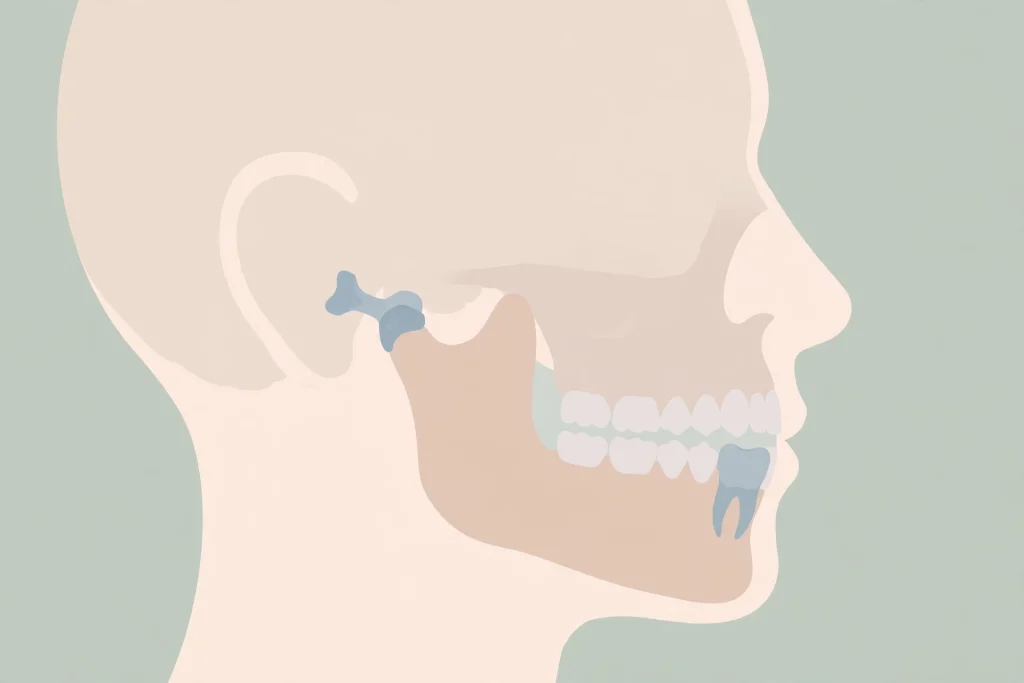
Wisdom teeth sit at the very back of the mouth. They do not sit inside the TMJ, and their presence does not automatically change the position of the jaw joint. However, problems around a wisdom tooth can create pain or restricted movement in the same general area.
Can impacted wisdom teeth cause TMJ symptoms?
An impacted wisdom tooth may cause local inflammation, gum infection, pressure, or pain in the back of the jaw. If the surrounding tissues become swollen or painful, chewing and opening the mouth may become uncomfortable. This can resemble some symptoms of TMD without proving that the joint itself is damaged.
Symptoms that may overlap include:
- Pain near the back of the jaw or in front of the ear
- Tenderness when chewing or opening the mouth
- Jaw stiffness or a reduced ability to open widely
- Pain that seems to spread toward the ear, temple, or cheek
These symptoms are not specific to wisdom teeth. Tooth decay, gum infection, muscle tension, dental abscesses, and TMD can produce overlapping pain. Read our guide to how impacted wisdom teeth can cause jaw pain for more detail about tooth-related causes.
Can wisdom teeth cause jaw clicking or popping?
Wisdom teeth are not an established direct cause of clicking or popping in the TMJ. A click may come from movement of structures inside the joint, while other jaw noises can have different causes. Clicking or popping without pain or limited movement is common and, by itself, usually does not require treatment.
If clicking is painful, comes with repeated catching, or makes it difficult to open or close your mouth, arrange an assessment with a dentist or clinician familiar with TMD. Do not assume the wisdom tooth is responsible simply because it is nearby.
Wisdom teeth and lockjaw: are they connected?
People use “lockjaw” to describe different problems. After wisdom tooth inflammation or surgery, some people develop trismus—temporary difficulty opening the mouth because the jaw muscles and nearby tissues are sore or tight. This is not necessarily the same as the jaw joint mechanically locking.
A true locking episode may involve the jaw getting stuck open or closed, or catching so that normal movement is difficult. Both persistent trismus and joint locking deserve professional assessment. If you cannot open your mouth enough to eat or drink, contact a dentist or oral surgeon promptly.
Can wisdom teeth removal cause TMJ?
Wisdom teeth removal does not mean you will develop a chronic TMJ disorder. However, jaw soreness, stiffness, and temporary difficulty opening the mouth can occur after oral surgery. Keeping the mouth open during a lengthy procedure, muscle fatigue, inflammation, and the difficulty of the extraction may contribute to short-term symptoms.
Research on whether third-molar extraction increases the long-term risk of TMD is mixed. A 2020 systematic review found that several included studies reported more TMD signs or symptoms after extraction, but the studies were nonrandomized and had moderate-to-high risk of bias; the authors rated confidence in the overall evidence as low to moderate. A separate case-control study did not find a statistically significant association between third-molar removal and one specific type of jaw-joint disc displacement. These findings do not establish that extraction causes chronic TMJ disease.
If jaw pain begins after surgery, tell your oral surgeon when it started, whether it is improving, and whether you have clicking, locking, swelling, or trouble opening your mouth. Follow the post-operative instructions you were given. For more on expected recovery, see how long jaw stiffness can last after wisdom teeth removal and our wisdom teeth recovery timeline.
TMJ vs. wisdom tooth pain: how can you tell the difference?
Symptoms overlap, so this comparison is a guide—not a diagnosis.
| Clue | More suggestive of a wisdom tooth problem | More suggestive of TMD |
|---|---|---|
| Where it hurts | At the very back of the mouth, around the last molar or gum | In front of the ear, over the jaw joint, or in the chewing muscles |
| Gum changes | Swollen, red, tender gum; possible bad taste or drainage | Usually no gum swelling caused by the joint disorder itself |
| Chewing | Pain may be strongest around the back molar | Pain may increase with chewing, clenching, or prolonged jaw use |
| Jaw movement | Opening may feel restricted because of pain or inflammation | May involve muscle tenderness, painful joint noises, catching, or locking |
| Dental imaging | An exam and dental X-ray may show impaction, decay, or infection | A dentist evaluates the joint and muscles; imaging is used only when clinically indicated |
A wisdom tooth problem and TMD can also occur at the same time. A dentist may need to examine the teeth, gums, jaw muscles, and joint to identify the source.
Can wisdom teeth cause jaw misalignment?
There is no good evidence that wisdom teeth routinely push the jaw out of alignment or directly cause a TMJ disorder by changing the bite. Impacted teeth can damage nearby teeth or cause local dental problems, but that is different from shifting the jaw joint. If your bite suddenly feels different, or your upper and lower teeth no longer meet as usual, arrange a dental evaluation rather than assuming your wisdom teeth have moved your jaw.
What should you do if you have TMJ-like pain and wisdom teeth?

- Book a dental examination. A dentist can check for an impacted tooth, infection, decay, gum inflammation, and signs of TMD.
- Describe the pattern. Explain where the pain is, when it began, whether chewing makes it worse, and whether your jaw clicks, catches, or locks.
- Ask whether an X-ray is appropriate. Dental imaging can help assess wisdom teeth; TMJ imaging is not automatically needed for every jaw ache.
- Use gentle measures while waiting. Choose softer foods, avoid gum and hard or chewy foods, and do not force your jaw open. Follow your clinician’s advice about heat or cold and pain medicines.
- Do not remove a wisdom tooth solely to treat TMJ. Extraction should be based on a dental indication and an individualized discussion of benefits, risks, and alternatives.
For TMD, conservative care is generally considered first. The National Institute of Dental and Craniofacial Research recommends starting with reversible approaches and avoiding treatments that permanently change the teeth, bite, or jaw joint unless there is a clear clinical reason.
When should you seek urgent dental or medical care?
Contact a dentist or oral surgeon promptly if you have worsening tooth or jaw pain, facial or gum swelling, fever, pus or a persistent bad taste, or difficulty opening your mouth. Seek emergency medical care if you have trouble breathing or swallowing, rapidly spreading swelling, or swelling that affects the floor of your mouth or neck.
Also arrange an assessment for persistent painful clicking, repeated jaw locking, a sudden change in your bite, or jaw pain that does not improve. A clinician can help determine whether the cause is dental, muscular, joint-related, or something else.
Frequently asked questions
Does wisdom teeth cause TMJ?
Wisdom teeth are not proven to directly cause chronic TMD. An impacted or infected tooth can cause nearby jaw pain and stiffness that may feel similar to TMJ symptoms.
Can a wisdom tooth cause TMJ on one side?
A problematic wisdom tooth can cause pain on the side where it is located. One-sided pain alone does not confirm TMD; a dental examination can help identify whether the tooth, joint, or muscles are involved.
Can wisdom teeth removal make TMJ worse?
Some people experience temporary jaw muscle or joint discomfort after extraction. Research on longer-term TMD risk is mixed and does not prove that removal routinely causes or worsens a chronic disorder.
Is jaw clicking after wisdom teeth removal normal?
A painless click can be common and may not need treatment. New or painful clicking, catching, locking, or limited movement should be discussed with your dentist or oral surgeon.
Will removing my wisdom teeth fix TMJ?
Not necessarily. Removing a wisdom tooth may help when that tooth is the source of pain or infection, but it is not a general treatment for TMD. The cause should be identified before deciding on treatment.
Can wisdom teeth cause lockjaw?
Inflammation around a wisdom tooth or post-operative muscle soreness can cause trismus, which limits how widely you can open your mouth. Persistent or severe restriction needs dental assessment, especially if you cannot eat or drink.
Sources and further reading
- National Institute of Dental and Craniofacial Research: Temporomandibular Disorders (TMD)
- Systematic review: Is the extraction of third molars a risk factor for temporomandibular disorders? (2020)
- Case-control study: Wisdom tooth extraction and temporomandibular disc displacement (2005)
- American Dental Association: Wisdom Teeth
Medical note: This article is for general education and is not a diagnosis or a substitute for care from a dentist, oral surgeon, or qualified healthcare professional.