You’re sitting in the dentist’s chair, and you hear those three words nobody wants: “You have a cavity.”
Maybe it’s your first one. Maybe it feels like you get one every single time despite brushing religiously. Either way, you walk out wondering — why does this keep happening, and what can I actually do about it?
Cavities — also called dental caries or tooth decay — are the most common chronic disease in the world. More common than diabetes. More common than asthma. They affect people of every age, every income level, and every oral hygiene habit.
But here’s what most people don’t realize: cavities don’t happen suddenly. They develop through a predictable, multi-stage process — and at several points along the way, the damage can be slowed, stopped, or even reversed if you know what to look for.
This guide gives you the complete picture. What causes cavities, how they progress, the early warning signs most people miss, and — most importantly — what genuinely works to protect your teeth.
 Read More: How to Prevent Cavities Naturally: Daily Habits That Protect Your Teeth
What Is a Cavity?
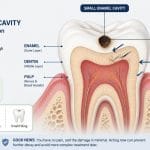
A cavity is a permanently damaged area in the hard surface of a tooth — enamel, dentin, or cementum — that has developed into a small hole or pit as a result of bacterial acid erosion. Left untreated, cavities grow deeper, eventually reaching the sensitive inner pulp of the tooth and causing significant pain, infection, and potential tooth loss.
The process is driven by specific bacteria, fueled by sugar, and enabled by inadequate oral hygiene — but the full picture is more nuanced than “sugar rots teeth.”
What Causes Cavity Teeth? The Complete Biology
Understanding the cause of cavities changes how you prevent them — because it’s not as simple as “eat less sugar and brush more.”
The Four Elements That Must All Be Present
Cavity formation requires a specific combination of factors occurring simultaneously:
1. Susceptible tooth surface
Not all teeth are equally vulnerable. Deep grooves on molar chewing surfaces, tight contacts between teeth, and areas near the gumline where enamel is thinner are all more susceptible. Weakened enamel — from acid erosion, dry mouth, or previous damage — is significantly more vulnerable than healthy enamel.
2. Cariogenic bacteria
Primarily Streptococcus mutans and Lactobacillus species — bacteria that colonize tooth surfaces in plaque biofilm and metabolize sugars to produce acid. These bacteria are present in virtually everyone’s mouth. Their concentration — and the strength of their acid production — varies between individuals and is influenced by diet, saliva composition, and oral hygiene habits.
 Read More: What Happens If You Ignore a Cavity for Too Long?
3. Fermentable carbohydrates
Sugars and refined carbohydrates that the bacteria ferment to produce acid. This includes obvious sources (candy, soda, juice) and less obvious ones (bread, crackers, starchy snacks, dried fruit). The frequency of sugar exposure matters as much as the quantity — every sugar exposure triggers an acid attack lasting 20–40 minutes.
4. Time
A single brief sugar exposure causes a brief acid attack that healthy enamel can recover from. But frequent exposures throughout the day — constant sipping of sugary drinks, regular snacking — mean the mouth never fully recovers its neutral pH, and progressive demineralization occurs.
Remove any one of these four elements and cavity formation is significantly impaired. Effective prevention targets all four simultaneously.

The Acid Attack — What Happens to Your Enamel
When cariogenic bacteria metabolize sugar, they produce lactic acid — which lowers the pH of your mouth from its normal neutral range (6.7–7.3) to below 5.5, the critical threshold at which enamel begins to demineralize — losing calcium and phosphate ions from its crystalline structure.
This isn’t irreversible damage at first. Saliva acts as a natural buffer and remineralizing agent — as pH rises back toward neutral between acid attacks, it deposits calcium and phosphate back into the enamel surface. Fluoride from toothpaste accelerates this remineralization dramatically.
The problem arises when acid attacks are frequent and sustained — when the demineralization rate consistently outpaces remineralization. Over time, the cumulative mineral loss weakens enamel structure until it physically breaks down — creating the cavity.
This is why the frequency of sugar exposure matters more than the total quantity. Sipping a sugary drink over three hours causes far more sustained acid damage than drinking the same amount in one sitting.
 Read More: Common Teeth Whitening Mistakes (And Exactly What to Do Instead)
How Cavities Start in Teeth: The Five Stages of Decay
Cavities don’t appear overnight. They progress through distin
Stage 1: Initial Demineralization (White Spot Lesion)
The earliest visible sign of cavity formation is a white spot on the tooth surface — a chalky, opaque area where enamel has begun to lose mineral density. At this stage, the enamel surface is still physically intact — no hole has formed.
This stage is reversible. With improved oral hygiene, fluoride application, and dietary changes, the enamel can remineralize and the white spot can disappear or stabilize. This is the critical intervention window.
Stage 2: Enamel Decay
As demineralization continues, the weakened enamel structure collapses — and a physical cavity forms in the outer layer. The tooth now has a hole. At this stage, the cavity is still confined to enamel and typically causes no pain — enamel has no nerve supply.
This stage requires professional treatment (a filling) but is still straightforward and inexpensive to address.
Stage 3: Dentin Involvement
Once the cavity breaches the enamel layer, it enters dentin — the softer, more porous layer beneath. Dentin contains microscopic tubules that connect to the tooth’s nerve supply, which is why sensitivity begins at this stage — to cold, heat, sweetness, and pressure.
Decay spreads more rapidly through dentin than enamel. A cavity that seemed small on the enamel surface can have significant dentin involvement underneath.
Stage 4: Pulp Involvement
When decay reaches the pulp — the soft inner tissue containing nerves and blood vessels — significant pain begins. Pulpitis (inflammation of the pulp) causes the characteristic severe, throbbing toothache that most people associate with cavities.
At this stage, a simple filling is no longer sufficient. Root canal treatment is typically required to remove the infected pulp tissue before the tooth can be restored.
Stage 5: Abscess Formation
If pulp infection is left untreated, bacteria spread beyond the root tip into the surrounding bone, forming a periapical abscess — a pocket of pus associated with severe pain, facial swelling, and systemic infection risk.
This is the stage that can lead to tooth loss and, in serious cases, spreading infection. It represents the endpoint of a process that began as a reversible white spot — and could have been interrupted at any earlier stage.

Early Signs of Tooth Decay — Cavity Symptoms You Should Know
One of the most important things to understand about cavities is that the most dangerous stages are often painless. By the time a cavity hurts, it has already progressed significantly.
Knowing the early, subtle signs allows you to seek treatment at a stage when it’s simpler, less expensive, and more conservative.
White or Chalky Spots on Tooth Surfaces
As described above, white spot lesions are the first visible sign of demineralization — and the only reversible stage. They’re most commonly found on the smooth surfaces of front teeth and the cheek-facing surfaces of back teeth.
If you notice a chalky white patch on a tooth that wasn’t there before — mention it to your dentist at your next appointment. It may be catchable before it becomes a cavity.
 Read More: Wisdom Teeth Recovery Tips: Do’s and Don’ts
Tooth Sensitivity
New sensitivity to cold, hot, or sweet stimuli — particularly when it wasn’t present before — is one of the most reliable early warning signs of dentin involvement.
Cavity-related sensitivity characteristics:
- Brief, sharp sensation triggered by specific stimuli (cold drink, sweet food)
- Disappears within seconds of removing the stimulus
- Localized to a specific tooth rather than generalized
Sensitivity that lingers for minutes after stimulus removal, or spontaneous throbbing pain with no trigger, suggests pulp involvement — a more advanced stage requiring prompt attention.
Visible Discoloration
As decay progresses through enamel and into dentin, the affected area may appear:
- Brown or black — oxidized bacterial metabolites discolor the decayed tissue
- Dull or chalky white — early demineralization
- Grey or shadowed — particularly on front teeth, where dentin decay can show through translucent enamel
Not all tooth discoloration is decay — staining from coffee, tea, or tobacco can look similar. Your dentist can distinguish between surface staining and structural decay.
Visible Holes or Pits
A visible hole, pit, or rough area on a tooth surface — particularly in the grooves of molar chewing surfaces — may be a cavity that has progressed to the point of physical enamel breakdown. At this stage, food and bacteria pack into the hole, accelerating further decay.
If you can feel a rough, sticky, or pitted area on a tooth when running your tongue across it — get it assessed.
Toothache or Spontaneous Pain
Spontaneous pain — particularly throbbing pain that occurs without a trigger — indicates pulp involvement. This is not an early symptom; it’s a signal that the decay has been progressing for some time and has now reached the nerve.
Spontaneous dental pain warrants a prompt (not routine) dental appointment.
 Read More: How to Clean Your Teeth at Home: Step-by-Step Routine

Why Your Teeth Are Getting Cavities — Hidden Risk Factors
If you feel like you’re doing everything right but still getting cavities, these lesser-known risk factors may be contributing.
Dry Mouth (Xerostomia)
Saliva is your mouth’s most sophisticated natural defense against cavities — it neutralizes acid, remineralizes enamel, and mechanically washes away food and bacteria. When saliva production is reduced, cavity risk increases dramatically.
Common causes of dry mouth:
- Many prescription and OTC medications (antihistamines, antidepressants, blood pressure medications, diuretics)
- Mouth breathing — particularly during sleep
- Autoimmune conditions (Sjögren’s syndrome)
- Dehydration
- Radiation therapy to the head and neck
If you take any medication regularly and are experiencing unexpectedly high cavity rates, ask your dentist whether dry mouth could be a factor.
Snacking Frequency
As discussed above, frequency of sugar exposure matters more than quantity. A person who eats three meals with no snacking exposes their teeth to three acid attacks per day. A person who sips a sweet coffee over three hours, snacks on crackers mid-morning, has a juice with lunch, and grazes on fruit in the afternoon may expose their teeth to 8–10 acid attacks — giving enamel little time to remineralize between each one.
The most cavity-producing habit isn’t eating a bar of chocolate at dessert — it’s slowly sipping a sugary or acidic drink throughout the day.
Deep Molar Grooves
Some people’s molars have naturally deeper and narrower fissures in their chewing surfaces — pits and grooves that toothbrush bristles genuinely cannot clean. Bacteria and food pack into these grooves and are never adequately removed.
Dental sealants — thin plastic coatings applied to the chewing surfaces of back teeth — are highly effective at preventing fissure cavities. Most commonly applied to children’s permanent molars, but available for adults too. Ask your dentist whether your molar anatomy makes you a sealant candidate.
Gum Recession
When gum tissue recedes, the root surface of the tooth is exposed. Root surfaces are covered by cementum rather than enamel — a softer, less acid-resistant material that is significantly more vulnerable to cavity formation. Root cavities can develop rapidly in areas of recession and are more difficult to treat than enamel cavities.
Dietary Acids (Beyond Sugar)
Acidic foods and drinks — citrus fruits, carbonated water, wine, sports drinks, vinegar-based foods — lower mouth pH directly, eroding enamel without any bacterial involvement. This erosion weakens the enamel surface and makes it more vulnerable to subsequent bacterial acid attack.
The combination of high sugar intake AND high acid intake is particularly destructive — and it’s the dietary pattern associated with many fizzy drinks.

Healthy Teeth vs Cavity Teeth — What’s the Difference?
Understanding what healthy teeth look like helps you identify when something has changed.
Healthy tooth characteristics:
- Smooth, glossy enamel surface
- Consistent color — white to slightly off-white, even in shade
- No sensitivity to normal temperature ranges
- No pain with biting or chewing
- Firm gum tissue at the margins — no recession or bleeding
Early cavity characteristics:
- Chalky white or brown spots on enamel
- Dull or matte appearance in previously glossy areas
- New sensitivity to cold, sweet, or hot stimuli
- Visible pitting or roughness in molar grooves
- Food consistently getting stuck in a specific area between teeth
Advanced cavity characteristics:
- Visible hole or dark discoloration
- Sensitivity that lingers after stimulus removed
- Spontaneous or throbbing pain
- Bad taste or smell from a specific tooth area
- Visible chip or fracture of weakened enamel
How to Protect Teeth From Cavities: The Evidence-Based Prevention Plan
Cavity prevention isn’t mysterious — it’s a well-understood combination of consistent daily habits, smart dietary choices, and professional maintenance.
Fluoride — The Single Most Effective Cavity Preventive
Fluoride is the most evidence-supported cavity prevention measure available. It works through multiple mechanisms:
- Remineralizes early lesions — incorporating into demineralized enamel as fluorapatite, which is more acid-resistant than the original hydroxyapatite
- Inhibits bacterial metabolism — reducing the acid-producing activity of cariogenic bacteria
- Strengthens enamel during formation in developing teeth
Practical fluoride sources:
- Fluoride toothpaste (minimum 1000ppm for adults — 1450ppm for high-risk individuals) used twice daily
- Spit but don’t rinse after brushing — leaving fluoride on enamel surface
- Fluoride mouthwash used at a separate time from toothbrushing
- Professional fluoride varnish applied at dental cleaning appointments
Brushing and Flossing — Technique Over Frequency
Two minutes, twice daily, with a soft-bristled brush and the Modified Bass technique removes the plaque biofilm before it produces sustained acid damage. Flossing daily removes interproximal plaque that the brush cannot reach — where many cavities begin.
The spit-don’t-rinse rule after brushing is one of the highest-return habit changes available — it leaves protective fluoride on your teeth rather than washing it immediately away.
For a complete brushing technique guide, our detailed post on how to properly brush your teeth covers every step of the correct method.
Dietary Strategies
Reduce frequency of sugar and acid exposure — the most impactful dietary change for cavity prevention:
- Limit sugary and acidic food to mealtimes rather than throughout the day
- Switch from sipping sugary drinks slowly to drinking them quickly with meals
- Choose water as your primary between-meal beverage
- Rinse with water after sugary or acidic food and drink
Include cavity-protective foods:
- Cheese — raises mouth pH and provides calcium and phosphate for remineralization
- Raw crunchy vegetables — stimulate saliva flow
- Green tea — catechins inhibit cariogenic bacteria
- Sugar-free gum with xylitol — stimulates saliva flow and xylitol specifically inhibits S. mutans activity
Professional Cleaning and Monitoring
Professional cleanings remove calcified tartar that harbors cavity-causing bacteria and cannot be removed by home care. They also allow your dentist to detect cavities at early, reversible, or easily treatable stages — before they become painful, expensive problems.
Regular dental X-rays detect interproximal cavities (between teeth) that are invisible on clinical examination — the most commonly missed cavity type.
The American Dental Association confirms that regular professional care combined with fluoride use and good oral hygiene represents the gold standard evidence-based cavity prevention strategy.
Every six months. Without exception.
Conclusion
Cavities are not inevitable — and they’re not a reflection of personal failure. They’re the predictable result of a specific biological process, and that process can be interrupted at multiple points with the right knowledge and habits.
Start with the fundamentals: fluoride toothpaste, proper technique, daily flossing, spit-don’t-rinse. Layer in smarter dietary habits — less frequent sugar exposure, more water, cavity-protective foods. And keep those six-monthly professional appointments where early problems can be caught before they become serious ones.
The difference between a white spot lesion caught at a check-up and a root canal treated at 2am isn’t luck — it’s the system you build around your oral health before the problem develops.
Build the system. Your future self will thank you.
Want to go deeper on keeping your mouth genuinely healthy? Our guides on how to clean teeth at home like a dental hygienist and natural teeth cleaning at home are the perfect next reads for building a complete, dentist-approved oral care routine.
Frequently Asked Questions
Q: What causes cavity teeth?
Cavities are caused by the interaction of four factors: susceptible tooth surfaces, cariogenic bacteria (primarily Streptococcus mutans), fermentable carbohydrates (sugars and refined starches), and time. The bacteria metabolize sugar to produce lactic acid, which lowers mouth pH below 5.5 and causes enamel to lose mineral density through a process called demineralization. With repeated acid attacks that outpace the mouth’s natural remineralization, the enamel structure eventually collapses into a physical cavity.
Q: What are the early signs of tooth decay?
The earliest sign of tooth decay is a chalky white spot on the enamel surface — an area of demineralization that is still physically intact and potentially reversible. As decay progresses, new sensitivity to cold, sweet, or hot stimuli develops, followed by visible discoloration (brown or black spots), pitting or roughness on the tooth surface, and eventually spontaneous pain — which indicates the decay has reached the tooth’s nerve supply.
Q: Can a cavity heal on its own?
The very earliest stage of tooth decay — the white spot lesion — can genuinely reverse with improved oral hygiene, fluoride application, and dietary changes. This is the only stage where natural healing is possible. Once the enamel has physically broken down into a cavity, the damage is permanent and requires professional dental treatment. This is why early detection through regular dental check-ups is so valuable.
Q: How do I know if I have a cavity without going to the dentist?
You may suspect a cavity if you notice: a new white, brown, or black spot on a tooth; new sensitivity to cold, hot, or sweet stimuli; a visible hole or pit in a tooth surface; food consistently getting caught in a specific area; or a bad taste from a specific tooth. However, many cavities — particularly between teeth — are undetectable without dental X-rays. Absence of symptoms does not mean absence of decay.
Q: How can I stop tooth decay before it gets worse?
If you suspect early decay, see your dentist promptly — early-stage cavities are much simpler and less expensive to treat. Meanwhile, maximize your remineralization support: use high-fluoride toothpaste, stop rinsing after brushing, reduce the frequency of sugar and acid exposure, stay well hydrated, and maintain consistent brushing and flossing. For a white spot lesion specifically, your dentist may recommend professional fluoride varnish application to support remineralization.
Looking for dental care options? Call to discuss the advertised dental service.
Call Now