It’s one of the most common questions I hear — and one of the most genuinely nuanced to answer.
Should I just buy whitening strips, or is it worth paying for professional treatment?
The honest answer isn’t a simple “professional is always better” or “save your money and DIY.” The right choice depends on several factors that are specific to you — your stain type, your budget, your timeline, your sensitivity history, and what result you’re actually trying to achieve.
What I can give you is a completely honest, evidence-based comparison of both options across every dimension that matters. Cost, results, safety, speed, convenience, longevity — all of it.
By the end of this guide, you’ll know exactly which option is right for your situation. And if the answer is “neither alone” — I’ll explain that too.
Quick Answer: Professional vs At-Home Whitening — Which Is Better?
Neither option is universally better — they serve different needs. Professional whitening delivers faster, more dramatic results (5–10 shades in one session) and is supervised by a dentist — making it the better choice for significant staining, time-sensitive situations, and cases where guidance is needed. At-home whitening is significantly more affordable, highly effective for surface staining when used consistently, and perfectly adequate for maintenance and moderate brightening. Most people benefit from a combination approach — professional treatment for an initial transformation, at-home maintenance to sustain it.
Understanding What You’re Actually Comparing
Before diving into the comparison, it’s worth establishing what we mean by each category — because both “professional” and “at-home” whitening cover a spectrum of options.
Professional Whitening — What It Includes
In-office whitening (e.g. Zoom, Beyond, Enlighten in-office): The most intensive form — high-concentration hydrogen peroxide gel (25–40%) applied by a dental professional, often with light or laser activation. Performed in the dental chair in a single session of 60–90 minutes.
Dentist-supplied take-home trays: Custom-fitted trays made from impressions of your teeth, supplied with professional-grade whitening gel (typically 10–22% carbamide peroxide). Used at home but prescribed, fitted, and monitored by your dentist.
Combination approach: Many dentists offer an in-office session followed by take-home trays for ongoing maintenance — combining the dramatic initial transformation of in-office treatment with the convenience of at-home top-ups.

At-Home Whitening — What It Includes
OTC whitening strips: The most widely used at-home option. Hydrogen peroxide or carbamide peroxide gel on a thin, flexible strip applied directly to teeth. Concentrations typically 6–14% hydrogen peroxide for OTC products.
OTC whitening tray kits: Generic or moldable trays with whitening gel — less precisely fitted than dentist custom trays, but functional for general use.
Whitening toothpaste: Daily maintenance through mild abrasive polishing and/or low-dose peroxide. Limited standalone whitening effect but valuable for maintenance.
Whitening mouthwash: Very low peroxide concentration, limited standalone effectiveness, useful as a daily maintenance layer.
LED/light whitening kits: OTC kits combining a light device with whitening gel. As covered in other guides, the light adds minimal benefit beyond what the gel achieves independently.
Comparing Results: How White Can Each Method Get You?
This is where most people start — and for good reason. If a method doesn’t deliver results, nothing else matters.
The Shade Scale Reality
Using the VITA shade guide — the dental standard for measuring tooth whiteness — here’s what each method realistically achieves:
| Method | Average Shade Improvement | Timeline |
|---|---|---|
| Whitening toothpaste | 1 shade | 4–6 weeks |
| OTC whitening strips (14% H₂O₂) | 2–4 shades | 7–14 days |
| OTC tray kit | 2–4 shades | 10–21 days |
| Dentist take-home trays | 3–6 shades | 2–4 weeks |
| In-office professional whitening | 5–10 shades | Single session (60–90 min) |
The honest caveat on all of these: Results vary significantly based on starting shade and stain type. A person starting at A3 (medium yellow) with primarily coffee staining will achieve results at the higher end of each range. A person with intrinsic staining or starting at A4 may see results at the lower end — or find that even professional whitening delivers less than the maximum cited range.
What Professional Whitening Does Better
Concentration: In-office gels use hydrogen peroxide concentrations 2–4 times higher than OTC products — reaching stain deposits that lower concentrations can’t effectively break apart.
Speed: No at-home method produces results in a single session. For someone needing a dramatic improvement before a wedding, interview, or major event, professional treatment is the only realistic option.
Evenness: Professional application ensures gel contacts all tooth surfaces evenly, with gum protection properly in place. Strips and generic trays can miss areas — particularly around the gumline and between teeth.
Supervision: If something goes wrong — excessive sensitivity, gum reaction, unexpected pain — you’re in a clinical setting with a professional who can address it immediately.
What At-Home Whitening Does Well Enough
For the majority of people with primarily extrinsic staining — coffee, tea, wine, general dietary staining — consistent at-home whitening with quality strips delivers results that are genuinely impressive and visible. Two to four shades in two weeks is a real transformation that most people are delighted with.
The key word is consistent. At-home whitening that’s done sporadically or incorrectly underperforms significantly relative to its actual potential.
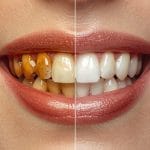 Read More: Teeth Whitening Results: What to Expect Before & After
Comparing Cost: What Are You Actually Paying For?
At-Home Whitening Costs
| Product | Average Cost | Treatment Duration |
|---|---|---|
| Whitening toothpaste | $8–$20 | Ongoing |
| OTC whitening strips (full course) | $30–$60 | 7–14 days |
| OTC tray kit | $25–$80 | 10–21 days |
| LED whitening kit | $40–$150 | 7–21 days |
Annual maintenance cost (strips + toothpaste): approximately $100–$200 per year for most people using a consistent maintenance protocol.
Professional Whitening Costs
| Method | Average Cost (USD) |
|---|---|
| Dentist take-home trays (custom) | $150–$400 |
| In-office whitening (single session) | $300–$800 |
| Combination in-office + take-home | $500–$1,200 |
These costs vary significantly by location, dentist, and specific system used — metropolitan areas and specialist cosmetic practices tend to be at the higher end of these ranges.
The True Cost Comparison
The gap between at-home and professional whitening costs is significant — but the comparison isn’t simply “professional is more expensive.” It’s about what you’re getting for the additional cost:
With professional treatment you’re paying for:
- Higher-concentration chemistry that achieves results faster and more dramatically
- Custom-fitted delivery (for take-home trays) that ensures even coverage
- Professional assessment of your stain type before spending money
- Clinical supervision and ability to address complications
- Long-term relationship with a dental professional who monitors your results
With at-home treatment you’re getting:
- Genuine, clinically validated results at a fraction of the cost
- Flexibility and convenience — whiten on your own schedule
- Maintenance capability without repeat professional visits
- A sustainable long-term approach to keeping results fresh
The smart financial approach for most people: One professional treatment for the initial transformation — then at-home maintenance to sustain it. This delivers professional-level results without the ongoing cost of repeat in-office sessions.
💡 Tip Box: If professional whitening is financially out of reach right now, dentist-supplied take-home trays are a worthwhile middle ground — significantly more effective than OTC trays due to better fit and higher gel concentration, at roughly half the cost of in-office treatment.
Comparing Safety: Which Is Actually Safer?
This is where the conversation gets more nuanced — and where some popular assumptions need questioning.
The Peroxide Safety Baseline
Both professional and at-home whitening products work through the same fundamental chemistry — hydrogen peroxide or carbamide peroxide breaking apart stain molecules in enamel. The safety profile of these compounds at appropriate concentrations is well-established, with decades of clinical use and research.
The primary difference is concentration — and concentration affects both effectiveness and the level of supervision required for safe use.
Risks With Professional Whitening
Gum sensitivity: High-concentration professional gels require careful gum protection — if gel contacts gum tissue, it causes a chemical burn (white spot on the gum) that resolves but is painful. This is why professional application includes gum barriers.
Tooth sensitivity: Higher peroxide concentrations produce more significant sensitivity during and after treatment. For most patients this is temporary — resolving within 24–48 hours. Patients with pre-existing sensitivity conditions may need a modified protocol.
Over-treatment risk: Less likely in a professional setting due to supervision, but possible if patients pursue too many in-office sessions in a short timeframe.
Risks With At-Home Whitening
Gum contact from strips or trays: Without professionally fitted barriers, whitening gel can contact gum tissue — causing mild irritation. This is usually minor compared to the burns possible with professional-concentration gels, but still worth managing carefully.
Overuse: The lack of supervision means some users apply products too frequently, for too long, or across too many consecutive courses — leading to enamel demineralization and sensitivity that a dentist would have identified and stopped.
Inappropriate use: Using whitening products over undiagnosed cavities, cracked teeth, or active gum disease without knowing it — because no assessment was done first.
DIY methods marketed as “whitening”: Lemon juice, charcoal, vinegar — these aren’t really in the at-home whitening category, but they’re often grouped with it. These cause genuine enamel damage. ADA-accepted products at recommended concentrations are safe; DIY acid methods are not.
The Safety Verdict
For most healthy adults with no significant dental issues: both professional and ADA-accepted at-home whitening are safe when used correctly. Professional treatment carries higher short-term sensitivity risk due to concentration, but lower risk of misuse due to supervision. At-home whitening carries lower acute risk but higher risk of inappropriate use without guidance.
The riskiest whitening isn’t professional or even aggressive at-home — it’s DIY acidic methods that erode enamel permanently. For more on common whitening mistakes that cause real damage, my guide on common teeth whitening mistakes covers exactly what to avoid.
According to the American Dental Association, whitening products should be used under the guidance of a dental professional, particularly for patients with sensitive teeth, gum issues, or existing restorations — and any whitening should begin with a dental examination.
Read More: Teeth Whitening Results: What to Expect Before & After
Comparing Longevity: How Long Do Results Last?
Neither whitening method produces permanent results — enamel continues to accumulate staining from diet and lifestyle regardless of how white you start. The question is how long results hold, and what maintenance looks like.
Professional Whitening Longevity
In-office whitening results typically last 6 months to 2 years depending on:
- Dietary habits (coffee, tea, wine consumption)
- Tobacco use
- Oral hygiene consistency
- Whether a maintenance protocol is followed
Without any maintenance — no whitening toothpaste, no occasional strip sessions, no dietary awareness — professional results typically fade toward pre-treatment shade within 6–12 months.
With a consistent at-home maintenance protocol, professional results can be sustained significantly longer — many patients find a professional top-up once per year is sufficient when combined with good daily habits.
At-Home Whitening Longevity
OTC whitening strip results typically last 3–6 months with no maintenance, or significantly longer with:
- Weekly maintenance strip sessions
- Daily whitening toothpaste
- Dietary awareness around staining foods
- Water rinsing after staining drinks
The practical reality is that at-home whitening lends itself to ongoing maintenance in a way professional whitening doesn’t — you can do a strip session weekly indefinitely (within safe frequency limits) to keep results consistently fresh, rather than waiting for a significant fade before a professional top-up.
The Longevity Verdict
For maximum initial results with minimal ongoing effort: Professional whitening, with periodic at-home maintenance.
For consistent, sustained brightness over time without large upfront costs: A solid at-home routine with regular maintenance sessions.
The combination approach wins on longevity: Professional treatment produces the dramatic starting point; at-home maintenance sustains it. This is genuinely the most effective long-term strategy for most people.
Comparing Convenience: Fitting Whitening Into Real Life
Professional Whitening Convenience Factors
Scheduling: Requires a dental appointment — scheduling, travel, waiting room time, procedure time. In-office treatment typically takes 60–90 minutes in the chair.
Downtime: No medical downtime, but 48 hours of white diet post-treatment is recommended — planning around social eating can be a consideration.
Follow-up: Multiple appointments may be needed if results require more than one session. Take-home tray fitting requires an impression appointment before trays are ready.
Accessibility: Not universally accessible — requires proximity to a dental practice offering whitening, and financial accessibility.
 Read More: Can You Whiten Your Teeth With Braces? Options & Safety
At-Home Whitening Convenience Factors
Scheduling: Completely flexible — whiten while watching television, while working from home, or in any 30–60 minute window that suits you.
Availability: Strips and kits are available in pharmacies, supermarkets, and online — no appointment or prescription needed.
Travel-friendly: Compact strips can be taken anywhere — travel whitening sessions are entirely practical.
Immediate start: No waiting for an appointment, impression, or tray manufacture — start the same day.
The Convenience Verdict
At-home whitening wins on convenience — significantly. The flexibility, accessibility, and immediate availability of OTC products make consistent maintenance far more practical than scheduling repeat professional visits.
This is a meaningful advantage — because the most effective whitening protocol is one you’ll actually follow consistently. A slightly less dramatic result achieved consistently outperforms a more dramatic result followed by neglect.
Who Should Choose Professional Whitening?
Professional whitening is the clearer choice when:
You need fast results: A job interview, wedding, reunion, or other event within 2–3 weeks leaves no time for gradual at-home results. Professional treatment delivers in a single session.
Your staining is significant: Starting at A4 or darker, with heavy tobacco or coffee staining, years of accumulated discoloration — professional concentrations reach stain layers that OTC products can’t effectively address.
You have intrinsic staining: Age-related yellowing from dentin showing through thinning enamel, or mild medication-related staining — higher concentration professional treatment gives the best chance of meaningful improvement.
You have dental work in your smile zone: A dentist can advise on how to whiten natural teeth while planning for restoration replacement to match — preventing the mismatched result that can occur when whitening with restorations present.
You’ve tried at-home whitening without adequate results: If multiple courses of quality OTC strips haven’t achieved what you’re looking for, professional assessment and treatment is the logical next step.
Who Is Well-Served by At-Home Whitening?
At-home whitening is the right choice when:
Your staining is primarily surface-level: Coffee, tea, wine, dietary staining — the bread-and-butter of at-home whitening. OTC strips with 10–14% hydrogen peroxide address this category very effectively.
You want to maintain professional results: After an in-office treatment, at-home maintenance is the most cost-effective and practical approach to keeping results fresh.
Budget is a significant factor: At-home whitening delivers genuine, visible results at a fraction of professional cost. For many people, this is simply the more realistic option.
You have mild-to-moderate discoloration: Starting at A2–A3 with primarily extrinsic staining — this is the ideal candidate for at-home whitening, where results are most predictable and impressive.
You want flexibility and ongoing control: At-home whitening puts the schedule in your hands — whiten when it’s convenient, maintain at your own pace.
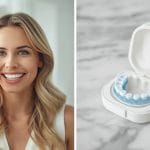 Read More: Teeth Whitening at Home: Options, Evidence & Safety
The Combination Approach: Often the Best of Both
For many people, the most effective answer isn’t “choose one” — it’s a staged approach that uses both strategically:
Stage 1 — Professional Treatment: One in-office whitening session or a dentist-supplied take-home tray course to achieve the dramatic initial transformation. This gets you to your target shade faster than at-home products alone, using concentrations that produce genuinely impressive results.
Stage 2 — At-Home Maintenance: Weekly whitening strip sessions, daily whitening toothpaste, consistent dietary awareness, and rinsing habits maintain the results achieved in Stage 1 without the ongoing cost of professional repeat treatments.
Stage 3 — Annual Professional Top-Up: Once per year — or when you notice meaningful fading — a professional clean and potentially a short top-up course refreshes the brightness that daily maintenance keeps close to your target shade.
This approach delivers the best long-term results for most people at a sustainable combined cost.
For a complete guide to building the daily habits that sustain whitening results between treatments, my guide on daily oral care routine for white teeth covers the full maintenance framework.
Special Considerations: Sensitivity, Braces, and Dental Work
Sensitivity
People with pre-existing sensitivity should discuss with their dentist before professional whitening — higher concentrations can trigger significant discomfort. At-home sensitive formulas with lower peroxide concentrations are often the better starting point, with professional treatment considered after enamel is strengthened with a sensitivity toothpaste pre-treatment course.
Braces
Traditional fixed braces make both professional and at-home whitening inadvisable during treatment — brackets prevent even coverage and create demarcation lines. Clear aligner wearers have more flexibility with at-home whitening.
Read More: Can You Whiten Your Teeth With Braces? Options & Safety
Existing Dental Restorations
Neither professional nor at-home whitening changes the color of crowns, veneers, or fillings. A dentist can map your restorations and plan whitening accordingly — making professional assessment particularly valuable in this scenario.
The Verdict: Which Is Right for You?
| Your Situation | Recommended Approach |
|---|---|
| Fast results needed (event within 2-3 weeks) | Professional in-office |
| Significant staining (A4 or darker) | Professional, then maintain at home |
| Mild-moderate surface staining | At-home strips, consistent routine |
| Budget is primary constraint | At-home whitening |
| Maintaining professional results | At-home maintenance |
| Dental restorations in smile zone | Professional assessment first |
| Sensitive teeth | At-home sensitive formula first |
| Braces (fixed) | Wait until removal |
| Clear aligners | At-home whitening during treatment |
| Best long-term results | Combination approach |
According to the Mayo Clinic, consulting a dental professional before whitening helps ensure the most appropriate method is chosen based on individual oral health factors — advice that applies whether you’re considering professional or at-home treatment.
Conclusion: The Honest Answer
Professional teeth whitening is more powerful, faster, and better supervised. At-home whitening is more affordable, more convenient, and perfectly effective for most people’s needs.
The choice isn’t which is objectively better — it’s which is better for your situation right now.
If budget allows and you want the most dramatic possible result quickly — professional whitening is worth every dollar. If you want effective, visible brightening on a realistic budget — quality at-home whitening delivers genuine results that you’ll be pleased with.
And if you want the best of both — start professional, maintain at home, top up annually. That’s the approach that gives most people the brightest, most sustained smile over the long term.
Your smile is worth a thoughtful decision — not just the cheapest option or the most expensive one.
Frequently Asked Questions
Q: Is professional teeth whitening worth the extra cost? For significant staining, fast results, or cases involving dental restorations or intrinsic discoloration, yes — professional whitening is worth the additional cost for the concentration, precision, and supervision it provides. For mild-to-moderate surface staining in someone willing to be consistent with at-home treatment, quality OTC whitening strips deliver excellent results at a fraction of the price.
Q: How many shades can at-home whitening realistically achieve? Quality at-home whitening strips with 10–14% hydrogen peroxide typically deliver 2–4 shades of improvement over a 7–14 day course for people with primarily extrinsic surface staining. Professional in-office whitening achieves 5–10 shades in a single session. Results at both ends depend significantly on starting shade and stain type.
Q: How long does professional whitening last compared to at-home? Professional in-office whitening results last 6 months to 2 years depending on maintenance habits. At-home whitening results from a full course last 3–6 months without maintenance, longer with consistent weekly touch-up sessions. Both benefit significantly from ongoing maintenance — and both fade without it.
Q: Can I do at-home whitening after professional treatment? Yes — and this is the recommended approach. Professional treatment achieves the dramatic initial transformation; at-home maintenance sustains it. Using whitening toothpaste daily and doing 1–2 strip sessions per week after professional treatment significantly extends how long results last between professional top-ups.
Q: Which teeth whitening method is safest? Both professional and ADA-accepted at-home whitening are safe when used correctly. Professional whitening carries higher short-term sensitivity risk due to concentration, but lower misuse risk due to supervision. At-home whitening at recommended frequencies is well-tolerated by most people. The genuinely unsafe category is DIY acidic methods — lemon juice, vinegar, charcoal — which cause permanent enamel damage regardless of how they’re marketed.
Looking for dental care options? Call to discuss the advertised dental service.
Call Now