
Updated November 13, 2026
Quick answer
You have just had your wisdom teeth out, and now there is a flight on your calendar. Maybe it was booked months ago. Maybe you need to fly home after surgery, or you are wondering whether a holiday is still possible next week. The question is a sensible one, and it is more common than …
You have just had your wisdom teeth out, and now there is a flight on your calendar. Maybe it was booked months ago. Maybe you need to fly home after surgery, or you are wondering whether a holiday is still possible next week.
The question is a sensible one, and it is more common than most people think. Flying itself is rarely dangerous after wisdom teeth removal — but flying at the wrong time can turn a normal recovery into a miserable trip, and in a small number of cases it can leave you dealing with a complication hundreds of miles from the surgeon who treated you.
This guide explains how soon you can fly, why the timing matters more than the cabin pressure, what the risks actually are, and how to make a flight as safe and comfortable as possible if you cannot postpone it.
A quick note before we start: this is educational information, not medical advice. There is no single rule that fits everyone, because every extraction is different. Your oral surgeon’s instructions always come first — if they tell you not to fly, do not fly.
The Short Answer: How Long Should You Wait to Fly?
Most dentists and oral surgeons suggest waiting at least 48 to 72 hours after wisdom teeth removal before flying. For many people, that is the minimum.
But the honest answer is that the safe wait depends on what kind of extraction you had:
- Simple extraction (a tooth that came out easily, no cutting or bone removal): many dentists are comfortable with flying after 24 to 48 hours, once bleeding has settled.
- Surgical extraction (which is what most wisdom teeth removal is — gum cut, bone removed, or the tooth sectioned): most guidance is 3 to 5 days at minimum, and ideally 7 days.
- Impacted or difficult wisdom teeth, or all four removed at once: many oral surgeons recommend waiting at least 7 days, and ideally up to 14 days, especially for a long-haul flight.
- If you had IV sedation or general anaesthesia: do not fly on the day of surgery at all. You should not travel alone or make important decisions for the rest of that day, and the NHS advises not driving for 24 hours after sedation, or 48 hours after a general anaesthetic.
There is no published trial and no formal guideline that names a mandatory grounding period after a wisdom tooth extraction, and airlines do not routinely ask about dental work. The numbers above are the range of advice that dentists and oral surgeons commonly give — not a law of nature. That is why the rest of this guide matters: understanding why dentists suggest waiting helps you judge your own situation, and it helps you ask your surgeon the right question.
Why Timing Matters More Than the Plane Itself
It is natural to assume the danger is the cabin pressure. It is part of the story, but it is not the main reason dentists ask you to wait.
The real issue is that the first few days after surgery are when the complications that genuinely need a dentist tend to appear — and a plane is the worst place to deal with them.
Here is what is happening inside your mouth in that first week. The moment your tooth comes out, blood fills the empty socket and forms a clot. That clot is not debris to be cleaned away. It protects the exposed bone and nerve endings underneath and gives your body a surface on which new tissue can grow. Over the next several days, the clot is slowly replaced by granulation tissue — a soft, pinkish healing tissue rich in tiny blood vessels. You can read the full day-by-day picture in our guide to what happens inside the socket: https://perfectwisdomteeth.com/wisdom-tooth-extraction-healing-stages/
The Mayo Clinic describes the standard aftermath: some blood may ooze on the first day, swelling of the cheeks usually improves within two or three days, bruising may take several more days to fade, and your jaw may feel stiff for a while. The NHS puts full recovery from wisdom tooth removal at up to two weeks, with the most noticeable symptoms concentrated in the first several days.
That timeline is the reason flying is a timing question:
- The first 24 hours belong to the clot. Oozing is expected, the clot is at its freshest, and you are still feeling the after-effects of anaesthesia or sedation. This is not a flying day.
- Days 2 to 3 are when swelling and pain usually peak. The Mayo Clinic notes that cheek swelling generally improves within two or three days, which means day two or three is often the worst of it — not day one. Boarding a plane at the peak of swelling is, at best, deeply uncomfortable.
- Days 3 to 5 are the highest-risk window for dry socket. Cleveland Clinic notes that dry socket usually develops within the first three days after a tooth is removed, and that if you have no symptoms by day five, you are likely in the clear. This is the window many surgeons most want you to stay within reach for.
- Around day 7, stitches are dissolving or being removed, a follow-up check has usually happened or can happen, and most pain has resolved. Flying after a week, once a post-operative check has confirmed the socket is healing, is the most conservative and most commonly suggested approach for impacted or difficult extractions.
In short, the flight does not usually cause the problem. It removes you from the person who can fix the problem, at exactly the time the problem is most likely to appear.
Does Cabin Pressure Affect a Healing Socket?
A commercial aircraft cabin is pressurised, but not to sea level. The CDC’s Yellow Book explains that most aircraft maintain a cabin pressure equivalent to an altitude of roughly 6,000 to 8,000 feet (about 1,800 to 2,400 metres). At that altitude, the air pressure is lower than on the ground, and any trapped air in the body expands slightly as the plane climbs and contracts again during descent.
In dentistry, tooth pain caused by changes in atmospheric pressure has a name: barodontalgia. It most commonly affects teeth with recent or incomplete treatment, and it is one of the reasons a fresh extraction site can throb during takeoff and landing.
Here is what cabin pressure does — and does not — do after wisdom teeth removal:
- It can make pain worse. Air trapped in the socket or in the sinus cavities near upper wisdom teeth expands as pressure falls. That can turn a dull ache into a sharp, throbbing pain that ordinary painkillers may not fully control, especially during ascent and descent.
- It is unlikely on its own to rip a healthy clot out. Most dental sources are clear on this: cabin pressure itself does not dislodge a well-formed clot. The clot is lost far more often through suction — straws, smoking, vigorous spitting and rinsing — than through pressure changes. But pressure changes combined with a fresh, fragile clot in the first day or two are a different matter, and that is why dentists are cautious about the first 24 to 48 hours.
- Dry cabin air is a real factor. Cabin humidity is typically only 10 to 20%, compared with 40 to 60% on the ground. Dry air dehydrates you, dries the tissues of the mouth, and can make the clot more fragile. Dehydration is common on flights anyway, and it does not help healing.
- Upper wisdom teeth deserve extra caution. Upper molars sit very close to the maxillary sinuses. The Mayo Clinic lists damage to the sinuses as a rare surgical complication, and blood or pus in nasal discharge after surgery is one of the symptoms it says should prompt a call to your surgeon. If your upper teeth were close to the sinus, or your surgeon mentioned a sinus communication, ask specifically about flying before you book — pressure changes affect the sinuses more than any other part of the mouth.
So the pressure is not a reason to panic, but it is a reason to respect the timing. A socket that is five days into healing handles a pressure change very differently from a socket that is five hours old.
The Real Risks of Flying Too Soon
1. Bleeding that restarts mid-flight
Some oozing on the first day is normal. The Mayo Clinic advises biting gently on gauze and not spitting too much, so you do not dislodge the clot. Heavy, persistent bleeding is not normal, and it is very hard to manage in a cramped aeroplane seat with no dentist available and limited supplies. If you are still oozing, or bleeding restarts after it had stopped, you are not ready to fly.
2. Dry socket
Dry socket (alveolar osteitis) is the complication oral surgeons warn about most. It happens when the blood clot does not form properly or is lost too early, leaving bone and nerve endings exposed to air, food and bacteria. Cleveland Clinic estimates it affects about 2% to 5% of all tooth extractions and is more common after wisdom teeth removal.
The pain is the giveaway: severe, deep, throbbing pain that begins or gets much worse two to five days after surgery — often after things had started to improve — and often radiates to the ear, temple or neck. Ordinary painkillers barely touch it, and there may be a bad taste or bad smell, or a socket that looks empty with whitish bone visible at the bottom. Dry socket needs a dentist: it usually requires the socket to be cleaned and dressed, and it can take seven to ten days to settle even with treatment. That is not something you want to discover at 35,000 feet, or in a hotel in a city where you do not know a dentist.
For the full side-by-side comparison of normal healing, dry socket and infection, see our guide: https://perfectwisdomteeth.com/signs-of-dry-socket-and-infection/
3. Swelling and pain at their worst
Swelling peaks around 48 to 72 hours. That is also when jaw stiffness — trismus — is at its worst, and opening your mouth wide enough to eat or drink comfortably can be hard. A flight on day two or three means travelling at the exact moment you feel worst, with dry cabin air, limited food options and nowhere to lie down with an ice pack.

4. Infection
Infection is a different problem from dry socket, and it tends to appear a little later — commonly three to seven days after surgery, sometimes later. The warning signs are pain and swelling that keep getting worse after day three instead of improving, fever, pus, and a persistent bad taste or odour. An infection needs prompt treatment, ideally from the surgeon who knows what was done. Flying away from them in that window is a gamble.
5. Being far from help
This is the risk that ties the others together. If bleeding restarts, dry socket appears or an infection develops, the best person to treat it is the oral surgeon who performed the extraction. They know how difficult the extraction was, whether there was a sinus exposure, and what was prescribed. A dentist at your destination can help in an emergency, but they are starting from scratch — and if you are travelling internationally, finding one, explaining your history, and paying for emergency care adds stress to an already painful situation.
Flying After Wisdom Teeth Removal: A Timeline
| When | What is usually happening | Flying? |
|---|---|---|
| Day 0 (surgery day) | Clot forms; oozing expected; numbness fades; sedation wearing off | Do not fly. Rest, head elevated, no straws or exertion. Do not travel alone after sedation or general anaesthesia. |
| Days 1–2 | Swelling climbing toward its peak; jaw stiff; soft foods only | Not recommended. Bleeding risk is highest, swelling is rising, and you may still be drowsy from medication. |
| Days 2–3 | Swelling and pain peak, then begin to improve (Mayo Clinic) | Avoid if you can. This is the worst-feeling part of recovery and the start of the dry socket window. |
| Days 3–5 | Highest-risk window for dry socket (Cleveland Clinic); clot converting to healing tissue | Only if your surgeon agrees. This is the practical test: is your pain settling or climbing? If it is climbing, do not travel. |
| Days 5–7 | Swelling receding; pain easing day by day; mouth opening improving | Usually reasonable for a straightforward extraction, if healing is on track and your surgeon has cleared you. |
| Day 7 and beyond | Stitches dissolving or removed; follow-up check often done; most soreness gone (NHS) | Generally fine. The most conservative and commonly suggested point for impacted or difficult extractions, and for long-haul flights. |
| Weeks 2 and beyond | Gum surface largely closed; bone still remodelling underneath for months | No flying restriction related to the extraction for most people. |
This table is a guide to a typical recovery, not a prescription. A simple extraction of one erupted tooth heals very differently from the surgical removal of four impacted teeth. Your surgeon’s figure — ideally given to you in writing — overrides everything in this table.
For the broader day-by-day recovery picture, see our recovery guide: https://perfectwisdomteeth.com/wisdom-teeth-recovery-guide/
If You Must Fly: How to Make It Safer
Sometimes postponing is not possible. A flight home after surgery, a non-refundable ticket, a family emergency — life does not always wait a week. If you have to fly, and your surgeon has said it is acceptable for your case, these steps reduce the risk and the discomfort.
Before you book or board
- Get clearance first — in writing if you can. Tell your surgeon the date, the flight length and the destination. Ask specifically: “Is it safe for me to fly on this date?” If they say no, listen. If they say yes, ask what to do if pain or bleeding starts while you are away, and get the number of an out-of-hours contact.
- Book the shortest, most direct flight you can. Every hour in the air is an hour away from help. A direct flight also avoids a second takeoff and landing, which are the moments when pressure changes are sharpest.
- Choose an aisle seat if possible. You will want to get up, move around, use the toilet to rinse gently, and stretch your jaw without climbing over strangers.
- Travel with someone if you can. This matters most in the first few days, and it is essential if you are still taking medication that makes you drowsy. Do not travel alone after sedation.
- Research a dentist at your destination before you leave. Save the name, address and phone number of a dental practice near where you will be staying. The International Association for Medical Assistance to Travelers (IAMAT) can help locate English-speaking dentists abroad. Knowing this in advance is far better than searching in pain at midnight.
- Check your travel insurance. Make sure it covers emergency dental treatment abroad, and know what you need to do to claim.
What to pack in your hand luggage
Do not put any of this in checked baggage. You need it within reach.
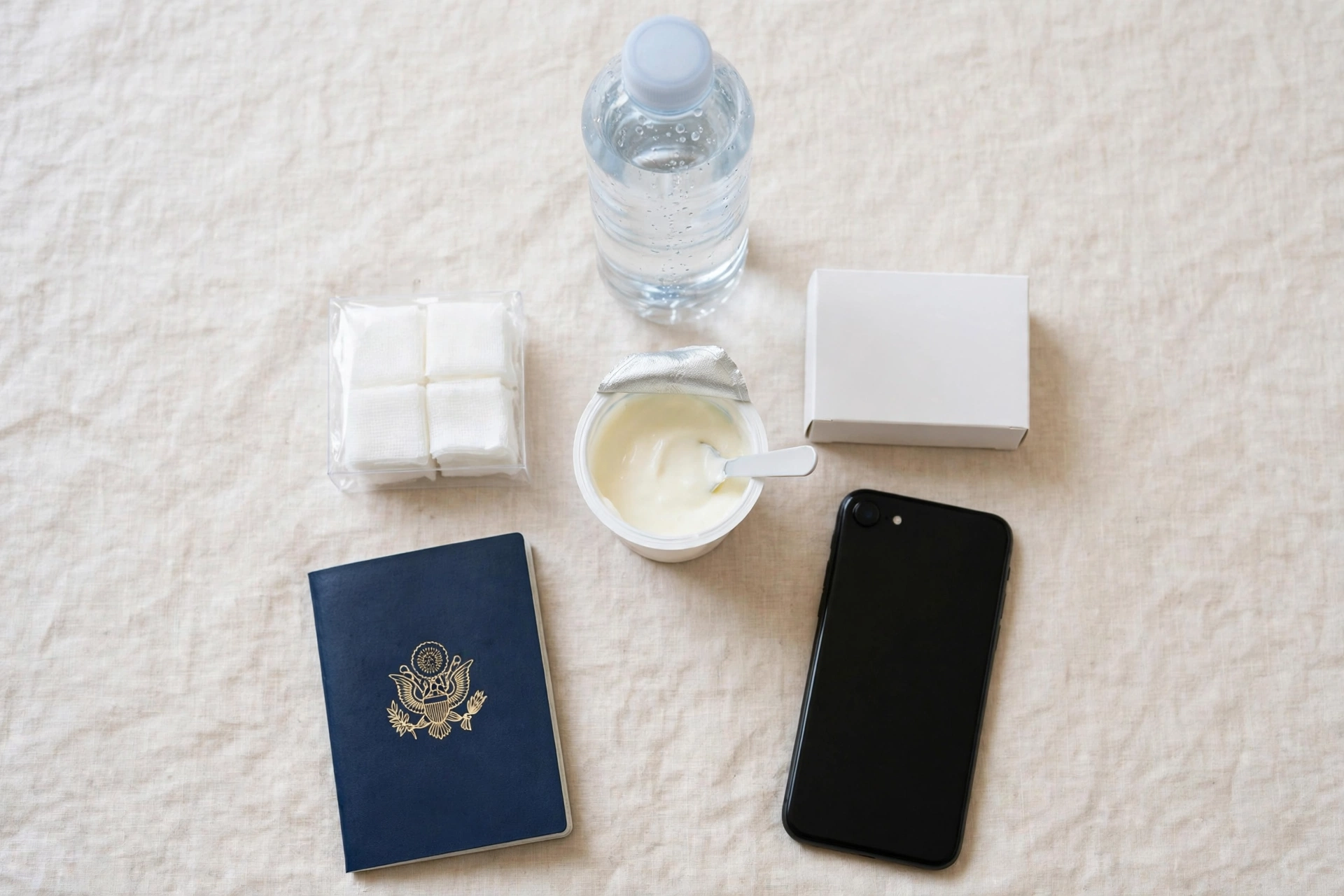
- Your pain medication, in its original packaging, plus a little extra in case of delays. Take a dose before the flight if your surgeon has said to keep to a schedule — do not wait until pain is severe.
- Gauze pads. A small supply, in case of oozing. Bite gently on clean gauze during takeoff and landing if you are flying within the first few days.
- A bottle of water. Sip water regularly from a cup or the bottle itself — never through a straw. The sucking action can pull the clot loose, and the Mayo Clinic advises against straws for at least a week.
- Soft food for the flight. Yoghurt, a smoothie in a cup (drunk, not sucked), mashed banana, a soft sandwich with the crusts removed — whatever you can eat without opening your mouth wide or chewing hard. Airline meals are often chewy, crunchy or spicy, and none of those are what a healing socket wants.
- Salt and a small cup for a gentle warm salt-water rinse after eating, if your surgeon has said rinsing is safe for you. Do not rinse vigorously, and do not rinse at all in the first 24 hours.
- An ice pack or a disposable cold compress, if the airline allows it, for swelling during the flight. A bag of ice from the cabin crew works too — ask for it wrapped in a cloth or napkin, never directly on the skin.
- Your surgeon’s phone number, written down, not just in your phone. Phones run out of battery; paper does not.
- Tissues and a small plastic bag, in case of bleeding or nausea. It is better to have them and not need them.
During the flight
- Stay hydrated. Sip water often. Cabin air is very dry, and dehydration does not help healing. Avoid alcohol entirely — it dehydrates you, can increase bleeding, and interacts with pain medication. Avoid carbonated and hot drinks for the first 24 hours, as the Mayo Clinic advises.
- Do not use a straw. This is worth repeating, because it is the single most common way people lose a clot. Drink from a cup or straight from a bottle.
- Do not smoke or vape. Smoking is one of the strongest risk factors for dry socket. The Mayo Clinic advises not smoking for at least 72 hours after surgery, and longer if possible. A long flight is not the time to break that rule.
- Eat soft food, and chew on the opposite side. If only one side was operated on, chew on the other side. If both sides were done, keep food soft and take small bites.
- Take your medication on schedule. Set a phone alarm. Pain is much easier to prevent than to chase once it has taken hold, and a long flight is a bad time to fall behind.
- Swallow and yawn gently during descent. The pressure change on landing is often when discomfort appears. Swallowing, yawning or chewing gum gently (only if your surgeon has said chewing is safe for you) can help equalise pressure in the ears and sinuses. Do not force it if it hurts.
- Use gauze during takeoff and landing if you are flying early. If you are within the first few days and your surgeon has agreed you can fly, biting gently on clean gauze during ascent and descent can help protect the clot and absorb any oozing.
- Do not use a nasal decongestant spray without asking. Some people reach for one to help with sinus pressure, but if you had upper wisdom teeth removed, ask your surgeon first — especially if there was any mention of a sinus exposure.
- Get up and move. A short walk up the aisle every hour or so helps circulation and reduces stiffness. Keep it gentle; this is not the time for strenuous activity, and the Mayo Clinic advises avoiding activities that require a lot of energy for at least a week.
After you land
- Check the sockets when you can. A little pink-tinged saliva is normal in the first day or two. Fresh, heavy bleeding, a socket that looks empty, or pain that is suddenly much worse than before the flight are reasons to call a dentist promptly.
- Keep up the aftercare. Gentle warm salt-water rinses after meals, soft foods, no straws, no smoking, no vigorous rinsing. The flight does not end the recovery — it just moves it to a new location.
- Do not ignore worsening pain. Pain that was improving and then becomes sharply worse between days two and five, especially throbbing pain spreading toward the ear, is the classic dry socket pattern described by the Mayo Clinic and Cleveland Clinic. Call a dentist the same day; do not wait to see if it passes.
When to Postpone Your Flight
Do not fly — and call your surgeon first — if any of these apply:
- You are still on the day of surgery, or you had IV sedation or general anaesthesia and have not yet had a full day to recover.
- You have active bleeding that will not settle with firm gauze pressure.
- Your pain is getting worse rather than better after day two or three.
- Swelling is still increasing after day three, or new swelling appears after it had started to go down.
- You have a fever, pus, a bad taste that salt-water rinsing does not remove, or trouble swallowing or breathing. The Mayo Clinic lists difficulty swallowing or breathing as a reason to call your dentist or oral surgeon urgently.
- Your surgeon has specifically told you not to fly.
- You have no way to reach dental care at your destination, and your flight is long-haul.
If your flight is essential and cannot be moved, tell your surgeon that too. They may be able to schedule a check-up before you leave, adjust your medication, or give you specific instructions for your case. A five-minute conversation before you travel is worth far more than a general guide — including this one.
Flying Home After Surgery Abroad
A special case worth mentioning separately: dental tourism. Some people travel abroad to have wisdom teeth removed, then fly home within a day or two. This is the highest-risk version of the question, because you are combining a surgical extraction with a flight and with leaving the surgeon behind.
If you are planning this, the same rules apply, only more strictly: wait at least 48 to 72 hours as an absolute minimum, and ideally until after a post-operative check. Ask the treating surgeon for written aftercare instructions and a contact number. Find out what your travel insurance covers for follow-up dental care at home. And be honest with yourself about the trade-off: the money saved on surgery is not saved if you end up paying for emergency treatment for a dry socket at home.
Frequently Asked Questions
Can I fly the day after wisdom teeth removal?
It is not recommended. The day after surgery you are still managing oozing, swelling is still rising, and you may still be feeling the after-effects of sedation. The worst of the swelling is still to come, and dry socket most often appears in the days after that. If you have no choice, get your surgeon’s explicit agreement first — do not decide this on your own.
Can I fly 3 days after wisdom teeth removal?
For many people with a straightforward extraction, flying from around day three is considered reasonable by many dentists — if your pain is settling, bleeding has stopped, and your surgeon has cleared you. Day three is also when swelling peaks and the dry socket window opens, so judge by the trend: pain that is steadily improving is reassuring; pain that is getting worse is a reason to stay put. If your extraction was impacted or difficult, or all four teeth were removed, wait longer.
Can I fly a week after wisdom teeth removal?
For most people, yes. By day seven, swelling has usually receded, pain is much reduced, stitches are dissolving, and a follow-up check has usually confirmed healing is on track. This is the point most oral surgeons are comfortable with, including for impacted teeth and for long-haul flights. If you are still in significant pain or have any signs of infection at day seven, see a dentist before flying rather than hoping the flight will be fine.
Does flying cause dry socket?
Flying does not directly cause dry socket in the way that smoking or using a straw can. Dry socket happens when the blood clot is lost or fails to form, and the main risk factors are the extraction itself, smoking, and suction in the mouth. But flying in the first few days adds several things that do not help: dry cabin air, dehydration, pressure changes, and distance from your dentist. The risk is highest in the first three to five days, which is why that window matters so much.
Will cabin pressure make my teeth hurt?
It can. Air trapped in the socket or in the sinuses expands as cabin pressure falls during ascent, and contracts again during descent. This is called barodontalgia — pressure-related tooth pain. It is usually worst during takeoff and landing, and it is more likely if you had upper wisdom teeth removed, because of their proximity to the sinuses. Swallowing and yawning gently during descent often helps. If the pain is severe or does not settle after landing, contact a dentist.
What should I do if my socket starts bleeding on the plane?
Stay calm. Bite firmly but gently on a clean gauze pad (or a clean, damp tea bag if you have no gauze) for 20 to 30 minutes without checking it every minute. Keep your head upright, avoid spitting, and do not rinse vigorously. Sip cool water. If bleeding does not slow after sustained pressure, or it restarts heavily, tell the cabin crew — they have a first aid kit and can contact medical advice on the ground. See a dentist as soon as you land.
Can I fly after wisdom teeth removal if I had IV sedation?
Not on the day of surgery, and not alone the next day. Sedation and general anaesthesia are followed by a period — commonly the first day — when you are told not to travel alone, drive, or make important decisions. The NHS advises not driving for 24 hours after sedation, or 48 hours after a general anaesthetic. The same caution applies to flying: wait until the sedation has fully worn off, you are alert, and you can manage your own medication and aftercare. If you had IV sedation, ask your surgeon specifically about your case — the advice in our sedation guide is a good starting point: https://perfectwisdomteeth.com/iv-sedation-wisdom-teeth/
The Bottom Line
Flying after wisdom teeth removal is usually safe — once you have waited long enough. For a straightforward extraction, that often means 48 to 72 hours. For a surgical or impacted extraction, it more often means 3 to 5 days at minimum, and ideally a week. Same-day and next-day flights are the least advisable, particularly after sedation or a difficult extraction.
The decision is not really about the plane. It is about where you are in healing, whether your pain is getting better or worse, and whether you can reach your surgeon if something goes wrong. If you are past the worst of the swelling, your pain is steadily improving, bleeding has stopped, and your surgeon has said you can travel — book the flight, pack the gauze and the water bottle, and go.
If any of that is not true, move the flight. A delayed trip is an inconvenience. A dry socket in another country is a different kind of trip entirely.
Disclaimer
This article is for general educational purposes only and is not medical advice. It does not replace the instructions given by your own dentist or oral surgeon, who know the details of your extraction. If your surgeon’s advice differs from anything in this guide, follow your surgeon’s advice. If you develop heavy bleeding, difficulty swallowing or breathing, fever, or pain that is getting worse rather than better, contact your dentist, oral surgeon, or local emergency services promptly.
Sources
- Mayo Clinic — Wisdom tooth removal: what to expect: https://www.mayoclinic.org/tests-procedures/wisdom-tooth-extraction/about/pac-20395280
- Cleveland Clinic — Dry socket: symptoms, causes & treatment: https://my.clevelandclinic.org/health/diseases/17731-dry-socket
- NHS — Wisdom tooth removal: recovery
- CDC Yellow Book — cabin pressure equivalent to 6,000–8,000 feet altitude