
Updated November 17, 2026
Quick answer
Cereal is one of those foods you don't think about until you can't have it. It's the default breakfast — quick, familiar, comforting. And after wisdom teeth removal, when breakfast has narrowed to yoghurt and scrambled eggs, a bowl of cereal starts to look very appealing. So can you eat cereal after wisdom teeth removal? …
Cereal is one of those foods you don’t think about until you can’t have it. It’s the default breakfast — quick, familiar, comforting. And after wisdom teeth removal, when breakfast has narrowed to yoghurt and scrambled eggs, a bowl of cereal starts to look very appealing.
So can you eat cereal after wisdom teeth removal? The honest answer is: it depends entirely on the cereal, and on how you eat it. Crunchy cereal straight from the box is one of the worst choices in the first week. But the right cereal, prepared the right way, can be back on the menu much sooner than you’d expect.
Why Crunchy Cereal Is a Problem
It comes down to three things your healing mouth doesn’t want:
Hard, sharp pieces. Cornflakes, granola and bran flakes are full of rigid edges that can scratch a healing socket, and small fragments can lodge in the extraction site.
Chewing. Crunchy cereal demands real jaw work, and in the first few days your jaw is stiff, swollen and sore. Forcing it through a bowl of granola puts pressure on the sockets.
Sugar residue. Sweetened cereals leave a sugary film around the sockets — combined with trapped food particles, it’s an invitation for irritation.
None of this means cereal is banned for a month. It means the crunchy version has to wait, and the soft version needs a little technique.
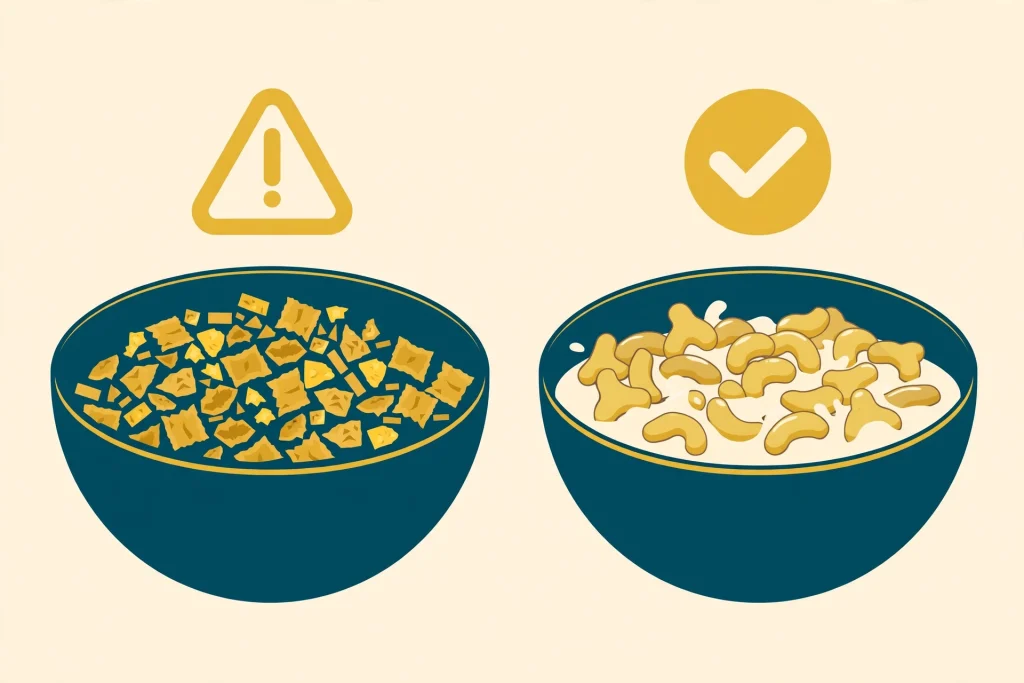
Safe vs. Risky Cereals: The Comparison
| Cereal | Texture | Verdict |
|---|---|---|
| Instant oatmeal / porridge | Very soft when cooked | Safe from day 2–3 |
| Cream of Wheat / farina | Smooth, spoonable | Safe from day 2–3 |
| Rice Krispies (soaked) | Softens fast in milk | Okay from day 5–7, fully soggy |
| Cheerios (soaked) | Small, softens well | Okay from day 5–7, fully soggy |
| Cornflakes (soaked) | Softens but stays flaky | Wait until day 7–10 |
| Shredded Wheat (soaked) | Fibrous, slow to soften | Wait until day 10–14 |
| Bran flakes | Rough, high fibre | Wait until day 10–14 |
| Granola | Hard clusters, nuts, seeds | Wait 2–3 weeks |
| Muesli | Raw oats, nuts, dried fruit | Wait 2–3 weeks |
| Crunchy nut cereals | Hard nuts, sharp pieces | Wait 2–3 weeks |
| Sugary kids’ cereals | Hard shapes, high sugar | Wait 2–3 weeks |
The pattern is simple: the softer the cereal, the sooner it comes back. Instant oatmeal and Cream of Wheat are essentially soft foods already; granola and muesli are crunchy snacks in a bowl — they belong at the far end of the timeline.
For more on oatmeal specifically, our guide to eating oatmeal after wisdom teeth removal covers temperatures, toppings and the best varieties in detail.
The Soggy-Cereal Method
Here’s the trick that brings cereal back a week earlier: don’t eat it crunchy — soak it until it’s completely soft. It’s genuinely the way to eat cereal during recovery.
How to do it:
- Pour your cereal into the bowl first — Rice Krispies or plain Cheerios work best.
- Add cold or lukewarm milk. (Cold milk feels better on sore gums in the first week; avoid hot milk.)
- Wait. This is the important part. Give it a full 5–10 minutes. Stir once or twice. You’re waiting for every piece to go soft all the way through — no crunchy centre, no crisp edge.
- Test a piece with your spoon. If it squashes easily against the side of the bowl, it’s ready. If it still snaps, wait longer.
- Eat slowly with a small spoon, chewing on the side away from the sockets if you need to chew at all.
Tips that make it better:
- Add a sliced banana on top — it sweetens the bowl naturally and is soft enough for any stage of recovery.
- Stir in a spoonful of yoghurt for extra protein and a creamier texture.
- Don’t add nuts, seeds or dried fruit until you’re back to normal foods — they’re exactly the small hard bits that get stuck in sockets.
A Realistic Cereal Timeline
- Days 1–2: No cereal — liquids and very smooth foods only.
- Days 3–4: Instant oatmeal or Cream of Wheat, served lukewarm. These are cereals in all but name, and they’re safe now.
- Days 5–7: Fully soggy Rice Krispies or Cheerios in cold milk — the first real “bowl of cereal” moment.
- Days 7–10: Soggy cornflakes and other flaked cereals, soaked thoroughly.
- Days 10–14: Lightly soaked cereal, and Shredded Wheat or bran flakes if comfortable. Chew carefully, on the opposite side.
- After 2–3 weeks: Normal cereal, including granola and muesli, once chewing feels completely normal and your dentist is happy with healing.
If anything scratches, catches, or leaves bits in a socket, go back a step. A gentle warm salt-water rinse after eating helps clear any residue.
Milk, Sugar and Dry Socket: What Else to Know
Milk is fine. The old myth that dairy slows healing after oral surgery doesn’t hold up — milk, yoghurt and cheese are all fine, and the calcium and protein genuinely help. Oat or soy milk work just as well.
Sugar is the real concern. One bowl of sweetened cereal won’t ruin your recovery, but sugar plus food debris plus a healing socket is worth minimising in week one. Choose plain cereals while healing and save the frosted ones for later.
Never use a straw. This is worth repeating because cereal-adjacent drinks are where people slip up — sipping the leftover milk through a straw, or drinking a smoothie with one. The suction can pull the blood clot out of the socket and cause dry socket. Always drink from a glass.
Rinse after eating. Cereal leaves crumbs, so rinse gently with warm salt water after each meal — no vigorous swishing in the first few days.
What to Eat Instead in the First Few Days
If cereal is still off the table and you’re bored of yoghurt, try these breakfast alternatives:
- Scrambled eggs — soft, protein-rich, and easy to eat from day two.
- Smoothie bowl — banana, yoghurt and a spoonful of peanut butter, eaten with a spoon.
- Pancakes — soft, torn into small pieces (see our pancakes guide).
- Applesauce with cinnamon — a warm, comforting option that feels like breakfast even though it’s basically dessert.
The Bottom Line
Cereal isn’t one food — it’s a spectrum, and where a cereal sits on it decides when it comes back. Oatmeal and Cream of Wheat are fine from day two or three, soggy Rice Krispies and Cheerios from day five, granola and muesli after two to three weeks. Soak it until completely soft, eat with a small spoon, and never drink the milk through a straw.
FAQs
Can you eat cereal after wisdom teeth removal on day 1?
No. Even soft cereals need a little chewing, and your mouth needs complete rest on day one. Try instant oatmeal from day two or three.
Is oatmeal considered cereal after wisdom teeth removal?
Yes, and it’s the safest cereal of all. Instant oatmeal, served lukewarm with plenty of liquid, is soft, smooth and easy to swallow.
Can I eat Cheerios after wisdom teeth removal?
Yes, from around day five to seven — but only fully soaked in milk until completely soft, with no crunchy centre.
Is granola okay after wisdom teeth removal?
Not until two to three weeks. Granola’s hard clusters, nuts and seeds are sharp and almost guaranteed to lodge in a healing socket.
Can I drink milk with cereal after wisdom teeth removal?
Yes, dairy is fine after wisdom teeth removal — the idea that milk slows healing is a myth. Drink the milk from the bowl with a spoon or straight from the glass, but never through a straw.
What cereal is safest after wisdom teeth removal?
Instant oatmeal and Cream of Wheat are the safest — smooth, soft and spoonable from day two or three. After that, fully soaked Rice Krispies or plain Cheerios are the next best step.