If your dentist has just told you that one — or more — of your wisdom teeth is impacted, you probably have a lot of questions.
What exactly does impacted mean? How serious is it? What does the surgery actually involve? And how much worse is recovery going to be compared to a regular extraction?
These are exactly the right questions to ask — and this guide answers all of them, in plain language, without the kind of vague reassurances that leave you more anxious than informed.
Here’s what I want you to know upfront: impacted wisdom tooth extraction is one of the most commonly performed oral surgical procedures in the world. Millions of people go through it every year. And while it’s more involved than a simple extraction, it’s a well-understood, highly refined procedure with a predictable recovery path when you know what to expect.
Before deciding what treatment you may need, read our guide to 10 signs of impacted wisdom teeth. If you’re planning the procedure in the U.S., you can also review how dental insurance may cover wisdom teeth removal.
Understanding what’s happening — before, during, and after — makes an enormous difference to how prepared and in control you feel. Let’s get into it.
What Does “Impacted Wisdom Tooth” Actually Mean?
An impacted wisdom tooth is one that cannot fully emerge through the gumline into its correct position — either because there isn’t enough space in the jaw, because it’s growing at an incorrect angle, or because it’s blocked by the adjacent second molar.
Wisdom teeth are the last teeth to develop — typically erupting between ages 17 and 25. By this point, most people’s jaws are already fully developed, and there simply isn’t room for four additional molars to emerge properly. The result: the wisdom tooth gets stuck — partially or completely — beneath the gum and bone.
The Four Types of Impaction Explained
Not all impacted wisdom teeth are the same — and the type of impaction significantly affects how complex the extraction will be.
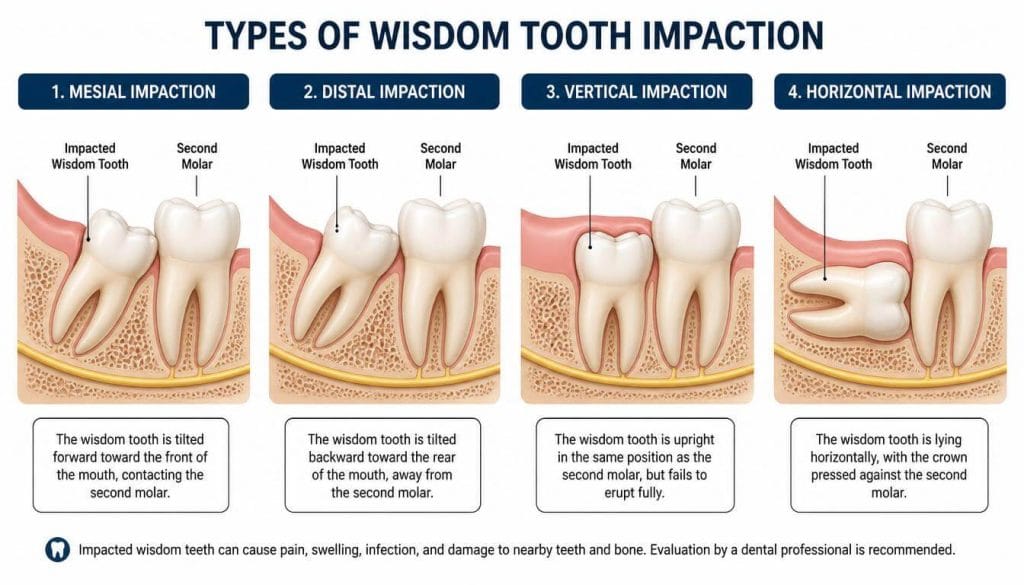
Mesial Impaction
The most common type. The wisdom tooth is angled forward — tilting toward the front of the mouth at approximately 45 degrees — pressing directly into the root of the second molar in front of it. This angle puts significant pressure on the adjacent tooth and is one of the more symptomatic impaction types.
Distal Impaction
The opposite of mesial — the tooth is angled backward, away from the adjacent molar and toward the back of the jaw. Less common than mesial impaction. Depending on the degree of angulation, this can range from straightforward to complex for extraction.
Vertical Impaction
The wisdom tooth is growing in the correct upright orientation — but it’s simply stuck below the gumline because there isn’t enough space for it to emerge. Sometimes vertical impactions partially erupt; other times they remain completely submerged. These can be easier to extract than angular impactions depending on depth.
Horizontal Impaction
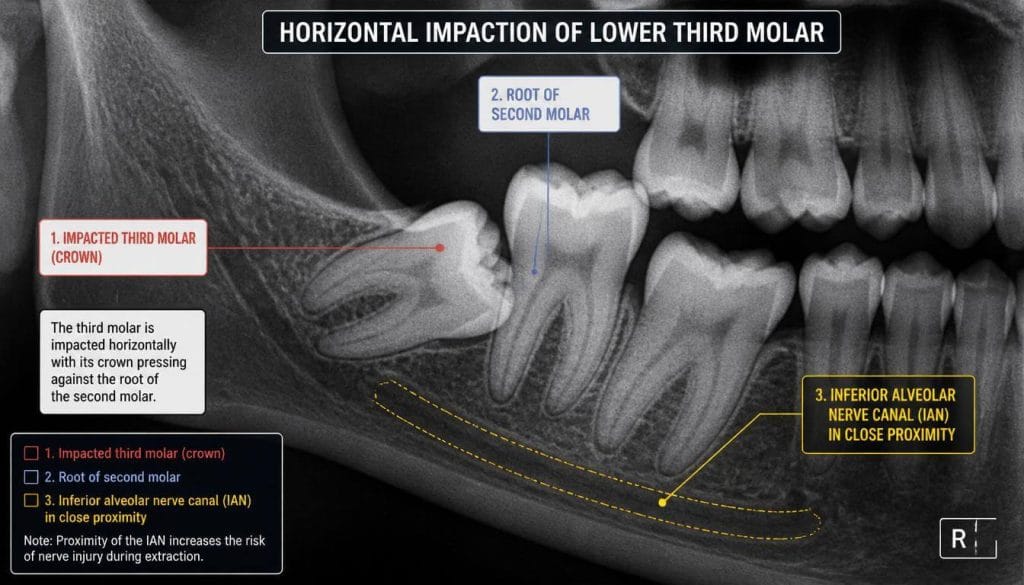
The most complex type. The wisdom tooth is growing completely sideways — at a near-90-degree angle — directly into the root of the second molar. Horizontal impactions are almost always fully submerged in bone, require the most extensive surgical procedure to remove, and carry the highest risk of complications including nerve proximity issues.
Partially vs Fully Impacted — Key Differences
Beyond the angle of impaction, the degree of eruption matters significantly:
Partially Impacted
The crown of the tooth has partially broken through the gumline — visible or palpable in the mouth. This creates a particularly problematic situation: a flap of gum tissue (called the operculum) covers part of the tooth, creating a pocket that traps food and bacteria. This is the primary cause of pericoronitis — a painful infection specific to partially impacted wisdom teeth.
Fully Impacted
The tooth remains completely beneath the gum tissue and jawbone — with no portion visible in the mouth. Fully impacted teeth may be asymptomatic for years, discovered only on routine dental X-rays. When they do cause problems, they’re often more serious — including cyst formation, root resorption of adjacent teeth, or significant infection.
Why Impacted Teeth Don’t Just Go Away
This is a question I hear constantly — and the answer is important.
An impacted wisdom tooth cannot resolve on its own. The jaw structure is fixed in adulthood. The tooth has nowhere to go. The longer it remains impacted, the higher the cumulative risk of:
- Progressive damage to the adjacent second molar’s root
- Chronic infection and inflammation cycles
- Cyst or tumor development around the impacted crown (rare but serious)
- Increasing complexity of eventual extraction as bone density increases with age
This is why many oral surgeons recommend extraction of problematic impacted teeth in the late teens or early twenties — when bone is less dense, roots are less fully formed, and healing is faster.
Monitoring a symptomatic impacted tooth with the hope that it resolves is not a realistic strategy. It won’t.
Symptoms of an Impacted Wisdom Tooth
Impacted wisdom teeth range from completely asymptomatic to acutely painful — and the symptoms you experience depend heavily on the type and degree of impaction, and whether infection has developed.
Pain, Swelling, and Jaw Stiffness
The classic symptom cluster of a problematic impacted wisdom tooth:
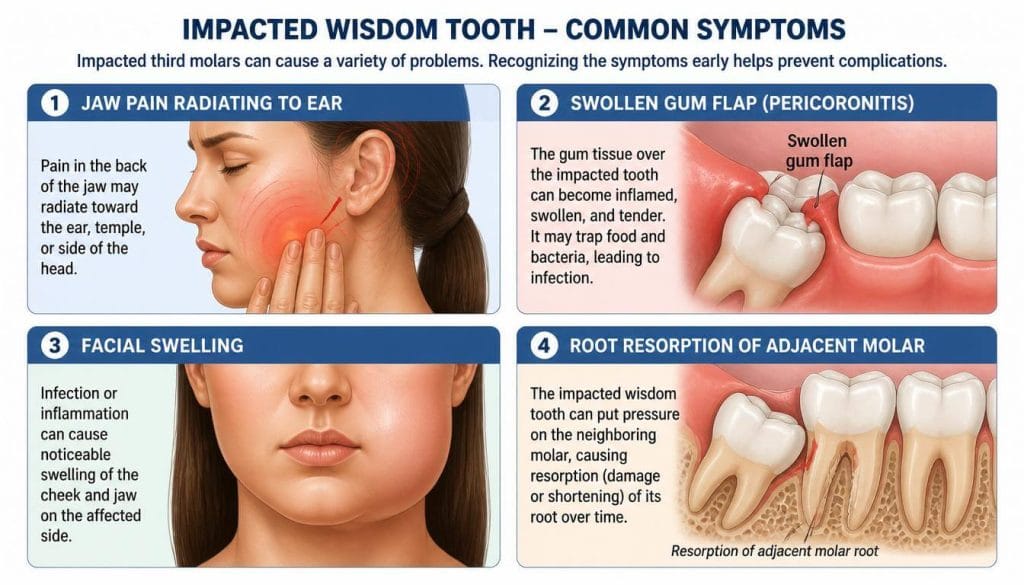
Pain typically presents as a deep, persistent aching at the back of the jaw — often radiating toward the ear, temple, or along the jawline. It’s frequently mistaken for earache, TMJ pain, or headache. The pain can be constant or intermittent, and often worsens when chewing, speaking, or opening the mouth wide.
Our post on whether headaches can be caused by wisdom teeth explores this radiating pain phenomenon in detail — worth reading if you’re experiencing head or ear pain alongside jaw discomfort.
Swelling around the back of the jaw, cheek, and sometimes the lymph nodes beneath the jaw is common during active inflammation. Facial asymmetry from one-sided swelling is a tell-tale sign.
Trismus — jaw stiffness or limited mouth opening — develops when inflammation spreads to the muscles of mastication surrounding the jaw joint. Difficulty opening your mouth wider than two finger-widths is a significant symptom that warrants prompt dental attention.
Infection Signs — Pericoronitis Explained
Pericoronitis is the specific infection associated with partially impacted wisdom teeth — and it’s one of the most common dental emergency presentations.
When a wisdom tooth is partially erupted, the gum flap (operculum) covering the remaining portion of the crown creates a dark, moist pocket that is nearly impossible to clean effectively. Food debris and bacteria accumulate under this flap, leading to infection of the surrounding gum tissue.
Signs of pericoronitis include:
- 🔴 Intense, throbbing pain at the back of the jaw
- 🔴 Swollen, red gum tissue around the wisdom tooth
- 🔴 Pus or unpleasant taste/smell from the area
- 🔴 Swollen lymph nodes under the jaw
- 🔴 Fever in more serious cases
- 🔴 Difficulty swallowing (in severe cases — seek urgent care)
Pericoronitis can be mild and self-limiting — or it can progress to a serious spreading infection. A first episode is typically treated with professional irrigation, antibiotics if indicated, and warm salt water rinses. However, recurrent pericoronitis is a strong indication for extraction — the underlying cause cannot be resolved any other way.
⚠️ Warning Box: If you experience jaw swelling that is spreading toward your neck or throat, difficulty swallowing or breathing, or a fever above 38.5°C (101°F) with jaw swelling — seek emergency care immediately. Spreading dental infection can be life-threatening and requires urgent medical attention.
When an Impacted Tooth Damages Surrounding Teeth
One of the most serious — and unfortunately often silent — consequences of impacted wisdom teeth is damage to adjacent structures.
Root resorption occurs when the impacted wisdom tooth’s crown presses against the root of the second molar, causing the body to actively resorb (dissolve) that root structure. This can result in permanent damage to or loss of the second molar — a far more consequential tooth than the wisdom tooth itself.
Cyst formation — a dentigerous cyst — can develop around the crown of an impacted tooth. These fluid-filled sacs expand slowly, destroying surrounding bone and potentially damaging adjacent tooth roots. Regular dental X-rays are the only way to detect these before they cause significant damage.
This is why monitoring asymptomatic impacted wisdom teeth with regular radiographic review is so important — symptoms alone don’t capture the full picture of what may be happening beneath the surface.
Our post on shocking signs you’re ignoring impacted wisdom teeth covers the less obvious warning signs that often get dismissed as unrelated dental issues.
How Impacted Wisdom Tooth Extraction Is Performed
This is the section most people are most anxious about — so let’s walk through it carefully and honestly.
Why It’s More Complex Than a Simple Extraction
A simple extraction — the kind performed for a fully erupted tooth — involves loosening the tooth in its socket using an elevator instrument and removing it with forceps. The tooth is accessible, the ligament is detachable, and the procedure typically takes minutes.
An impacted wisdom tooth extraction is a surgical procedure — categorically different in scope:
- The tooth is partially or fully beneath gum tissue and bone
- Accessing it requires cutting through the gum
- Bone must often be removed to expose the tooth
- The tooth frequently needs to be cut into sections for removal
- The wound requires suturing after extraction
This is why impacted extractions are performed by oral surgeons or dentists with specific surgical training — and why they’re performed under local anesthesia with sedation options rather than local anesthesia alone in most cases.
Anesthesia Options
Before discussing the surgical steps, it’s worth understanding your anesthesia options:
Local anesthesia only — appropriate for simpler impactions, fully conscious throughout. You’ll feel pressure but no pain.
Local anesthesia + oral sedation — anti-anxiety medication taken before the procedure. You remain conscious but significantly calmer.
IV sedation (conscious sedation) — administered through an intravenous line, producing a deeply relaxed, semi-conscious state. Most people have little or no memory of the procedure. The most popular option for impacted extractions.
General anesthesia — full unconsciousness, typically reserved for very complex cases, multiple simultaneous extractions, or patients with severe dental anxiety.
Discuss all options with your oral surgeon at your consultation — there is no universally “right” choice, only the right choice for your specific situation and comfort level.
Incision and Bone Removal Steps
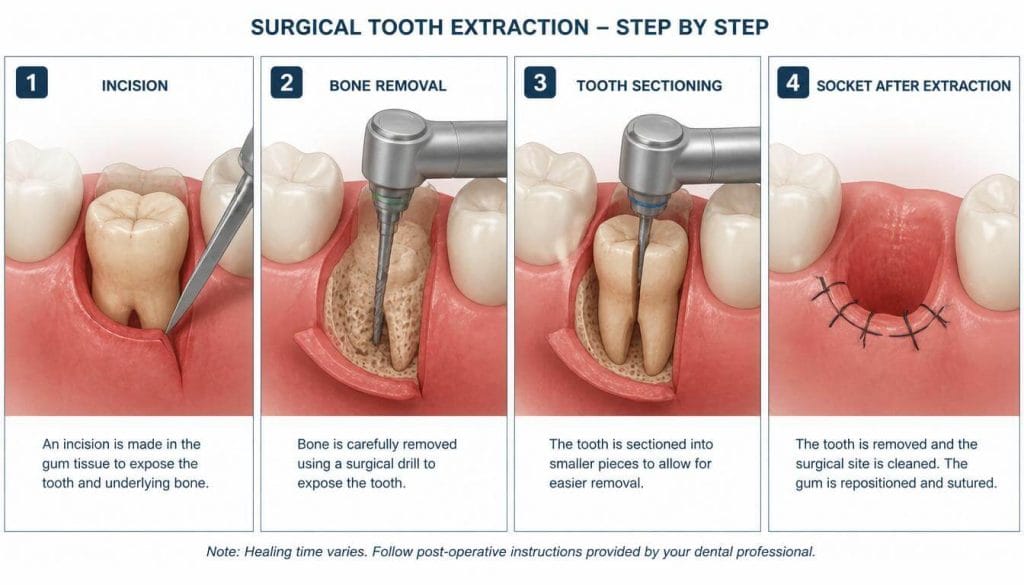
Here is what actually happens during a surgical impacted wisdom tooth extraction, step by step:
Step 1: Anesthesia Administration
Local anesthetic is injected around the wisdom tooth and into the nerve block supplying the area. If IV sedation is being used, this is administered first and takes effect before local anesthetic is given.
Step 2: Incision
The oral surgeon makes a precise incision through the gum tissue over and around the impacted tooth, creating a flap that is gently lifted back to expose the underlying bone and the crown of the tooth beneath.
Step 3: Bone Removal
Using a surgical handpiece (dental drill) with sterile irrigation, the surgeon removes the bone covering the impacted tooth — typically just enough to expose the crown and create a path for extraction. This is the step most associated with the vibration and pressure sensations patients describe — you should feel pressure but no sharp pain.
Step 4: Tooth Sectioning
In most impacted extractions — particularly horizontal and mesial impactions — the tooth is cut into two or more sections using the surgical handpiece. This allows each piece to be removed through a much smaller opening than the whole tooth would require, minimizing the amount of bone that needs to be removed and reducing trauma to surrounding tissue.
Step 5: Extraction of Sections
Each tooth section is carefully elevated and removed using specialized instruments. The surgeon works systematically to ensure all fragments are fully removed.
Step 6: Socket Cleaning and Inspection
The empty socket is thoroughly irrigated with sterile saline and inspected to ensure no tooth or bone fragments remain. The bone edges may be smoothed if necessary.
Step 7: Suturing
The gum flap is repositioned and closed with sutures — either dissolvable or non-dissolvable depending on surgeon preference and case complexity. Dissolvable sutures typically dissolve within 7–14 days. Non-dissolvable sutures require a brief removal appointment at 7–10 days post-surgery.
The entire procedure typically takes 30–90 minutes depending on impaction complexity and whether multiple teeth are being removed simultaneously.
Stitches — What Type and Why
Sutures serve several important functions after impacted extraction:
- Close the incision to protect the underlying socket
- Hold the gum flap in its correct anatomical position during healing
- Reduce bleeding by applying tissue tension
- Minimize the size of the food-trapping wound opening
Dissolvable sutures (polyglycolic acid or chromic gut) are absorbed by the body over 7–21 days. No removal appointment needed — they gradually loosen and fall away as healing progresses. The most commonly used option.
Non-dissolvable sutures (silk or nylon) provide more precise wound closure and are preferred by some surgeons for complex cases. Require a 7–10 day removal visit — a quick, painless appointment.
Recovery From Impacted Wisdom Tooth Extraction vs Simple Extraction
If you’ve had a simple extraction before and are expecting a similar recovery — it’s important to recalibrate your expectations. Impacted extraction recovery is meaningfully more intensive.
Why Recovery Is Longer and More Intense
The additional trauma of the surgical procedure — incision, bone removal, tooth sectioning — creates a larger wound with more tissue disruption than a simple extraction. This means:
- More significant swelling, often peaking at 48–72 hours rather than immediately
- More pronounced bruising (often appearing on the jaw and neck by day 2–3)
- Longer period of soreness and limited jaw function
- Higher pain medication requirements in the first 72 hours
- More dietary restrictions for a longer period
The good news is that the recovery trajectory is predictable — and knowing what’s coming at each stage makes it significantly easier to manage.
For a complete day-by-day breakdown of what to expect, our ultimate wisdom teeth recovery timeline covers every stage from the first hours through week four.
Swelling, Bruising, and Trismus Timeline
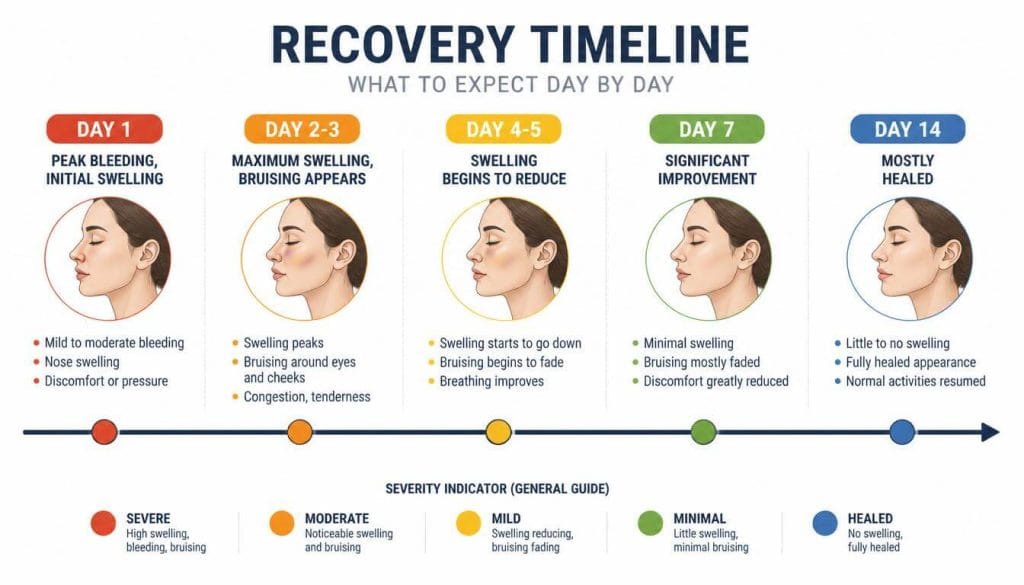
Swelling:
- Begins within hours of surgery
- Peaks at 48–72 hours post-procedure
- Begins reducing from day 4–5 onward
- Largely resolved by day 7–10 for most patients
- Applying ice packs (20 minutes on, 20 minutes off) during the first 24–48 hours significantly reduces peak swelling
Bruising:
- Often doesn’t appear until day 2–3 as blood tracks through tissue planes
- May appear on the jaw, cheek, and sometimes the neck
- Color progresses from purple/red to yellow/green as it resolves
- Typically fully resolved by day 10–14
Trismus (Limited Mouth Opening):
- Common after lower impacted extractions, particularly those close to the masseter muscle
- May limit mouth opening to 2–3 finger widths in the first 3–5 days
- Gradually improves as inflammation reduces
- Gentle jaw exercises from day 3–4 (as advised by your surgeon) help recovery
- Most patients return to normal mouth opening within 10–14 days
Increased Dry Socket Risk and How to Prevent It
Dry socket — the dislodgement or failure of the protective blood clot in the extraction socket — is the most common complication after wisdom tooth extraction. The risk is significantly higher after surgical impacted extraction compared to simple extraction, for several reasons:
- Larger surgical wound takes longer to clot and stabilize
- Bone exposure during surgery can impair clot adhesion
- Longer procedure time means more tissue disruption
- Lower impacted sites are more prone to dry socket than upper teeth
Dry socket risk factors:
- Smoking or tobacco use (the most significant risk factor)
- Oral contraceptive use (affects clotting factors — discuss timing with your surgeon)
- Poor oral hygiene before surgery
- Drinking through straws (suction dislodges clots)
- Vigorous rinsing in the first 24 hours
- Physical exertion increasing blood pressure
Prevention protocol:
- ✅ No straws for minimum 72 hours — ideally one full week
- ✅ No smoking for at least 72 hours — ideally longer
- ✅ No vigorous rinsing for 24 hours — gentle salt water rinse from day 2
- ✅ Avoid hard, crunchy, or small-particle foods near the socket
- ✅ Sleep with head elevated to reduce blood pressure at the site
- ✅ Take prescribed medications as directed
Dry socket presents as a sudden onset of severe, throbbing pain 2–4 days after surgery — often after a period of initial improvement. If this happens, contact your oral surgeon promptly — it’s treated easily with a medicated dressing in the socket but should not be left untreated.
Do All Impacted Wisdom Teeth Need Removing?
The short answer is no — not all impacted wisdom teeth require extraction. But the decision requires careful professional assessment and cannot be made based on symptoms alone.
Cases Where Monitoring Is Appropriate
Some impacted wisdom teeth can be monitored rather than immediately extracted:
Fully asymptomatic, fully impacted teeth — with no sign of cyst formation, adjacent tooth damage, or infection — can sometimes be monitored with regular radiographic review (typically every 1–2 years). This is more commonly appropriate for older patients where surgery carries higher risk.
Vertical impactions with adequate space — where the tooth is simply slow to erupt but on a correct trajectory — may be given time to emerge naturally, particularly in younger patients.
High surgical risk patients — where the proximity of the impacted tooth to the inferior alveolar nerve, or general health factors, makes the risk of surgical complications outweigh the risk of leaving the tooth in place.
However — and this is important — monitoring is not a permanent solution. It’s a watch-and-wait approach that requires genuine follow-through on regular radiographic review. An asymptomatic impacted tooth that develops a cyst or causes root resorption without being detected on scheduled X-rays is not being adequately monitored.
Questions to Ask Your Oral Surgeon
Going into your consultation prepared makes a significant difference. Here are the key questions worth asking:
About your specific impaction:
- What type of impaction do I have — and what does that mean for the complexity of surgery?
- Is my tooth fully or partially impacted?
- Is my inferior alveolar nerve close to the tooth roots?
- Are there any signs of cyst formation or damage to the adjacent molar?
About the procedure:
- What anesthesia options do you recommend for my case?
- Will the tooth need to be sectioned?
- Will I need sutures — and are they dissolvable?
- How long do you anticipate the procedure taking?
About risks specific to my case:
- What is my individual risk for nerve involvement or paresthesia?
- Is there any reason to delay or avoid extraction?
- What happens if I choose to monitor rather than extract?
About recovery:
- How long should I take off work or school?
- What pain management protocol do you recommend?
- When can I return to exercise?
A good oral surgeon will welcome these questions — and their answers will tell you a great deal about their thoroughness and communication style before you commit to the procedure.
Conclusion
Impacted wisdom tooth extraction is a genuinely well-understood procedure — performed millions of times every year with predictable outcomes for the vast majority of patients.
Yes, it’s more involved than a simple extraction. Yes, the recovery requires patience and preparation. But with the right oral surgeon, the right anesthesia approach for your anxiety level, and genuine understanding of what to expect at every stage — it’s an entirely manageable experience.
The most important thing you can do is go into it informed. Know your impaction type. Ask your questions at the consultation. Prepare your recovery supplies in advance. Follow post-operative instructions precisely — especially in the first 72 hours when the foundations of your healing are being laid.
You’ll be on the other side of it faster than you expect.
Planning your recovery? Our complete wisdom teeth recovery guide and guide on foods to eat after wisdom teeth removal have everything you need to prepare for a smooth, well-nourished healing process.
Frequently Asked Questions
Q: What is an impacted wisdom tooth extraction?
An impacted wisdom tooth extraction is a surgical procedure to remove a wisdom tooth that cannot fully emerge through the gumline due to insufficient space, incorrect angulation, or obstruction by the adjacent molar. Unlike a simple extraction of a fully erupted tooth, surgical impacted extraction requires incision through gum tissue, removal of overlying bone, and often sectioning of the tooth into pieces for removal. It is performed under local anesthesia, typically with sedation options available.
Q: How long does recovery from impacted wisdom tooth removal take?
Most patients feel significantly better within 5–7 days of impacted wisdom tooth extraction, with major swelling and discomfort resolving in that window. Full soft tissue healing typically takes 2–3 weeks. Complete bone healing of the socket takes 3–6 months, though this is not felt by the patient. Recovery from impacted extraction is meaningfully longer than simple extraction due to the larger surgical wound and associated tissue disruption.
Q: What are the four types of wisdom tooth impaction?
The four types of wisdom tooth impaction are mesial (tooth angled forward toward the adjacent molar — the most common type), distal (tooth angled backward away from the molar), vertical (tooth upright but unable to erupt due to insufficient space), and horizontal (tooth growing completely sideways into the adjacent molar root — the most complex type requiring the most extensive surgical procedure to remove).
Q: Is impacted wisdom tooth surgery painful?
The procedure itself should not be painful — local anesthesia eliminates sharp pain, though pressure and vibration sensations are normal and expected. With IV sedation, most patients have little or no memory of the procedure. Post-operative pain is managed with prescribed pain medication and anti-inflammatories like ibuprofen. Pain typically peaks in the first 48–72 hours and steadily improves from day 3–4 onward. Sudden severe pain after a period of improvement may indicate dry socket and should be reported to your surgeon.
Q: Do all impacted wisdom teeth need to be removed?
No — not all impacted wisdom teeth require extraction. Fully asymptomatic, fully impacted teeth with no evidence of cyst formation, infection, or adjacent tooth damage may be monitored with regular radiographic review. However, symptomatic impacted teeth, those showing signs of infection (pericoronitis), evidence of adjacent molar damage, or cyst formation typically require extraction. The decision should be made in consultation with an experienced oral surgeon based on current radiographic findings and clinical examination.
Looking for dental care options? Call to discuss the advertised dental service.
Call Now