
Updated November 12, 2026
Quick answer
If your oral surgeon has mentioned a bone graft alongside your wisdom tooth removal, you probably have questions — starting with "wait, what?" It sounds like a much bigger deal than having a tooth pulled. Here is the reassuring part first: a bone graft is a small, routine addition to the surgery, not a second …
If your oral surgeon has mentioned a bone graft alongside your wisdom tooth removal, you probably have questions — starting with “wait, what?” It sounds like a much bigger deal than having a tooth pulled.
Here is the reassuring part first: a bone graft is a small, routine addition to the surgery, not a second operation. It takes a few extra minutes, it is done while you are already numb or asleep, and it helps the jaw heal stronger. Most people who have a wisdom tooth out never need one at all.
What a Bone Graft Actually Is
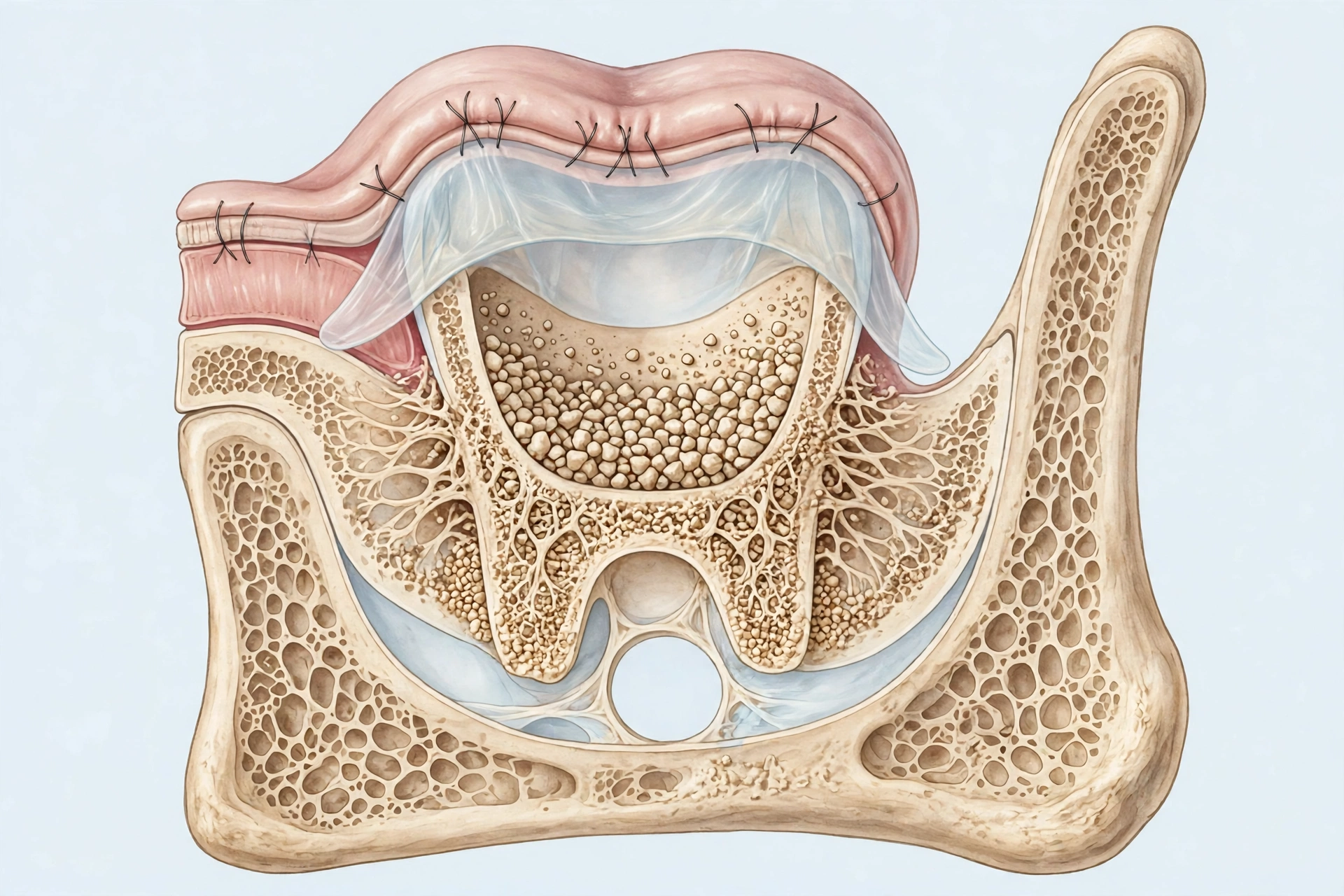
When a tooth is removed, it leaves a hole in the jawbone — the socket. Normally that socket fills in on its own over the following weeks and months. A bone graft is simply a small amount of grafting material placed into that socket at the time of the extraction, to support healing.
The material itself is usually not what people imagine. It is not a chunk of bone taken from somewhere else in your body. In most wisdom tooth cases, the surgeon uses processed bone granules — from a processed donor source or a synthetic scaffold material. Your own bone grows into the granules, and over time they are gradually replaced by your own living bone. Think of it like scaffolding: the graft holds the space and gives new bone something to grow on. The socket is then usually stitched closed over the top, which helps keep the graft in place while it settles.
When Is a Bone Graft Needed?
A graft is not routine. Your surgeon will usually recommend one when the extraction leaves a defect that may not heal well on its own:
The tooth was deeply impacted. A wisdom tooth buried deep in the jaw, or lying sideways, often needs a fair amount of surrounding bone removed just to get it out, leaving a large socket. A graft helps fill the gap and supports the neighbouring tooth.
The neighbouring tooth is at risk. If the wisdom tooth was leaning against the second molar, removing it can leave the back of that molar with less bone supporting it. The gum can sink into the gap and the molar can become loose over time. A graft preserves the bone around it.
You are older. Bone heals more slowly with age. In younger patients, sockets usually fill in quickly on their own; after your thirties or forties, the same defect may heal less completely, so a graft is more often suggested.
There was infection or a cyst. If infection or a cyst had already eaten away bone around the tooth, the socket may be larger than usual, and a graft can help restore the area.
Future dental work is planned. If you might one day need an implant there, keeping the bone volume now makes that far easier later — implants need solid bone to anchor into.
When a Graft Is Probably Not Needed
Most wisdom tooth removals fall into this group:
| Situation | Graft usually needed? |
|---|---|
| Young adult, straightforward extraction, healthy bone | No |
| Small socket, no damage to neighbouring tooth | No |
| Upper wisdom tooth with plenty of bone around it | Rarely |
| Deep impaction with a large bony defect | Often yes |
| Bone loss behind the second molar | Often yes |
| Implant planned for that spot in future | Often yes |
If your surgeon has not mentioned a graft, that is usually a good sign — the socket is expected to heal well on its own. It is not worth requesting “just in case”: an unnecessary graft adds cost and healing time for no benefit.
What Happens on the Day
From your side, almost nothing changes. The graft is placed during the same appointment, under the same anaesthetic, and adds only a few minutes. You will not feel it being done.
After the tooth is out and the socket is cleaned, the surgeon places the grafting granules into the socket, sometimes with a thin dissolvable membrane over the top, and stitches the gum closed. The stitches are usually the dissolving kind.
Aftercare is the same as for any extraction. Do not disturb the area, and expect the socket to feel slightly “fuller” for the first week or two. A few tiny white granules escaping in the first days is normal and does not mean the graft has failed. If a large amount comes out, or the socket looks open, call your surgeon.
Recovery: What Is Different?
Recovery with a bone graft is much like recovery without one, with a few differences.
Swelling and soreness may be slightly more noticeable for the first few days, because the surgery itself was a little more involved. This is usually manageable with the pain relief your surgeon recommends — paracetamol, which is the same medicine as acetaminophen, sold as Tylenol in some countries, is commonly part of the plan. Take medicines only as directed, and check labels so you do not double up.
Healing takes a little longer: a normal socket fills with bone over a few months, and a grafted socket follows the same timeline, sometimes a touch slower at the start. Your surgeon will usually want a follow-up, and may take an X-ray after a few months to check the bone is filling in well.
The rules that protect any extraction socket matter even more here: no smoking or vaping, no drinking through a straw, no vigorous rinsing on the first day, and soft foods while the gum is tender. The graft needs a calm, undisturbed socket.
Most people are back to normal daily life in about the same time as after a standard extraction — a few days of taking it easy, then a gradual return to normal eating. The deep bone healing continues quietly for months. Our guide on how long wisdom teeth recovery takes gives a realistic week-by-week picture.
Cost, and Questions Worth Asking
A bone graft adds to the cost. How much depends on the material, whether one socket or several need grafting, and your location. Insurance sometimes covers grafting when it is medically necessary, but coverage varies widely, so check before the day.
Before you agree, these questions are worth asking your surgeon:
- Why do I need a graft — what did the X-ray show?
- What material will be used, and why that one?
- What is the total cost, and does my insurance cover any of it?
- What happens if I choose not to have the graft?
That last question matters. Saying no is always an option, and your surgeon should be able to explain what changes without it — usually a slower fill of the socket and more bone loss behind the neighbouring molar.
Frequently Asked Questions
Does a bone graft hurt?
The graft is placed while you are numb or asleep, so you do not feel it. Afterwards, soreness is similar to a normal extraction, sometimes slightly more for the first few days.
How long does a bone graft take to heal?
The gum usually closes within a couple of weeks. The bone underneath takes months to fully mature — typically three to six months before it is solid on an X-ray.
Can a bone graft fail?
Grafts can fail, though it is uncommon in a clean, undisturbed socket. Infection, smoking, or disturbing the socket raise the risk. Worsening pain, swelling that increases after the first few days, a bad taste, or discharge are reasons to call your surgeon promptly.
Will I feel the graft material in my mouth?
Most people do not — the granules are small and buried under the gum. Some notice a slightly firm feeling in the socket for a week or two, and occasionally a few tiny granules escape in the first days. Both are normal.
Is a bone graft the same as a dental implant?
No. A graft rebuilds bone in the empty socket; an implant is a titanium post placed into healed bone to replace a missing tooth. A graft is sometimes done so an implant can be placed later, but they are separate procedures.
Do I need a bone graft if my wisdom tooth was not impacted?
Usually not. Straightforward extractions in healthy bone normally heal well on their own.
The Bottom Line
A bone graft is a small addition to the surgery that helps the jaw heal stronger when the socket is large, the neighbouring tooth needs support, or future dental work is planned. Most people never need one — a healthy socket heals on its own. Then follow the aftercare closely: keep the socket calm and clean, and go to your follow-ups.