
Updated November 12, 2026
Quick answer
You had your wisdom tooth out, and instead of getting steadily better, things have gone the other way: more pain than two days ago, swelling that is growing, a bad taste that will not go away, or a fever you cannot shake. This article covers the treatment itself: what your dentist does at the appointment, …
You had your wisdom tooth out, and instead of getting steadily better, things have gone the other way: more pain than two days ago, swelling that is growing, a bad taste that will not go away, or a fever you cannot shake.
This article covers the treatment itself: what your dentist does at the appointment, when antibiotics help and when they do not, and what drainage involves. (For the warning signs, see our guide to the signs of infection after wisdom teeth removal.)
First Things First: Get Seen, Don’t Wait It Out
The single most important step is also the simplest: call your dentist or oral surgeon promptly and get examined. An infection in the mouth does not reliably clear up on its own — do not manage it with leftover antibiotics or tablets borrowed from someone else. Those can mask symptoms.
When you call, describe it plainly: when the extraction took place, your symptoms, whether they are getting worse, and whether you have a fever or discharge. That is enough for the dental team to judge urgency — most practices will fit a suspected infection in the same day or the next. Trouble breathing or swallowing, or swelling spreading rapidly into your neck, is emergency care.
While you wait, rinse gently with warm salt water if advised, take pain relief as directed, and do not poke or squeeze the socket — trying to drain it yourself risks pushing bacteria deeper.
What Happens at the Appointment
A typical appointment for a suspected infection goes roughly like this:
- Examination and questions. Your dentist will look at the socket and gum, feel the jaw and neck for tender glands or spreading swelling, and check your temperature. They will ask when symptoms started and what medicines you took.
- X-ray, if needed. Sometimes an X-ray is taken to check for a tooth or bone fragment, or spread into the surrounding bone. Not every infection needs one.
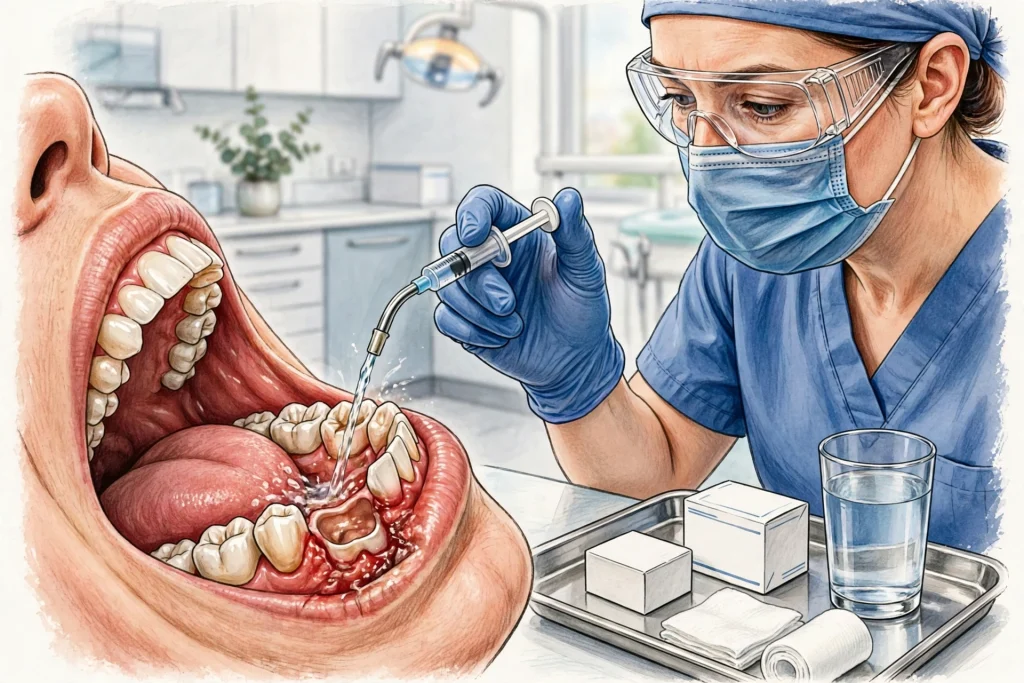
- Cleaning the socket. Often the first treatment is local: the dentist gently cleans out the socket, flushing away debris, trapped food, and infected material with a sterile solution. This alone often brings rapid relief, because it removes the source of the problem.
- Drainage, if there is a collection of pus. If an abscess has formed — a pocket of pus under the gum — it needs draining. The dentist makes a small opening so the pus can escape, and may place a tiny drain so it keeps draining. It is done under local anaesthetic and usually brings quick relief from the pressure and throbbing pain.
- Antibiotics, when appropriate. After the local treatment, your dentist will decide whether antibiotics are needed. They are not automatic — that decision is covered below.
- A plan for follow-up. Before you leave, you should know what to expect, what to do if symptoms worsen, and when to come back.
Antibiotics: What They Do and Don’t Do
Antibiotics are the part most people ask about, and the most misunderstood.
Antibiotics kill or slow the bacteria causing an infection, and they can be essential when it is spreading, when you have a fever, or when it is moving beyond the socket into the cheek, jaw, or neck. Your dentist will usually prescribe a course and tell you to finish it exactly as directed, even if you feel better after a couple of days — stopping early can let the infection come back.
But antibiotics have real limits. They cannot drain a pocket of pus — no tablet can. If there is an abscess, it has to be opened and drained. They also cannot remove trapped debris or a tooth fragment in the socket. That is why local cleaning and drainage come first, and antibiotics support that treatment rather than replacing it.
Antibiotics are also not needed for every post-extraction problem. A dry socket is a healing problem rather than an infection, usually treated with a dressing in the socket. Our guide to dry socket — what it is and what to do immediately explains the difference — the two feel similar but are treated differently.
Take antibiotics only if they were prescribed for you, for this problem. Never take leftover antibiotics or someone else’s prescription, and never stop a course without speaking to the prescriber first. Tell your dentist about any antibiotics you have taken recently, and any allergies.
Drainage and Cleaning: The Part That Actually Fixes It
When pus collects in a closed space, pressure builds — and that pressure causes much of the throbbing pain. Opening the collection releases it, lets the infected material out, and allows healing to start. Relief is often noticeable within hours, not days.
After numbing the area, the dentist makes a small incision or opens the socket, flushes it with a sterile solution, and lets it drain. Sometimes a small rubber drain is left in for a day or two to keep the opening from sealing over too soon. Do not attempt drainage at home: squeezing a swollen cheek or gum can push infection into deeper tissues, including the spaces around the jaw and neck, where it becomes far more serious.
The Days After Treatment: What to Expect
Treatment is the turning point, but healing still takes a few days:
Day 1: Pain and pressure often ease noticeably once the socket has been cleaned or drained, though the area will still be sore. Some oozing is normal.
Days 2–3: Swelling should start to settle and the bad taste should fade. Keep taking any prescribed antibiotics. Eat soft foods, drink plenty of fluids, and avoid smoking or vaping.
Days 4–7: Most people feel substantially better by now — the socket cleaner, the gum less red, the pain mostly gone. A drain, if placed, is usually removed around this time.
After a week: If all has gone well, the infection should be resolved and normal healing takes over. A follow-up visit is common.
The key word is “gradually improving.” A single bad hour does not mean the treatment failed — but a pattern of getting worse needs another look.
When to Go Back
Go back to your dentist promptly — the same day if you can — if:
- Pain that was improving starts getting worse again
- Swelling increases after it had started to settle, or spreads towards the neck
- Fever returns or does not settle
- Pus or discharge continues or increases after a few days of treatment
- You cannot open your mouth as wide, or swallowing becomes difficult
- The antibiotics cause a rash or severe stomach upset
Seek emergency care straight away for trouble breathing, significant difficulty swallowing, swelling spreading rapidly into the neck or floor of the mouth, or a high fever with feeling very unwell — rare, but hours matter.
Go back too if you simply feel something is not right, even if you cannot name it. A quick check that finds nothing beats waiting on a problem that turns out to be real.
Frequently Asked Questions
How long does it take for antibiotics to work for a tooth infection?
Most people start to feel some improvement within a couple of days. If there is no improvement after a few days, or symptoms worsen, contact your dentist rather than waiting for the course to finish.
Can a wisdom tooth infection go away without antibiotics?
Some mild infections improve with local treatment alone — cleaning and drainage — without antibiotics. Others need them. Do not assume a suspected infection will resolve on its own.
Is drainage painful?
The area is numbed first, so it should not be painful, though you may feel pressure. Afterwards, the relief from the released pressure usually outweighs the soreness, which settles over a day or two.
Can I still eat and drink normally during treatment?
Soft foods and plenty of fluids are best for the first few days. Avoid alcohol-based mouthwash, very hot foods, and chewing on the affected side.
What if the infection keeps coming back?
A recurring infection usually means something is still driving it — a fragment in the socket or a pocket that is not draining. Your dentist may take an X-ray or refer you to an oral surgeon.
Do I need to see a specialist?
Most are treated by your own dentist or oral surgeon. A referral is more likely if the infection is severe, spreading, or not responding to treatment.
The Bottom Line
Treatment is usually straightforward: get seen promptly, let the dentist clean and drain the socket, take antibiotics only if prescribed for this problem, and follow the aftercare. The local treatment is what actually clears the infection; antibiotics support it, they do not replace it. Healing should then improve steadily; if it does not, or if pain, swelling, or fever come back, go back promptly.