
Updated November 15, 2026
Quick answer
Causes of Impacted Wisdom Teeth: Why They Get Stuck and What Happens Next By Dr. Sarah Mitchell, BDS, MSc | PerfectWisdomTeeth.com Your wisdom teeth are the last teeth to arrive — and for millions of people, they never fully make it. Instead of erupting cleanly into position, they get stuck. They grow sideways. They press …
Causes of Impacted Wisdom Teeth: Why They Get Stuck and What Happens Next
By Dr. Sarah Mitchell, BDS, MSc | PerfectWisdomTeeth.com
Your wisdom teeth are the last teeth to arrive — and for millions of people, they never fully make it.
Instead of erupting cleanly into position, they get stuck. They grow sideways. They press into adjacent teeth. They sit trapped beneath the gum, causing pain that radiates to the jaw, ear, and temple for no obviously visible reason.
This is impaction — and it’s far more common than most people realise. But why does it happen in the first place? Why do some people’s wisdom teeth come through perfectly while others face extraction, infection, and years of recurring problems?
The answer lies in a combination of jaw anatomy, genetics, and evolutionary biology that most dental content skips right over. Let’s get into it.
Quick Answer: What Causes Impacted Wisdom Teeth?
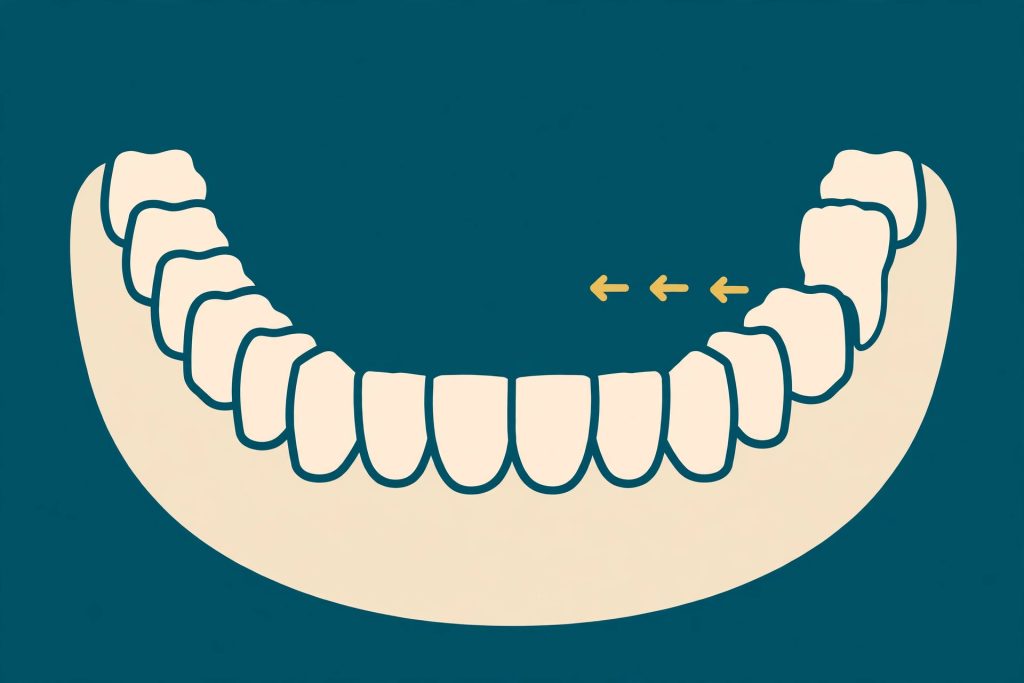
Impacted wisdom teeth occur when there is insufficient space in the jaw for the tooth to erupt fully and correctly into position. The most common cause is a jaw that is too small relative to the size of the wisdom tooth — a mismatch influenced by genetics, modern diet, and evolutionary changes in human skull structure. The tooth becomes impacted when it cannot complete its eruption path, resulting in it growing at an angle, remaining partially submerged, or becoming completely trapped in bone.
The Root Cause: Jaw Size vs. Tooth Size
The single most fundamental cause of wisdom tooth impaction is a mismatch between the size of your jaw and the size of your third molars.
Your wisdom teeth are the same size as any other molar — substantial teeth designed for grinding food. But if your jaw doesn’t have adequate space at the back to accommodate them, there’s simply nowhere for them to go.
This isn’t a defect. It’s actually a relatively recent evolutionary development.
The Evolutionary Story Behind Impaction
Our ancient ancestors had significantly larger jaws — necessary for processing the tough, uncooked, fibrous diets that required sustained grinding. As human diets changed over thousands of years (softer foods, cooking, less jaw-intensive eating), jaw size gradually reduced through evolutionary pressure.
But here’s the problem: our teeth didn’t shrink at the same rate as our jaws. The wisdom teeth that were once perfectly accommodated in a larger jaw now frequently find themselves arriving to a party where there’s no space left.
This is why wisdom tooth impaction — virtually unknown in some hunter-gatherer populations with more jaw-intensive diets — is now one of the most common dental issues in modern populations.
Genetic Factors: Why It Runs in Families
If one of your parents had impacted wisdom teeth, your risk is meaningfully higher.
Jaw size and tooth size are both largely genetically determined. What you inherit from your parents includes the architectural proportions of your skull and jaw — and sometimes those proportions simply don’t accommodate third molars well.
In my experience, patients who mention their parents both had wisdom teeth removed almost always end up in the same position. It’s not inevitable — but it’s a reliable predictor worth knowing about.
Genetics also influence:
- The angle at which wisdom teeth develop in the bone
- The thickness of overlying bone and gum tissue
- The timing of eruption relative to how developed the jaw is
- Whether wisdom teeth form at all (some people are simply born without them)
💡 Tip Box: If you’re a parent with a history of impacted wisdom teeth, mention it to your child’s dentist when they’re around 14–16. Early X-ray assessment of developing wisdom teeth at this stage gives time to plan and potentially avoid more complex interventions later.
The Types of Impaction — And Why Each Happens
Not all impactions are the same. The direction the tooth is trying to grow tells a story about how and why it became stuck.
Mesial Impaction (Most Common)
The tooth angles forward — toward the front of the mouth — pressing into the root of the second molar in front of it.
Why it happens: This is the most common impaction type, occurring when the tooth begins erupting at an angle rather than straight up, often because it’s trying to follow the curve of the jaw but doesn’t have enough space to complete the rotation.
The risk it creates: Prolonged pressure against the adjacent molar can damage that tooth’s root — sometimes causing significant harm to a perfectly healthy second molar.
Horizontal Impaction (Most Severe)
The tooth lies completely on its side — essentially pointing horizontally rather than vertically, pressing directly into the root of the adjacent tooth.
Why it happens: Extreme space limitation in the jaw, or an unusual angle of tooth development, leaves the tooth no upward pathway at all.
The risk it creates: This is often the most painful impaction type and carries the highest risk of adjacent tooth damage. It almost always requires surgical extraction.
Vertical Impaction
The tooth is correctly oriented — growing straight up — but simply can’t break through the gum or bone because there isn’t enough space.
Why it happens: The tooth’s eruptive path is correct, but the jaw has run out of room before the tooth can fully emerge. The tooth may be partially visible or completely submerged.
What it means: Vertical impaction is sometimes asymptomatic and may be monitored rather than immediately extracted, particularly if the tooth isn’t pressing on adjacent structures.
Distal Impaction (Least Common)
The tooth angles backward — away from the other teeth — toward the back of the jaw.
Why it happens: Less common and not entirely understood, but may relate to the angle of tooth development in the bone, or the slope of the posterior jaw.
Partially Erupted Wisdom Teeth: A Problem in Their Own Right
Some wisdom teeth don’t become fully impacted — they partially erupt, with just a portion of the crown breaking through the gum surface while the rest remains covered.
This creates a specific problem that fully impacted teeth don’t have.
The partially erupted tooth creates a gum flap — called an operculum — that covers part of the tooth and creates a pocket that is virtually impossible to clean properly. Food and bacteria accumulate under this flap, leading to a condition called pericoronitis: inflammation and infection of the tissue surrounding the partially erupted tooth.
This is one of the most common reasons people end up seeking emergency dental care in their late teens and early twenties — the recurring cycle of pericoronitis infection that comes with a partially erupted lower wisdom tooth.
If you’ve been experiencing recurring pain, swelling, or a bad taste at the back of your mouth, this may be exactly what’s happening. My guide on early signs your wisdom teeth are attacking covers the warning signs that something more than normal eruption discomfort is going on.
Other Contributing Factors Beyond Jaw Size
While the jaw-to-tooth-size mismatch is the primary cause, several other factors influence whether and how a wisdom tooth becomes impacted.
Timing of Eruption
Wisdom teeth typically begin their eruption journey between ages 17 and 25 — but the jaw has usually finished growing by the mid-teens. This means wisdom teeth arrive after the jaw’s growth plates have closed, leaving no flexibility for the jaw to adapt or expand to accommodate the incoming teeth.
Earlier developing wisdom teeth (some begin erupting at 16–17) sometimes have a better chance of finding space simply because the jaw may still have some remaining growth. Later-developing ones face a fully formed, fixed jaw.
Dense Overlying Bone
In some people, the bone overlying the developing wisdom tooth is thicker or denser than average — physically preventing the tooth from breaking through even when there might technically be space.
This is more common in the lower jaw (mandible), where bone tends to be denser than in the upper jaw. It partly explains why lower wisdom teeth are impacted more frequently and more severely than upper ones.
Soft Tissue Resistance
Even when bone isn’t the barrier, dense gum tissue can resist eruption. Some patients have thicker, less yielding gingival tissue that doesn’t yield easily to an erupting tooth — slowing or halting the eruption process.
Abnormal Tooth Development
Occasionally, the wisdom tooth itself develops abnormally — an unusual shape, size, or root curvature that prevents normal eruption even in a jaw with adequate space.
Dilacerated roots (roots that curve sharply) are one example — the unusual root form can anchor the tooth in bone in a way that prevents normal upward movement.
Why Lower Wisdom Teeth Are More Commonly Impacted
If you’re experiencing wisdom tooth problems, statistically it’s more likely in your lower jaw — and there are specific anatomical reasons for this.
The mandibular angle: The lower jaw curves at the back in a way that reduces available space for the lower third molars more significantly than the upper jaw does.
Denser bone: Lower jaw bone is generally denser, making eruption more physically demanding for the tooth.
Less room to maneuver: The geometry of the lower jaw simply leaves less margin for a wisdom tooth to find its way into correct position.
Upper wisdom teeth, while certainly also impacted in many patients, tend to have a slightly better success rate at erupting due to the more favorable bone density and jaw geometry of the maxilla.
When Impaction Leads to Complications
Understanding the causes of impaction matters because impacted wisdom teeth don’t always stay quietly in position. Left unmonitored, they can create a cascade of problems:
Damage to adjacent teeth: Particularly mesial and horizontal impactions pressing continuously against the second molar’s root — a risk that increases with time.
Cyst formation: A dental follicle (sac) surrounds every developing wisdom tooth. When a tooth remains impacted, this follicle can occasionally expand into a dentigerous cyst — a fluid-filled sac that can gradually enlarge and damage surrounding bone.
Recurring infection: As covered above, partially erupted teeth create ongoing pericoronitis risk. For a full breakdown of what wisdom tooth infection looks like and when it becomes serious, my guide on wisdom tooth infection swelling covers the escalation signs you need to know.
Crowding effects: While the evidence on wisdom teeth directly causing front tooth crowding is somewhat contested, pressure from impacted teeth can contribute to shifting of adjacent teeth in some cases.
Should Every Impacted Wisdom Tooth Be Removed?
Not necessarily — and this is an important nuance that gets lost in blanket “just get them out” advice.
Some impacted wisdom teeth remain completely asymptomatic for years or decades, causing no damage and requiring only periodic monitoring with X-rays. The decision to extract should be based on:
- Whether the impaction is causing active symptoms (pain, infection, swelling)
- Whether it’s pressing on or damaging adjacent teeth
- Whether a cyst or other pathology is developing
- The patient’s age and overall health
- The surgical complexity and risk of the extraction itself
In my experience, the patients who benefit most from proactive early extraction are those in their late teens or early twenties — before roots are fully formed, before complications develop, and when the bone is more flexible. Waiting until significant symptoms develop often means a more complex surgical situation.
For a clear picture of what the extraction and recovery process actually involves, my complete wisdom tooth extraction guide walks through everything from assessment to recovery.
Conclusion: Impaction Is Common — But Not Inevitable to Ignore
Impacted wisdom teeth are the product of a mismatch between modern jaw size and ancestral tooth size — a genuine evolutionary quirk that affects a significant proportion of the population.
Understanding why they become impacted helps you take the right steps at the right time — whether that’s early X-ray monitoring in your teens, proactive extraction before complications develop, or simply understanding the symptoms that signal something needs attention.
If you’re noticing jaw aching, recurring gum swelling, or pressure at the back of your mouth, don’t write it off as stress. Your wisdom teeth may be trying to tell you something worth listening to.
Frequently Asked Questions
Q: What is the most common cause of impacted wisdom teeth? The most common cause is insufficient space in the jaw for the wisdom tooth to erupt fully. This jaw-to-tooth-size mismatch is largely genetic and has become increasingly common as modern human jaws have evolved to be smaller while tooth size has remained relatively unchanged.
Q: Why do wisdom teeth grow sideways? Wisdom teeth grow sideways — a mesial or horizontal impaction — when there is no clear upward eruption path due to space limitation. The tooth angles in the direction of least resistance, often pressing into the adjacent second molar. The specific angle depends on how the tooth originally developed in the bone and the geometry of the surrounding jaw.
Q: Can impacted wisdom teeth cause problems even without pain? Yes — some impacted wisdom teeth cause no immediate pain but can silently damage adjacent tooth roots, develop cysts, or create ongoing infection risk. This is why regular dental X-rays are recommended even for asymptomatic patients, particularly during the late teens and early twenties when wisdom teeth are most actively developing.
Q: Are impacted wisdom teeth genetic? Strongly so. Both jaw size and tooth size are largely determined by genetics, and patterns of impaction tend to run in families. Having parents who required wisdom tooth extraction is a meaningful predictor of your own risk, though not a certainty.
Q: At what age do wisdom teeth typically become impacted? Most wisdom tooth impaction becomes clinically apparent between ages 17 and 25, when the teeth attempt to erupt. However, the developmental position of wisdom teeth in the bone — which determines whether impaction will occur — can often be seen on X-ray from age 14–16, which is why early monitoring is valuable.
Article by Dr. Sarah Mitchell, BDS, MSc — Lead Writer, PerfectWisdomTeeth.com