
Updated November 15, 2026
Quick answer
Types of Impacted Wisdom Teeth: Which Position Do You Have? By Dr. Sarah Mitchell, BDS, MSc | PerfectWisdomTeeth.com Your dentist shows you an X-ray and points to your wisdom tooth. "It's impacted," they say — and then they use a word like mesial or horizontal that you immediately forget. You nod. You smile. You have …
Types of Impacted Wisdom Teeth: Which Position Do You Have?
By Dr. Sarah Mitchell, BDS, MSc | PerfectWisdomTeeth.com
Your dentist shows you an X-ray and points to your wisdom tooth. “It’s impacted,” they say — and then they use a word like mesial or horizontal that you immediately forget.
You nod. You smile. You have no idea what any of it means.
Here’s what you actually need to know: the type of impaction determines everything — how serious the situation is, what symptoms you’ll experience, how complex the extraction will be, and whether your surrounding teeth are at risk.
Not all impacted wisdom teeth are created equal. And understanding yours takes less than five minutes.
Quick Answer: What Are the Types of Impacted Wisdom Teeth?
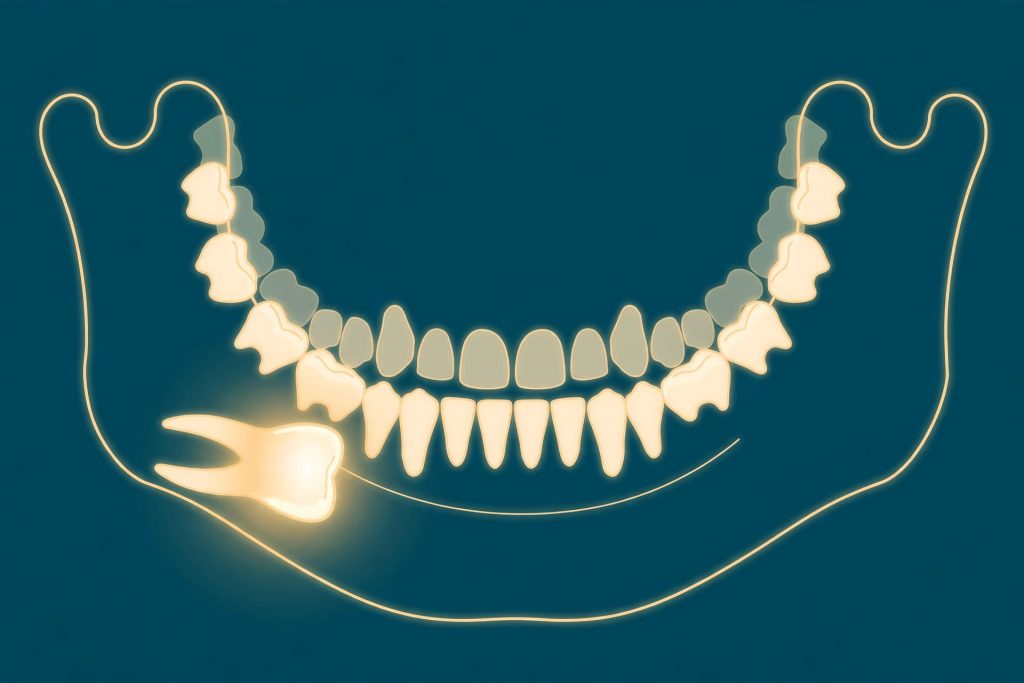
There are four main angular types of wisdom tooth impaction — mesial (angled forward), distal (angled backward), vertical (upright but stuck), and horizontal (lying completely sideways). Within each type, impaction is further classified as soft tissue (tooth blocked by gum only) or bony (tooth fully or partially surrounded by jawbone). The type of impaction directly influences symptoms, risks to adjacent teeth, and surgical complexity.
Why the Type of Impaction Matters
Before we get into each type, here’s why this classification actually matters for you — not just for your dentist.
Different impaction types carry different risks:
- Adjacent tooth damage — some angles press directly into the neighboring molar’s root
- Cyst development — certain impaction types are more associated with follicular cyst formation
- Extraction complexity — a horizontal tooth buried in bone requires surgical removal; a soft tissue impaction may be much simpler
- Symptom patterns — pain, swelling, and referred headaches vary depending on the direction of pressure
Knowing your type helps you have a more informed conversation with your oral surgeon — and understand why one person walks out of extraction in 20 minutes while another needs a referral to an oral surgeon.
Type 1: Mesial Impaction — The Most Common
Mesial impaction is by far the most frequently seen type — accounting for the majority of all wisdom tooth impactions.
What It Means
“Mesial” means toward the front of the mouth. In a mesial impaction, the wisdom tooth is angled forward — tilted toward the second molar in front of it — rather than growing straight up.
The degree of angulation varies significantly. Some mesial impactions are only slightly angled — perhaps 20–30 degrees off vertical. Others are nearly horizontal, angled at 60–80 degrees.
Why It’s Concerning
The forward tilt means the crown of the wisdom tooth is pressing — with the full eruptive force of a developing molar — directly against the root of the adjacent second molar.
Over time, this sustained pressure can cause:
- Root resorption of the second molar — where the adjacent tooth’s root is literally dissolved by the pressure
- Decay — where two teeth are pressed together, creating a space that traps food and bacteria and is impossible to clean
- Pain radiating from the back of the jaw forward toward the ear and temple
💡 Tip Box: Mesial impaction is sometimes called a “leaning” tooth — if you picture someone leaning their full body weight against a wall, that’s essentially what a mesially impacted wisdom tooth is doing to your second molar. The longer it leans, the more structural damage accumulates.
Type 2: Horizontal Impaction — The Most Severe
If mesial impaction is a tooth leaning, horizontal impaction is a tooth lying completely on its side.
What It Means
In a horizontal impaction, the wisdom tooth is rotated approximately 90 degrees from its correct position — pointing sideways rather than upward. Instead of trying to emerge through the gum, it’s pressing directly into the side of the adjacent tooth’s root.
On an X-ray, a horizontally impacted tooth looks striking — a tooth turned entirely sideways within the jaw, like someone lying down in a space meant for someone standing up.
Why It’s the Most Serious Type
Horizontal impaction almost always causes the most significant problems of any impaction type:
- Direct, sustained pressure on the adjacent root — the most aggressive form of pressure damage
- Almost invariably requires surgical extraction — there is no scenario where a horizontal tooth erupts normally
- Highest risk of nerve proximity — in the lower jaw, horizontally impacted wisdom teeth often sit very close to the inferior alveolar nerve, making extraction more technically complex
- Persistent pain — often causes chronic, deep jaw aching that’s hard to localize
If your dentist or oral surgeon uses the word “horizontal” when describing your impaction, know that extraction will almost certainly be recommended sooner rather than later — and that the procedure will likely be more involved than a simple extraction.
For what to expect when that extraction happens, my complete wisdom tooth extraction guide walks through every stage of the process.
Type 3: Vertical Impaction — The Deceptive One
Vertical impaction sounds like the best-case scenario — and sometimes it is. But it has its own complications worth understanding.
What It Means
In vertical impaction, the wisdom tooth is correctly oriented — growing straight up, the direction it’s supposed to go. The problem is that despite pointing in the right direction, it can’t complete its eruption because something is physically blocking it.
That blockage is either:
- Insufficient jaw space — the tooth runs out of room before it can fully emerge
- Dense overlying bone — the bone above the tooth is too thick for the tooth to push through
- Adjacent tooth in the way — the second molar is sitting in a position that blocks forward movement
Why It’s the “Deceptive” Type
Vertical impactions are sometimes asymptomatic — causing no obvious pain or swelling — making them easy to overlook until a routine X-ray reveals the tooth sitting just beneath the gum surface, going nowhere.
This absence of symptoms doesn’t mean absence of risk. A vertically impacted tooth:
- Can still contribute to cyst formation around its follicle
- Can cause pressure on adjacent teeth without pain
- Can become a pericoronitis risk if partially erupted through the gum
Some vertical impactions are monitored rather than immediately extracted — particularly if they’re fully submerged in bone, asymptomatic, and not pressing on adjacent structures. Others that are partially erupted need removal to prevent recurring infection.
Type 4: Distal Impaction — The Rare One
Distal impaction is the least common of the four types — and the one most people have never heard of.
What It Means
“Distal” means toward the back of the mouth. In distal impaction, the wisdom tooth angles away from the other teeth — tilting toward the back of the jaw rather than forward.
Because it’s tilting away from the second molar rather than toward it, distal impaction carries less adjacent tooth damage risk than mesial impaction. But it’s not without its own complications.
Why It Still Matters
A distally angled tooth may:
- Press against the posterior bone of the jaw
- Create an awkward eruption path that makes partial eruption (and pericoronitis) more likely
- Be more technically complex to extract depending on the ramus anatomy — the back section of the lower jaw
Distal impactions are often monitored closely but treated based on symptoms and progression rather than automatically extracted.
Soft Tissue vs. Bony Impaction: The Other Classification
Beyond the angular types, impaction is also classified by how the tooth is blocked — and this classification directly influences surgical complexity.
Soft Tissue Impaction
The tooth has fully penetrated through the bone — its crown has emerged past the jawbone — but is still partially or fully covered by gum tissue that it cannot push through.
Extraction complexity: Generally lower. The bone doesn’t need to be removed; the gum is the primary obstacle.
Symptom risk: Soft tissue impactions are the most common cause of pericoronitis — the gum flap creates a perfect bacterial trap. If you’re having recurring gum infections at the back of your mouth, a soft tissue impaction is a likely cause.
Partial Bony Impaction
The tooth has partially erupted through bone but remains partially surrounded by jawbone. It’s stuck — neither fully in the bone nor fully out of it.
Extraction complexity: Moderate to high. Some bone removal is typically required to free the tooth, plus sectioning (cutting the tooth into pieces) is often necessary.
Symptom risk: This type frequently causes ongoing pericoronitis, adjacent tooth pressure, and pain that comes and goes rather than being consistently severe.
Complete Bony Impaction
The tooth is entirely enclosed within the jawbone — nothing has emerged through either bone or gum.
Extraction complexity: Highest of all types. Significant bone removal is required, often with tooth sectioning. This is typically performed by an oral and maxillofacial surgeon rather than a general dentist.
Symptom risk: Paradoxically, completely bony impactions can be entirely asymptomatic — no pain, no swelling — making them easy to miss without routine X-rays. The risks (cyst formation, adjacent root pressure) accumulate silently.
What Your X-Ray Is Actually Showing
When your dentist takes an OPG (panoramic X-ray) — the wide-view X-ray that shows all four wisdom teeth simultaneously — here’s what they’re assessing for each tooth:
- Angular position — which of the four impaction types applies
- Depth in the bone — how much bone overlies the tooth
- Root formation — how developed the roots are (younger patients with less developed roots have easier extractions)
- Proximity to the inferior alveolar nerve — the nerve running through the lower jaw that supplies sensation to the lower lip, chin, and teeth
- Relationship to adjacent teeth — whether root damage to the second molar has already begun
- Follicular sac size — whether any cyst formation has started
Understanding what the X-ray is looking for helps explain why two people with “impacted wisdom teeth” can have very different conversations with their dentist afterward.
For the full picture of what happens after diagnosis — from symptoms to treatment options — my guide on shocking signs you’re ignoring impacted wisdom teeth covers the symptoms that often go unrecognised until problems are well established.
Which Type Is Most Likely to Need Immediate Removal?
Not every impacted wisdom tooth requires urgent action. Here’s a quick guide based on impaction type:
| Type | Urgency Level | Primary Concern |
|---|---|---|
| Horizontal | High — almost always extract | Adjacent root damage, nerve proximity |
| Mesial (severe) | High — extract before root damage | Second molar root resorption |
| Mesial (mild) | Monitor or extract | Depends on symptoms and progression |
| Partial bony (any type) | Moderate-High | Pericoronitis risk, adjacent pressure |
| Soft tissue | Moderate | Recurrent infection risk |
| Vertical (complete bony) | Monitor | Cyst risk, reassess regularly |
| Distal | Monitor or extract | Depends on symptoms |
The decision is never based on impaction type alone — your age, overall dental health, symptom history, and the specific anatomy of your case all factor in. This is a conversation to have with your dentist or oral surgeon with your X-rays in hand.
If the idea of that conversation — or the extraction itself — feels overwhelming, my guide on managing dental anxiety before wisdom tooth surgery offers practical strategies that genuinely help.
Conclusion: Know Your Type, Understand Your Options
The four types of impacted wisdom teeth — mesial, distal, vertical, and horizontal — aren’t just dental jargon. They’re a blueprint for understanding what’s happening in your jaw, what risks your specific impaction carries, and what treatment looks like.
Horizontal is the most serious. Mesial is the most common. Vertical is the most deceptive. Distal is the rarest.
Knowing which one you have — and whether it’s soft tissue, partial bony, or complete bony — puts you in the position to ask better questions, make more informed decisions, and understand why your dentist is recommending what they’re recommending.
The X-ray is your roadmap. Now you know how to read it.
Frequently Asked Questions
Q: What is the most common type of wisdom tooth impaction? Mesial impaction — where the wisdom tooth angles forward toward the second molar — is the most common type, accounting for the majority of all wisdom tooth impactions. It occurs when the tooth cannot complete its eruption and tilts forward as it tries to find space, pressing against the adjacent tooth’s root.
Q: Which type of impacted wisdom tooth is the most serious? Horizontal impaction is generally considered the most serious type. The tooth lies completely sideways, pressing directly into the root of the adjacent molar, and almost always requires surgical extraction. It carries the highest risk of adjacent tooth damage and the most surgical complexity, including potential proximity to the inferior alveolar nerve in the lower jaw.
Q: Can a vertically impacted wisdom tooth erupt on its own? Sometimes — a vertically impacted tooth is oriented correctly and may eventually erupt if sufficient space exists. However, many vertically impacted teeth remain stuck beneath the gum or bone indefinitely. Whether to monitor or extract depends on symptoms, depth in the bone, relationship to adjacent structures, and whether the tooth is causing any problems.
Q: What is the difference between soft tissue and bony impaction? Soft tissue impaction means the tooth has fully cleared the jawbone but remains blocked by overlying gum tissue — generally a less complex extraction. Bony impaction means the tooth is still fully or partially surrounded by jawbone — requiring bone removal during extraction, which increases surgical complexity and recovery time.
Q: How do I know what type of impaction I have? An OPG (panoramic dental X-ray) is the standard way to assess impaction type. Your dentist or oral surgeon will use this X-ray to identify the angular position of the tooth (mesial, distal, vertical, or horizontal), its depth in the bone, and its proximity to surrounding structures. If you haven’t had an OPG yet and are experiencing wisdom tooth symptoms, requesting one is the most important first step.
Article by Dr. Sarah Mitchell, BDS, MSc — Lead Writer, PerfectWisdomTeeth.com