
Updated November 12, 2026
Quick answer
You wake up from wisdom teeth surgery and half your chin feels like it belongs to someone else. Your lip is heavy, and when you sip water a little of it escapes without you noticing. The anaesthetic should have worn off hours ago — so why is everything still numb? Take a breath. Numbness after …
You wake up from wisdom teeth surgery and half your chin feels like it belongs to someone else. Your lip is heavy, and when you sip water a little of it escapes without you noticing. The anaesthetic should have worn off hours ago — so why is everything still numb?
Take a breath. Numbness after wisdom teeth removal is one of the most frightening-feeling complications, and also one of the most misunderstood. Most of the time it is temporary and gets better on its own over days or weeks. But it is worth understanding properly, because the difference between “normal and settling” and “needs a prompt call to your surgeon” matters.
Two Very Different Kinds of Numbness
Anaesthetic numbness is expected — it is the whole point of the injection — and it usually wears off within two to five hours. If you had sedation or general anaesthesia, you may feel groggy for the rest of the day. A good sign: feeling returns gradually, with tingling, a patch of lip waking up before the chin does.
Nerve numbness is different. It is still there the next morning, and the morning after that. It does not fade hour by hour the way anaesthetic does. It might cover your lower lip and chin on one side, or one side of your tongue, and it stays roughly the same from day to day. This is the numbness people mean when they talk about nerve damage, and it deserves a call to your surgeon — not panic, but a call.
| Anaesthetic numbness | Nerve-related numbness | |
|---|---|---|
| Lasts | A few hours | Days, weeks, sometimes longer |
| What to do | Wait, and be careful not to bite your cheek | Call your surgeon and describe it |
If you are still numb a full day after surgery, ring the practice — it is never a wasted call.
Which Nerves Are Involved — and Why Lower Teeth Carry the Risk
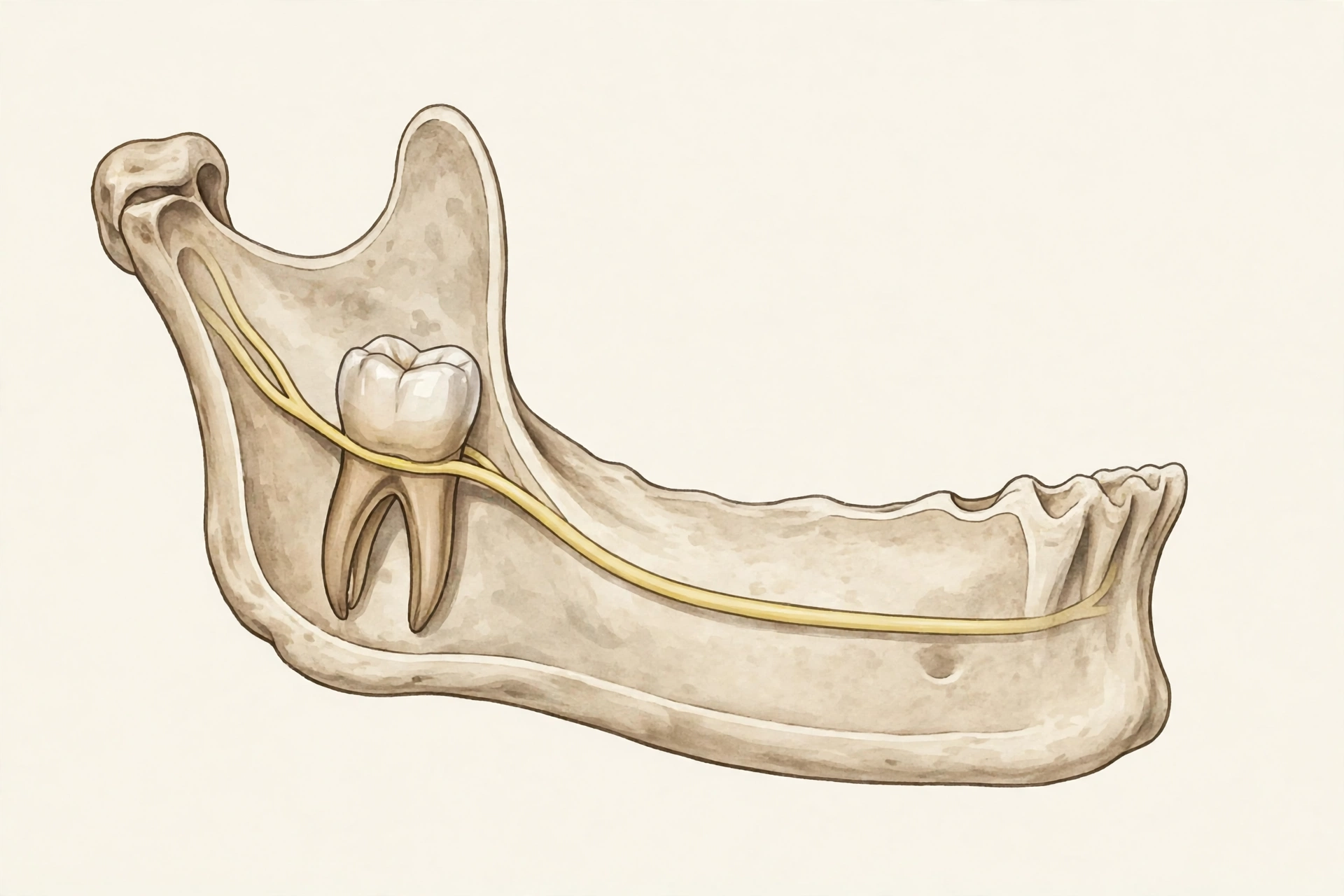
Your lower wisdom teeth sit uncomfortably close to a nerve called the inferior alveolar nerve. It runs through the lower jawbone, underneath the roots of the lower molars, and carries feeling from your lower lip, chin, and the skin over the side of your jaw. It does not control movement — you can still move your lip and speak normally — but it is why you can feel a crumb on your chin.
There is a second nerve worth knowing about: the lingual nerve. It runs along the inside of the lower jaw, close to the tongue side of the wisdom tooth, and gives feeling to one side of your tongue. If it is affected, food may taste strange on that side.
Upper wisdom teeth almost never cause this kind of numbness, because no major sensory nerve runs past their roots. That is why numbness is overwhelmingly a lower-teeth problem, and why your surgeon may have talked about nerve risk beforehand if your lower teeth were deeply impacted or their roots looked close to the nerve.
Why does the nerve get affected at all? Usually it is not cut — that is rare. More often it is bruised or stretched as the tooth comes out of a tight space, or pressed on by swelling afterwards. Sometimes the root sits wrapped around the nerve. Even a careful extraction can leave the nerve unhappy for a while, which is why surgeons take detailed X-rays or a 3D scan first when a lower tooth looks close to the nerve.
What Numbness Actually Feels Like
People describe it in surprisingly similar ways:
- A lower lip or chin that feels “asleep” — but does not wake up.
- Tingling, pins and needles, or a faint buzzing in the lip or tongue.
- A patch of skin that feels oddly thick or rubbery when you touch it.
- A change in taste on one side of the tongue, or food tasting flat and dull.
- Accidentally biting your cheek or lip while eating, because you cannot feel where your teeth are.
None of these mean you have done anything wrong. They are the normal signs of a sensory nerve recovering — and numbness often feels worse in the first few days, when swelling is at its peak. As swelling goes down, some people notice feeling start to creep back. That is a hopeful sign.
How Long Does It Usually Last?
This is the question everyone asks, and the honest answer is that it varies — but the pattern is fairly consistent.
Most nerve-related numbness improves within a few weeks, and for many people feeling is back to normal within one to three months. Tingling or pins and needles often appear first, and that is usually a good sign: the nerve is waking up.
For a smaller number it takes longer — six months, sometimes up to a year — with gradual improvement the whole time. Nerves heal slowly, so patience is genuinely part of the treatment.
A small minority are left with some permanent change in feeling. Permanent numbness after lower wisdom tooth removal is uncommon, but the risk is higher when the tooth was deeply impacted, when the roots were very close to or wrapped around the nerve, and when the patient is older. Your surgeon should have discussed your personal risk before the operation. There is no home test that tells you which group you are in; time and follow-up appointments are how it becomes clear.
What To Do While You Wait
You cannot speed up a healing nerve, but you can protect yourself while it recovers.
Eat carefully. Without full feeling, it is easy to bite your cheek or tongue, or to burn yourself on hot food or drink. Eat on the unaffected side, take smaller bites, and let hot drinks cool a little more than usual. If you keep biting the same spot, tell your surgeon — a sore that keeps reopening can become infected.
Protect the numb area. You might not notice a cut or graze on a numb lip, so be a little more careful than usual with hot drinks and sharp food, and check the area in the mirror occasionally.
Keep your follow-up appointments. Your surgeon will test the feeling by touching the lip or tongue lightly, and record whether it is improving. Those records matter if the numbness goes on for months.
Keep a short weekly note. Once a week, jot down whether the numb patch feels smaller and whether tingling has started. Day-to-day changes are invisible, but a weekly note shows the trend.
Call promptly, rather than waiting for your next appointment, if the numbness spreads, if you develop new weakness in moving your lip or jaw, or if pain suddenly gets much worse. Those are not the usual pattern, and they deserve a quick check.
The Bottom Line
Numbness after wisdom teeth removal is scary, but it is usually temporary. Anaesthetic numbness fades within hours; nerve-related numbness improves slowly over weeks to months, and only rarely stays permanently. Call your surgeon if numbness is still there the day after surgery, keep your follow-up appointments, and protect the numb area while it heals. Most people get their feeling back.
Frequently Asked Questions
How do I know if my numbness is from the anaesthetic or nerve damage?
Anaesthetic numbness fades steadily over a few hours. If you are still numb the morning after surgery, it is more likely nerve-related — call your surgeon and describe exactly what you feel and where.
Will the numbness in my lip and chin go away?
In most cases, yes — usually within a few weeks to a few months. Tingling is often the first sign of recovery. A small number of people have numbness that lasts longer or stays permanently.
Can I eat normally if part of my mouth is numb?
Eat carefully, on the unaffected side where possible, with smaller bites and food that is not too hot. Avoid chewing on the numb side until feeling returns, so you do not bite your cheek or tongue.
Why does only my lower lip feel numb, not my whole face?
The nerve involved supplies feeling only to the lower lip, chin, and nearby skin on that side. It does not affect the rest of your face, and it does not control movement.
Should I be worried if I feel tingling instead of numbness?
Tingling usually means the nerve is waking up, which is encouraging. Mention it at your follow-up anyway, so your surgeon can record the change.
When should I call my surgeon urgently about numbness?
Call the same day if numbness is still present 24 hours after surgery, if it spreads to new areas, or if you develop weakness moving your lip or jaw.
Related reading: Wisdom Tooth Extraction Healing Stages and Complications of Impacted Wisdom Teeth