
Updated November 12, 2026
Quick answer
A few days after your upper wisdom tooth came out, you blow your nose — and air whistles out of the socket. Or you take a sip of water and feel it trickle somewhere it should not go. Your first thought is probably that something has gone badly wrong. It might be a sinus perforation: …
A few days after your upper wisdom tooth came out, you blow your nose — and air whistles out of the socket. Or you take a sip of water and feel it trickle somewhere it should not go. Your first thought is probably that something has gone badly wrong.
It might be a sinus perforation: a small opening between the mouth and the sinus above your upper teeth. It sounds alarming, and it does need care, but it is a known complication of upper wisdom tooth removal, and most small perforations heal on their own with the right aftercare.
What Is a Sinus Perforation?
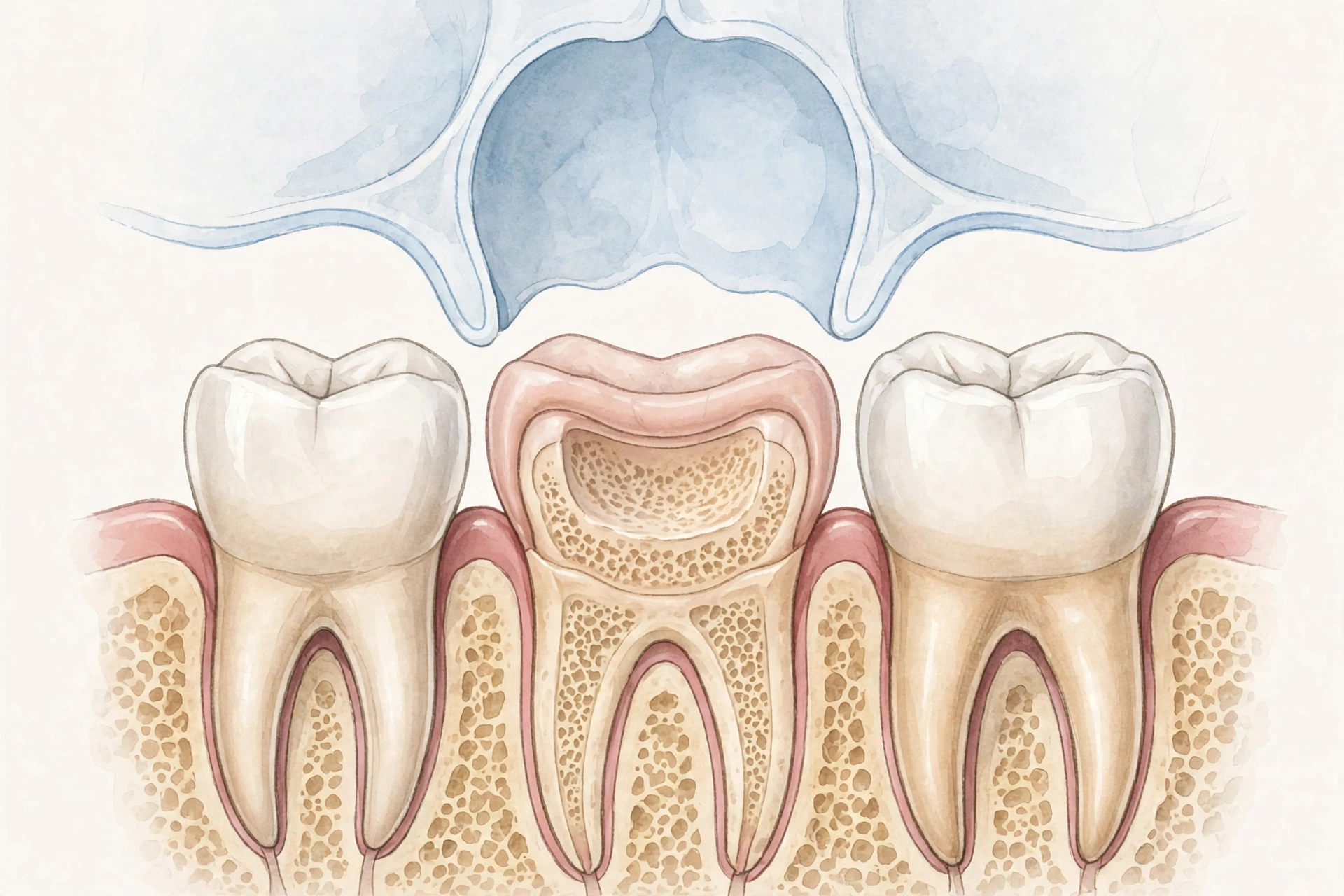
Your upper wisdom teeth sit directly underneath the maxillary sinuses — the hollow, air-filled cavities behind your cheekbones, on either side of your nose. In some people the roots of the upper molars are separated from the sinus by only a paper-thin layer of bone. In others, the root tip pokes into the sinus lining.
When the tooth is removed, that thin barrier can tear, leaving a small hole — dentists call it an oroantral communication — between the socket and the sinus. It is not necessarily a mistake. Sometimes the bone is so thin that any extraction would open it, and the surgeon may not know until the tooth is already out. It happens more often with deeply impacted teeth, long roots, and teeth with infections or cysts around them.
Most perforations are small, just a few millimetres across; larger ones need more active treatment. Either way, it needs to be found early. Your surgeon will usually check before you leave the chair, often by asking you to pinch your nose and blow gently while they watch the socket. If air bubbles through, there is an opening.
How to Tell: The Signs to Watch For
A small perforation does not always announce itself — normal soreness can hide it in the first day or two. But there are a few distinctive signs:
- Air passing through the socket when you breathe through your nose, sneeze, or blow your nose — sometimes with a faint whistling sound.
- Liquid coming out of your nose when you drink, or feeling water trickle into the socket.
- A strange, hollow feeling in the socket, or the sense that air is moving where it should not.
- Mucus or blood-tinged discharge from one nostril on the same side as the extraction.
- Pain or pressure in the cheek or around the eye on that side that does not ease as the days pass.
One or two of these on their own, especially in the first day, may be nothing — a little air in the socket is common right after any upper extraction. But if the signs persist beyond a day or two, or you can clearly feel air or liquid passing through, call your surgeon. They can confirm it with a quick examination, and finding out early makes healing much simpler.
What Your Surgeon Will Do
If a perforation is spotted during surgery, the surgeon will often close it straight away. For a small opening, that can be as simple as placing a stitch across the socket, sometimes with a small piece of absorbable material to help it seal. You may be told to avoid certain things (more on that below) and sent home with the usual aftercare plus a few extra rules.
For a larger opening, the surgeon may cover the hole with a flap of gum tissue, stitched into place. This is a small additional procedure, usually done at the same appointment or shortly after, and it heals like any other gum wound.
If it is only discovered days later, the approach depends on its size and whether there is infection. Small ones can still close on their own with careful aftercare. Larger ones, or ones with signs of a sinus infection, usually need a closure procedure and sometimes antibiotics.
The Rules That Matter Most: Do and Don’t
Healing a sinus perforation is mostly about one thing: no air or pressure through the hole. Every time pressure builds in the sinus, it pushes against the fragile clot and tissue trying to seal the opening. These rules sound fussy, but they are the whole treatment for a small hole.
| Do | Don’t |
|---|---|
| Sneeze with your mouth open | Blow your nose hard |
| Breathe through your mouth if your nose is blocked | Use a straw, or suck hard on anything |
| Take medicines as prescribed | Smoke or vape — it slows healing and raises infection risk |
| Eat soft food, chewed on the other side | Eat crunchy, sharp, or crumbly food near the socket |
| Rinse gently with salt water if advised | Rinse forcefully or spit hard |
| Sleep with your head raised | Fly or dive until your surgeon clears you |
The nose-blowing rule surprises most people. With a cold or hay fever it is miserable — but a hard blow can reopen a healing perforation in a second. Dab the nose gently instead, and sneeze with your mouth open. It feels undignified. Do it anyway.
Smoking deserves a special mention. It is one of the biggest risk factors for a perforation failing to heal, because it reduces blood flow and irritates the sinus lining. If you smoke, this is the time to stop, at least until your surgeon confirms the hole has closed.
How Healing Usually Goes
For a small perforation that is looked after properly, the timeline is reassuring. In the first week, the socket fills with a clot and soft tissue starts to seal the opening. A little air movement early on does not necessarily mean it has failed.
By two to three weeks, the gum should have closed over the socket, and the strange air and liquid sensations fade. Your surgeon will usually want to see you around this time to check the closure.
Full healing of the bone underneath takes longer — weeks to a few months — but once the gum has sealed, the sinus is protected and the risk drops sharply. Larger perforations, or ones that needed a tissue flap, can take a little longer. Follow your surgeon’s timeline, not a general one: they know the size of your opening.
During healing, watch for signs of a sinus infection: thick yellow or green discharge from one nostril, a bad smell or taste that does not go away, cheek pressure that gets worse, and fever. If any appear, call your surgeon the same day.
The Bottom Line
A sinus perforation after upper wisdom tooth removal is a known complication, not a disaster. Most small ones close on their own within a few weeks if you follow the aftercare — above all, do not blow your nose hard, do not use straws, do not smoke, and sneeze with your mouth open. The warning signs are air or liquid passing through the socket, discharge from one nostril, or cheek pressure that does not ease. If you notice them, call your surgeon promptly. Found early and looked after properly, a perforation heals — and once it has closed, it rarely causes lasting trouble.
Frequently Asked Questions
How do I know if I have a sinus perforation?
The clearest signs are air passing through the socket when you breathe or blow your nose, or liquid coming out of your nose when you drink. If you notice either for more than a day or two, call your surgeon — they can confirm it with a quick examination.
Will a sinus perforation heal on its own?
Small ones usually do, within two to three weeks, with careful aftercare. Larger ones may need a stitch or a small gum flap to close them. Your surgeon will judge the size and decide.
Can I fly with a sinus perforation?
Not until your surgeon says it is safe. Cabin pressure changes push air through the opening and can delay healing or reopen it. Ask before booking anything.
How long should I avoid blowing my nose?
Usually for at least two weeks, or until your surgeon confirms the hole has closed. Dab gently instead of blowing, and sneeze with your mouth open.
Is it dangerous if food gets into the socket?
Food in the socket is uncomfortable, but it is not an emergency on its own. Rinse very gently if your surgeon has advised it, and do not poke at it. A bad smell, bad taste, or discharge means calling your surgeon.
What happens if a sinus perforation does not heal?
A hole that stays open can lead to a chronic sinus infection and may need surgical closure. This is uncommon when the perforation is found early and the aftercare rules are followed.
Related reading: Wisdom Tooth Extraction Healing Stages and Signs of Dry Socket and Infection