
Updated November 12, 2026
Quick answer
Your surgeon looks at the scan, pauses, and says something you did not expect: "We could take the whole tooth out — but with roots this close to the nerve, I would rather leave the roots where they are." Leave part of a tooth in your jaw on purpose? It sounds wrong, like a job …
Your surgeon looks at the scan, pauses, and says something you did not expect: “We could take the whole tooth out — but with roots this close to the nerve, I would rather leave the roots where they are.”
Leave part of a tooth in your jaw on purpose? It sounds wrong, like a job half done. But a coronectomy — removing the crown of the wisdom tooth and deliberately leaving the roots behind — is a recognised, well-studied option, and for some lower wisdom teeth it is the safer choice.
What a Coronectomy Actually Is
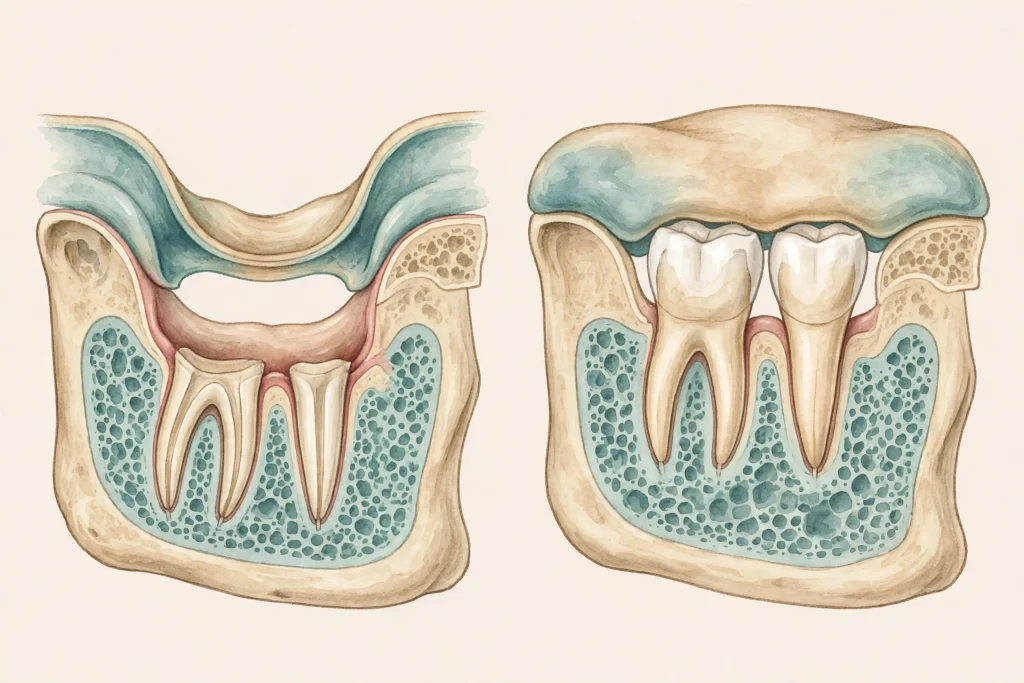
A coronectomy is a partial wisdom tooth removal. The surgeon removes the crown — the part of the tooth you can see — and leaves the roots in the jawbone, usually trimming them a few millimetres below the bone surface so the gum can heal over them.
The idea is simple. The crown is the part that causes the trouble: it pushes against the tooth in front, traps food, and gets infected. The roots, on the other hand, are often the dangerous part to remove, because they sit wrapped around or pressed against the nerve that gives feeling to your lower lip and chin. If the crown goes and the roots stay, the problem is solved without disturbing the nerve.
The roots are not dead or infected — they are healthy roots, still attached to the bone, with their blood supply intact. A living root in clean bone usually just sits there quietly, and the gum heals over it.
Coronectomy is not new or experimental — it has been used for decades, and it is a standard option for lower wisdom teeth whose roots sit very close to the inferior alveolar nerve.
Who It Is For — and Who It Is Not For
A coronectomy is not for every wisdom tooth. It is for a specific situation, and your surgeon will only suggest it when the picture fits.
It is usually considered when:
- The lower wisdom tooth’s roots are very close to, touching, or wrapped around the nerve, as shown on an X-ray or 3D scan.
- The tooth is impacted or partly erupted and causing problems — pain, infection, or damage to the tooth in front.
It is usually not suitable when:
- The tooth or its roots are already infected, or there is decay reaching into the roots.
- The tooth is loose, so the roots would not stay put.
- The roots are crossed or oddly shaped in a way that makes a clean cut impossible.
Your surgeon will talk through the alternatives. Sometimes the choice is between a coronectomy and a full removal with a higher nerve risk; sometimes, if the tooth is not causing trouble, the third option is to leave it alone and watch it. The right answer depends on your scan and your symptoms.
Coronectomy vs Full Removal
| Coronectomy | Full removal | |
|---|---|---|
| What is removed | Crown only; roots left in place | Whole tooth, roots included |
| Nerve injury risk | Lower | Higher if roots touch the nerve |
| Surgery time | Often shorter | Often longer |
| Main follow-up issue | Roots may move; needs checking | Socket healing, dry socket risk |
| Chance of a second procedure | Small, if roots cause trouble | Very low |
Neither option is “better” in general — the question is which fits your tooth. For a straightforward tooth sitting well away from the nerve, full removal is usually right. For roots hugging the nerve, a coronectomy trades a small chance of further treatment later for a much lower risk of numbness now.
What Happens on the Day
From your side of the chair, a coronectomy feels much like a normal wisdom tooth removal. It is usually done under local anaesthetic, with sedation if you prefer, and it often takes a little less time than a difficult full extraction.
The surgeon removes the gum over the tooth, takes the crown off — usually in one piece, sometimes sectioned — and trims the remaining roots to a few millimetres below the bone. The roots are left undisturbed: no pulling, no force. The gum is stitched closed, and you go home with the same aftercare as a normal extraction — soft food, no straws, no smoking, gentle rinsing once your surgeon says to start.
Pain and swelling are usually similar to, or a little less than, a full removal. Most people are back to normal eating within a week or two.
Aftercare, and the Roots That Move
Here is the part that surprises people: in the months after a coronectomy, the roots left behind often start to move — slowly, upwards, towards the surface. This is called root migration, and it happens in a large proportion of cases. It is not a complication. It is the roots doing what roots do when the crown is gone: drifting, a few millimetres over months or years.
For most people, the roots move a little and then stop, settling under the gum, and never cause a problem. Your surgeon will check them with X-rays at follow-up appointments — often at six months and a year — to see how far they have moved.
A small number do need a second procedure later, usually because the roots have moved close to the surface or become infected. If that happens, the roots are removed then — and by then they have usually moved away from the nerve, so the removal is much safer. That is one of the quiet advantages of a coronectomy: even when it leads to a second step, that step is easier.
Aftercare is the same as after any wisdom tooth surgery: soft food for a few days, no straws or smoking, keep the area clean as instructed, and take pain relief as advised. If you notice the gum opening over the site, or a hard edge poking through months later, call the practice — do not poke at it yourself.
The Risks, Honestly
The most common issues are the same as any extraction: pain, swelling, bruising, and a small risk of infection or dry socket. Nerve numbness is still possible, but the risk is much lower than with full removal of a high-risk tooth — that is the whole point.
The risks specific to coronectomy are: the roots becoming exposed or infected later and needing removal; a small chance that a root is accidentally loosened during surgery, in which case the surgeon will usually remove it there and then; and, rarely, the remaining roots irritating the tooth in front.
None of this makes coronectomy a gamble — it is a calculated trade: a much lower nerve risk now, against a small chance of further treatment later. Your surgeon should explain the numbers for your own case.
The Bottom Line
A coronectomy is a deliberate, well-studied option for lower wisdom teeth whose roots sit dangerously close to the nerve. The crown comes out, the roots stay, and the nerve is left undisturbed. Most people heal like any other extraction, the roots drift a little and settle, and nothing more is needed. A small number need the roots removed later — usually more safely by then. If your surgeon suggests it, it is not a shortcut or a half-job.
Frequently Asked Questions
Is it safe to leave tooth roots in my jaw?
Yes, when the roots are healthy and the case is well chosen. Living roots in clean bone usually sit quietly, and the gum heals over them. Your surgeon will monitor them with X-rays.
Will the roots grow back or cause pain?
The roots do not grow back, but they often drift upwards over months — root migration, and it is normal. It usually causes no pain. If a root becomes exposed or infected, it can be removed later, usually more safely.
Does a coronectomy hurt less than a full removal?
Pain and swelling are usually similar, or a little less, because the surgery is often shorter and involves less force on the tooth. Recovery follows the same pattern as a normal extraction.
How often do the roots need to be removed later?
Only a small number need a second procedure, usually because the roots have moved close to the surface or become infected. Your surgeon will watch for this at follow-up.
Can a coronectomy be done on upper wisdom teeth?
It is almost always a lower-tooth procedure, because the nerve risk it avoids is a lower-jaw problem. Upper teeth sit near the sinus instead.
What should I do if I can feel something hard poking through the gum months later?
Call your surgeon or dentist and let them look at it. Do not poke at it yourself. It may be a root that has migrated to the surface.
Related reading: Complications of Impacted Wisdom Teeth and Wisdom Tooth Extraction Healing Stages