
Updated November 12, 2026
Quick answer
You went in to have a wisdom tooth taken out, the tooth came out — and then your dentist mentioned something you did not expect: a small piece of the root was left behind. Or maybe you only found out later, when a follow-up X-ray showed a tiny fragment sitting in the socket where the …
You went in to have a wisdom tooth taken out, the tooth came out — and then your dentist mentioned something you did not expect: a small piece of the root was left behind. Or maybe you only found out later, when a follow-up X-ray showed a tiny fragment sitting in the socket where the tooth used to be.
It sounds alarming. A piece of tooth, left inside your jaw, on purpose? The good news is that this is a known situation in dentistry, it happens more often than most people realise, and in many cases the right thing to do is simply to leave the fragment alone and keep an eye on it.
How Does a Root Get Left Behind?
Wisdom teeth are awkward customers. Their roots are often curved, hooked, or spread apart, and they sit close to nerves and thin bone at the back of the jaw. During an extraction, a root tip can snap off — because the root is thin and brittle, curved around a piece of bone, or the tooth was already cracked or weakened by decay.
When that happens, the dentist faces a choice in the moment: dig the fragment out, or leave it where it is. Digging sounds like the obvious answer, but it is not always the safer one. Reaching a deep, tiny root tip can mean removing a fair amount of surrounding bone, and that bone might be sitting right next to the nerve that gives feeling to your lower lip and chin. A dentist weighing a small, clean fragment against the risk of nerve damage may reasonably decide that the fragment is the lesser problem.
There is also a recognised technique behind this. When the root tip is very small, free of infection, and close to an important nerve, dentists sometimes deliberately leave it in place. It is a judgement call, made with the X-ray in front of them, not an accident that gets swept under the rug. What matters is that you are told about it, which is exactly why your dentist mentioned it.
Roots like these are one reason impacted wisdom teeth removal surgery can be more involved than a straightforward extraction.
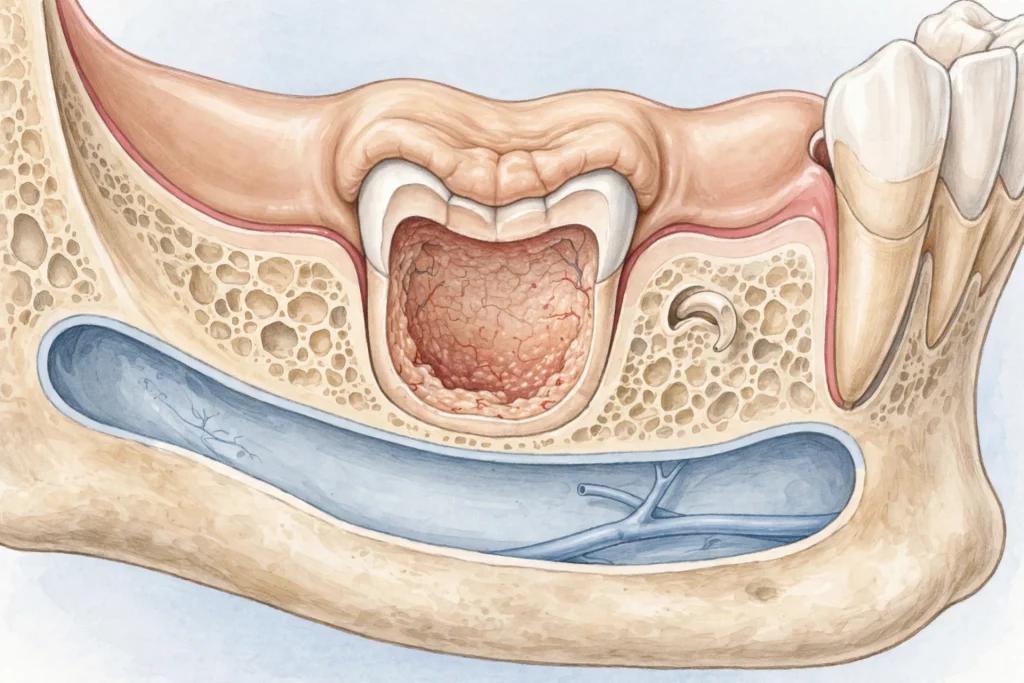
Will a Left-Behind Root Cause Problems?
Most of the time, no. A small root fragment buried in bone tends to do one of two quiet things: it stays exactly where it is, walled off by the body, and causes no trouble at all; or it slowly works its way towards the surface over months or even years, eventually poking through the gum, at which point it can be picked out easily in a routine visit.
Problems are possible, though. A fragment can become a focus for infection, especially if bacteria were already present around the tooth before it was removed. It can delay healing of the socket, or cause a persistent sore spot on the gum. In rare cases, a larger fragment can interfere with the bone filling in properly, or cause ongoing pain that does not ease as expected.
The size and position of the fragment matter a lot. A tiny tip tucked deep in solid bone is a very different matter from a larger chunk sitting near the surface of an infected socket. Your dentist will have judged this from the X-ray, and that judgement is what shapes the plan.
Leave It or Remove It: How Dentists Decide
There is no single rule. The decision depends on a handful of factors your dentist will weigh together:
- How big is the fragment? Tiny tips are far more likely to be left alone. Larger pieces usually come out.
- Was there infection? A fragment in a clean socket is a good candidate for leaving. One sitting in an infected area usually needs to go, because it can harbour bacteria.
- How close is the nerve? If the fragment hugs the nerve that serves your lower lip, removing it risks numbness that could last weeks or, rarely, be permanent. Leaving it is often the safer trade.
- How deep is it? A fragment buried in bone is hard to reach without removing bone.
- How is it behaving? A fragment that stays quiet for months is usually left alone indefinitely. One that keeps causing pain, swelling, or discharge will be taken out.
If the decision is to leave it, that is not the end of the story. Expect a follow-up X-ray after a few months to check that the fragment has not moved and the bone around it looks healthy. If your dentist did not book one, ask when they would like to see you again.
What Happens If It Stays Put
For most people, life goes on normally. You eat, brush, and heal exactly as you would after any extraction. The socket closes over, the bone gradually fills in around the fragment, and within a year or so the area looks unremarkable on an X-ray. If you are unsure what normal healing looks like, our guide to wisdom tooth extraction healing stages walks through it week by week.
What Happens If It Needs to Come Out
If the fragment starts causing trouble — persistent pain, repeated swelling, a bad taste that will not go away, or an X-ray showing the area is not healing — your dentist will plan a small procedure to retrieve it. This is normally done under local anaesthetic, through the same socket or a small incision in the gum, and it is typically much quicker than the original wisdom tooth removal.
Recovery tends to be straightforward: a few days of soreness, the usual advice about soft foods and gentle rinsing, and a follow-up to check the socket is healing.
Looking After the Socket at Home
Whether the fragment stays or goes, your day-to-day care is the same as after any extraction — and a clean socket heals around a fragment far better than an irritated one.
Keep the area clean but be gentle. Rinse with warm salt water as your dentist advised, starting when they say it is safe — usually after the first day. Do not poke the socket with your tongue, a toothpick, or a cotton bud, even if you are curious about what is in there. Avoid smoking and vaping, which slow healing and raise the risk of infection and dry socket. Eat soft foods for the first few days and chew on the other side. If you were given pain relief, take it exactly as directed — paracetamol is the same medicine as acetaminophen, sold as Tylenol in some countries, so check labels and do not double up on combination products.
Watch the pattern: healing pain should gradually fade. Pain that gets worse after the first few days, swelling that increases after day three, fever, pus, or a bad taste that persists are all reasons to call your dentist promptly rather than waiting for your next scheduled check.
Frequently Asked Questions
Is it common for a wisdom tooth root to be left behind?
It is not rare. Root tips break off in a small percentage of wisdom tooth extractions, particularly with lower wisdom teeth whose roots are curved or close to the nerve.
Can a left-behind root cause an infection?
It can, though it is uncommon when the fragment is small and the socket was clean. The risk is higher if infection was already present before the extraction. Worsening pain, swelling, fever, or discharge are signs to get checked promptly.
Will the fragment come out on its own?
Sometimes. Small fragments can slowly migrate towards the surface over months and either emerge through the gum or be removed easily at a check-up. Many never move at all and sit harmlessly in the bone.
Does it show up on an X-ray?
Yes. A root fragment is visible on a dental X-ray, which is how your dentist knows it is there and can judge its size and position. Follow-up X-rays are the usual way of monitoring it.
Will I need another surgery to remove it?
Only if it causes problems. Most retained fragments never need a second procedure. If one does need removing, it is usually a short procedure under local anaesthetic, much simpler than the original extraction.
The Bottom Line
Hearing that part of a tooth root was left behind is unsettling, but it is usually a deliberate, careful decision rather than a mistake. Small, clean fragments near a nerve are often safer left in place, and most cause no trouble at all. What matters is that you know it happened, that someone is keeping an eye on it, and that you know which symptoms mean “call the dentist” — pain that worsens instead of easing, swelling that keeps growing, fever, or discharge.