
Updated November 10, 2026
Quick answer
When a wisdom tooth starts hurting, "next available appointment in three weeks" is not an answer. You need someone who can see you today or tomorrow — and if you are paying cash, you need to know what it will cost before you sit in the chair. The good news: same-day and next-day wisdom tooth …
When a wisdom tooth starts hurting, “next available appointment in three weeks” is not an answer. You need someone who can see you today or tomorrow — and if you are paying cash, you need to know what it will cost before you sit in the chair.
The good news: same-day and next-day wisdom tooth appointments do exist. The bad news: they are rarely found by filling in an online booking form and waiting. The fastest route is almost always a phone call, to the right kind of office, with the right words.
This guide walks you through exactly who to call, in what order, what to ask, and what to do if nobody near you can see you today.

The Short Answer
Call an emergency dentist or an oral and maxillofacial surgeon directly and ask for a same-day appointment. Say it is a wisdom tooth, describe the pain and any swelling or fever, and ask whether they can examine you today — and whether same-day extraction is possible if it is needed.
If you are paying cash, ask for the self-pay price of the consultation, the X-rays, and the extraction separately before you agree to anything. Dental schools and community health centers are the cheapest fast options when money is tight.
If you have trouble breathing or swallowing, rapidly spreading facial swelling, or you feel seriously unwell, skip the dentist search and seek emergency medical care now. For everything you need to know about urgent situations, see our guide to where to get urgent wisdom tooth care in the USA.
What “Fast” Actually Means
It helps to know what you are really asking for, because “fast” can mean three different things — and offices answer differently depending on which one you mean.
A same-day examination. Most emergency dentists and many oral surgeons can fit in a same-day consultation: an exam, X-rays, pain relief, and a plan. This is the most realistic same-day outcome, and it is often all you need to get pain under control.
Same-day extraction. Sometimes possible, but never guaranteed. The office needs to see the X-rays first, check whether the tooth is impacted, whether there is infection, what sedation you need, and whether your medical history allows it. An impacted tooth, significant swelling, or a need for IV sedation usually means the extraction gets scheduled for another day — even if the exam happens today.
The soonest appointment, full stop. If today is impossible, ask for the first cancellation slot, and ask to be put on a cancellation list. Offices get cancellations every day, and a patient who says “I can come at an hour’s notice” often gets seen within 24–48 hours.
When you call, ask specifically: “Can you examine me today, and is same-day extraction possible if it is needed?” That one sentence separates offices that can actually help from offices that will only book you a routine consultation.
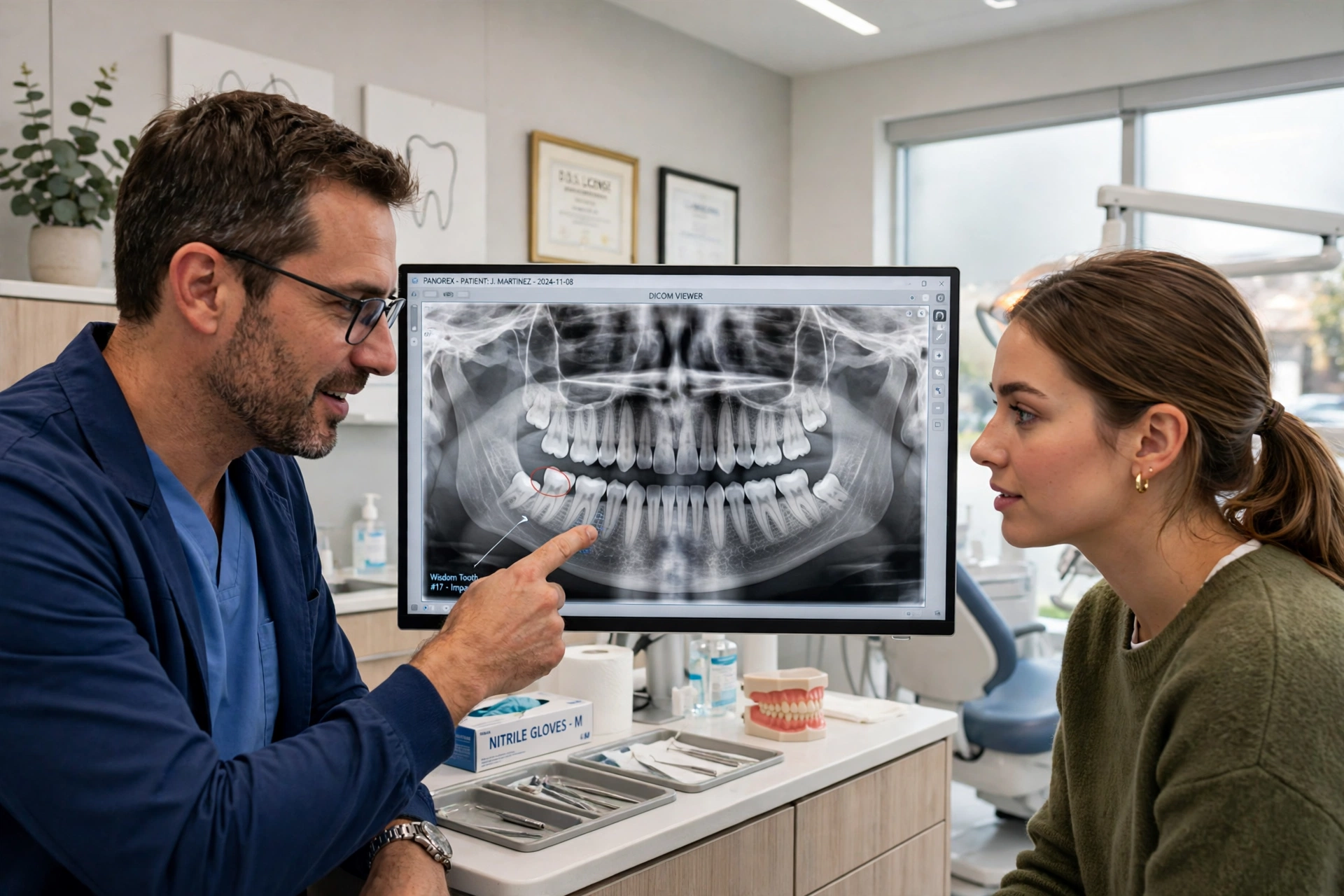
Step 1: Call Your Regular Dentist First
If you have a regular dentist, start there — even if it feels like the slowest option. Your own dentist already has your records and X-rays, knows your history, and many practices keep one or two emergency slots open each day for their own patients.
Call as early in the morning as possible and say plainly that it is a wisdom tooth and the pain is getting worse. Ask:
- “Do you have any emergency slots today?”
- “Can you examine the wisdom tooth today, even if extraction has to wait?”
- “If you cannot see me, can you refer me to an oral surgeon who might?”
A referral from your dentist can also speed things up at an oral surgeon’s office, because the surgeon’s team already knows what they are dealing with. For a full walkthrough of referrals and choosing a provider, see our guide on how to find and choose a wisdom teeth removal provider.
If your dentist cannot see you today, do not wait for a callback — move straight to Step 2.
Step 2: Search for Same-Day Emergency Dentists and Oral Surgeons
This is where most people waste time. Online booking systems show the next routine slot, not the emergency slots. A phone call is faster and more honest.
Search terms that work:
- “emergency dentist for wisdom tooth pain near me”
- “same-day wisdom tooth extraction near me”
- “urgent oral surgeon near me”
- “emergency oral surgeon [your city]”
- “weekend oral surgeon near me” (for Saturdays and Sundays)
Call, don’t just book online. Online listings can be out of date, and a booking form cannot tell the office how urgent your case is. Call the office directly and describe your symptoms in one or two sentences: where it hurts, how bad it is, how long it has been going on, and whether there is swelling or fever.
Call more than one office. If the first office cannot see you today, ask: “Do you know another practice nearby that might have a slot today?” Dental offices often know who in the area keeps emergency capacity. Call three or four offices if you have to — the whole round of calls usually takes less than half an hour, and it is the single most effective thing you can do.
Ask about after-hours and weekend cover. Some practices have an on-call number on their voicemail after hours. If you are calling in the evening or on a weekend, listen to the full voicemail message before hanging up — it often gives you an on-call number or directs you to an urgent service.
Step 3: Ask About Cash-Pay and Self-Pay Prices Before You Agree
If you do not have dental insurance, or your plan does not cover the procedure, you are a cash-pay (self-pay) patient — and that changes the conversation in your favour. Many offices offer a self-pay price that is lower than the insured price, and some offer a discount for paying in full on the day.
But prices vary enormously, so never agree to treatment without a written estimate. Ask for the price of each part separately:
- Consultation fee — what does the exam cost, and does it include X-rays?
- Imaging — is a panoramic X-ray included, or charged separately?
- Extraction — what is the price per tooth, and does it change if the tooth is impacted?
- Anesthesia or sedation — local anesthetic is usually included; IV sedation or general anesthesia is often a separate, significant charge.
- Follow-up — is a post-operative check included, or charged as another visit?
Then ask the two questions that save people the most money:
- “Is there a cash-pay or self-pay discount if I pay in full today?”
- “Do you offer payment plans or financing for the extraction?”
Many offices do offer payment plans, and there are also third-party financing options. Our guide to wisdom teeth removal payment plans and financing explains how they work and what to watch out for. For a sense of what extraction usually costs in different countries, see our wisdom teeth removal cost guide.

One caution: a very low cash price is not automatically a good deal. Ask what is included, who will perform the procedure, and what happens if there is a complication. Compare the full estimate — not just the headline number.
Step 4: The Cheapest Fast Options — Dental Schools and Community Clinics
If cost is the barrier, the fastest affordable care often comes from places people do not think of first.
Dental schools. University dental schools and oral surgery residency programs often treat patients at a fraction of private-practice prices, because the work is done by supervised students or residents. Appointments can be available quickly, especially for urgent cases — but the visits can take longer, and you may need a screening appointment first. Search “[your city] dental school clinic” or check the website of your nearest university with a dental school.
Community health centers. Federally qualified health centers and community dental clinics offer care on a sliding scale based on income, and many keep urgent slots for people in pain. Search “community dental clinic near me” or “low-cost emergency dentist [your city]”.
Local dental programs. Some counties, charities, and dental associations run emergency dental programs or free clinic days. Your state or local dental association website usually lists them, and a quick call to a community health center can point you in the right direction.
These options are not always same-day, but they are often the difference between getting seen this week and not getting seen at all — and they are worth one phone call before you give up.
What to Say When You Call
Offices move faster when you give them the information they need in the first thirty seconds. Use a short script like this:
“Hi, I’m having wisdom tooth pain and I need to be seen as soon as possible. The pain started [two days ago], it’s [severe and getting worse / constant / waking me at night], and I have [swelling / a bad taste / a fever / trouble opening my mouth]. Are you able to examine wisdom teeth today, and do you offer same-day extraction if it’s needed? I’m paying cash — could you tell me the self-pay price for the consultation and X-rays?”
Then tell them anything that affects safety: medical conditions, allergies, medicines you take, pregnancy, and any recent dental treatment. Do not stop prescribed medicines without advice from a clinician.
If the answer is no, ask two things before you hang up: “When is your earliest appointment?” and “Is there another practice nearby you would recommend for an urgent wisdom tooth?” Then call the next office on your list.
For Parents: Your Teen Has Wisdom Tooth Pain and a Suspected Impacted Tooth
A lot of the people searching for the fastest wisdom tooth dentist are parents — often of a 17-year-old with pain and a suspected impacted tooth. A few things that matter specifically in that situation:
Do not wait to see if it settles. Impacted wisdom teeth in teenagers can go from painful to infected quickly, and swelling around a partially erupted tooth can make opening the mouth difficult. If your teen has pain plus swelling, fever, a bad taste, or trouble opening their mouth, call today.
You can usually book without a referral. Many oral surgeons accept self-referrals, and a parent can book a consultation directly. Some practices and insurance plans do require a referral — ask when you call.
Bring the records. If your teen has recent dental X-rays, ask your family dentist to send them to the oral surgeon. It can speed up the consultation significantly, because the surgeon can see the tooth’s position before your teen arrives.
Consent and attendance. For a minor, a parent or guardian usually needs to be present and to consent to treatment. Check the office’s policy when you book, and ask whether sedation is planned and whether your teen will need an escort home.
Ask about timing. Teenagers often have school and exam schedules to work around. Ask the office what the recovery time looks like — most teens need a few days off school after extraction — and whether a Friday appointment would help.
For more on what an impacted tooth is and what to expect, see our guides to symptoms of impacted wisdom teeth and impacted wisdom teeth removal surgery.
What to Do While You Wait to Be Seen
Getting an appointment tomorrow is good — but tonight still hurts. While you wait:
- Follow any advice your dentist has already given you.
- Keep the area clean gently. Do not poke the gum or try to remove the tooth yourself.
- Drink water and eat soft foods that do not irritate the area.
- Use over-the-counter pain medicine only if it is safe for you, and follow the label. Ask a pharmacist or clinician if you are unsure — especially if you have medical conditions, take other medicines, or are pregnant.
- Do not place aspirin directly on the gum; it can injure the tissue.
- Do not take leftover antibiotics or someone else’s prescription.
Home care is a stopgap, not a treatment. If swelling, fever, pain, or your overall condition worsens while you wait, call the office back and say so — or seek urgent care. For a fuller list, see our urgent wisdom tooth care guide.
When to Go to the Emergency Department Instead
Some symptoms are not a dental appointment problem — they are a medical emergency. Go to an emergency department or call 911 in the United States if you have:
- Difficulty breathing or swallowing
- Rapidly spreading swelling in the face or neck
- Swelling around the eye that affects your vision
- Signs that you may be seriously unwell, such as confusion or a very high fever
Hospital emergency departments usually cannot do a routine extraction, but they can treat a dangerous infection. Do not delay emergency care while trying to find a particular dentist.
What Not to Do
- Do not keep shopping around for days while an infection spreads. If you have swelling, fever, or a bad taste, getting seen matters more than getting the cheapest quote. Get the exam first; you can still compare extraction prices afterwards.
- Do not assume a clinic can extract the same day just because it advertises emergency care. Always ask whether they offer same-day extraction or only same-day consultations.
- Do not hide your medical history to get seen faster. Allergies, medicines, and conditions like diabetes or bleeding disorders change what is safe. Tell the office everything relevant.
- Do not try home extraction or aggressive home remedies. They risk infection, bleeding, and damage to nearby teeth and nerves.
Frequently Asked Questions
Q: Which dentists can see me the soonest for wisdom tooth pain?
Emergency dentists and oral and maxillofacial surgeons are the fastest options. Call them directly — do not rely on online booking — and ask for a same-day examination. Your regular dentist may also keep emergency slots for existing patients, so call them first.
Q: Can I get a wisdom tooth removed the same day I call?
Sometimes, but not always. A same-day examination is common; same-day extraction depends on the X-rays, whether the tooth is impacted, whether there is infection, and what sedation you need. Ask the office directly: “Do you offer same-day extraction, or only same-day consultations?”
Q: How much does a cash-pay wisdom tooth extraction cost?
It varies widely by location, the complexity of the tooth, and the type of anesthesia. Always ask for a written estimate that separates the consultation, X-rays, extraction, anesthesia, and follow-up. Ask whether there is a self-pay discount for paying in full on the day, and whether the office offers payment plans.
Q: Can I see a dentist without insurance for wisdom teeth?
Yes. You can book as a self-pay (cash-pay) patient at most private practices, and dental schools and community health centers offer lower-cost care, often on a sliding scale based on income. Tell the office when you call that you are paying cash and ask for the self-pay price.
Q: My 17-year-old has wisdom tooth pain and a suspected impacted tooth — what should I do?
Call a dentist or oral surgeon today. Many oral surgeons accept self-referrals, and a parent can book the consultation directly. Bring any recent X-rays, and ask about the tooth’s position, whether extraction is recommended, the recovery time, and whether your teen will need an escort home after sedation.
Q: Do dental schools do wisdom tooth removal quickly?
Often, yes — and at a much lower price than private practice. But visits can take longer, and you may need a screening appointment first. Call your nearest university dental school clinic and explain that it is urgent.
Q: What if no dentist near me can see me today?
Ask to be put on a cancellation list and say you can come at short notice. Call other offices — including dental schools and community clinics — and ask for their earliest appointment. If your symptoms worsen while you wait (increasing swelling, fever, trouble opening your mouth or swallowing), call back and say so, or seek urgent medical care.
This article is for general education and does not replace an examination or personalized advice from a dentist or medical professional. If you have severe or worsening symptoms, seek professional care promptly.