Updated November 15, 2026
Quick answer
You are pregnant, and a wisdom tooth has started hurting — or an infected one has flared up at exactly the wrong time. The question that follows is an anxious one: can the tooth come out now, or do you have to wait until after the baby is born? The short answer is reassuring, and …
You are pregnant, and a wisdom tooth has started hurting — or an infected one has flared up at exactly the wrong time. The question that follows is an anxious one: can the tooth come out now, or do you have to wait until after the baby is born?
The short answer is reassuring, and it is also the reason this decision needs two people, not one: wisdom teeth removal during pregnancy is possible, and it is done when it is needed. Emergency treatment should not be delayed because you are pregnant — an untreated infection is usually more dangerous than a carefully planned extraction. But elective removal, the kind you would book simply because the tooth might cause trouble one day, is almost always better postponed.
This guide explains which trimester is safest, what changes about anaesthesia, X-rays and pain relief in pregnancy, when waiting is safe and when it is not, and how to manage the pain while you wait.
A quick note before we start: this is educational information, not medical advice. Every pregnancy and every extraction is different. Your dentist or oral surgeon and your obstetrician should decide together — if either of them tells you to wait, or to act now, their advice overrides anything in this guide.

The Short Answer: Can You Have Wisdom Teeth Removed While Pregnant?
Yes, if the tooth needs to come out. Dentists treat infection, severe pain, swelling and damage as reasons to act during pregnancy, in any trimester. A tooth that is not painful, infected or damaged can usually wait — ideally until the second trimester, or until after delivery.
That distinction — urgent versus elective — is the whole decision in one sentence:
- Act now: infection or abscess, swelling that is spreading, severe pain that stops you eating or sleeping, a cracked or badly decayed tooth, or a partially erupted tooth that keeps trapping food and getting infected.
- Wait: a healthy wisdom tooth with no symptoms, a tooth that aches occasionally but settles, or removal planned purely as a precaution before it ever causes trouble.
An infected tooth left untreated can spread, and pain that stops you eating or sleeping wears you down at a time when your body is already working hard. For those teeth, removal is the safer choice. For a quiet tooth, the surgery, the medicines and the stress are risks you do not need to take right now.
Which Trimester Is Safest?
If you can choose the timing, the second trimester is the window most dentists prefer. The reasons are practical rather than alarming, and they are worth understanding, because they explain why the same procedure gets a different answer in week 9 and in week 20.
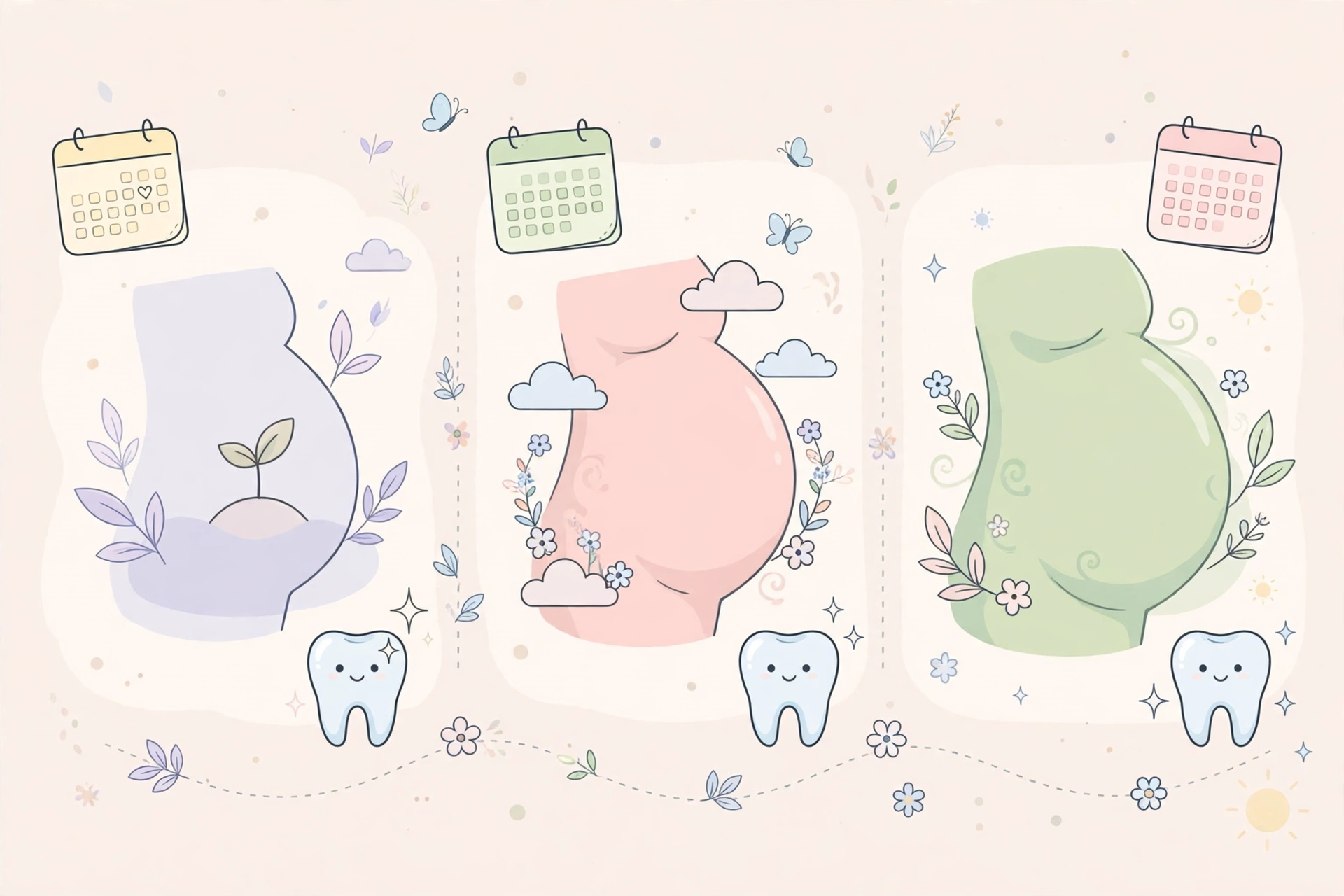
| Trimester | Weeks | What usually happens | Removal? |
|---|---|---|---|
| First trimester | Weeks 1–13 | The baby’s major organs are forming. Nausea and vomiting are often at their worst, and lying back in a dental chair can be miserable. | Elective removal is deferred. Urgent treatment — infection, severe pain — can still go ahead, because the risk of leaving it is greater. |
| Second trimester | Weeks 14–27 | Organ development is largely complete, nausea has usually eased, and the uterus is not yet large enough to make reclining uncomfortable. Energy tends to be better. | The preferred window for planned removal, if it cannot wait until after delivery. |
| Third trimester | Weeks 28 to delivery | Lying flat for a long procedure can press on the large vein that returns blood from the lower body, dropping blood pressure and causing dizziness or fainting. Appointments feel long, and the risk of premature labour rises with stress and pain. | Necessary treatment can still be done, but planned removal is usually postponed until after birth. Short appointments, with breaks and a tilted position, help if treatment cannot wait. |
Two cautions belong with this table. First, the trimester preference describes comfort and caution, not a line between safe and unsafe. The American College of Obstetricians and Gynecologists (ACOG) considers necessary dental care appropriate throughout pregnancy. A painful, infected tooth at week 9 should be treated at week 9, not booked for week 16. Second, wisdom tooth removal is longer and more involved than a filling. That is why dentists are more willing to postpone a wisdom tooth than a simpler procedure — the appointment is longer, the recovery involves more medicine, and the benefit of doing it now has to be clearer.
When to Wait — and When You Cannot Wait
It is usually safe to wait when:
- The tooth is fully erupted, healthy, and causes no pain or swelling.
- The pain is mild, occasional, and settles with warm salt-water rinses and rest.
- The tooth is partially erupted but cleanable, with no infection and no damage to the tooth in front of it.
- Your dentist can see a clear plan to monitor it — a check at each prenatal dental visit, and a plan to remove it after delivery.
Waiting is not the same as ignoring it. A wisdom tooth that is quiet today can become infected quickly, especially a partially erupted one, where a flap of gum traps food and bacteria. If you are waiting, keep the area as clean as you can, watch for the warning signs below, and have a dentist you can call.
Do not wait — get seen promptly — when:
- There is swelling in the cheek or jaw, especially swelling that is spreading or making it hard to open your mouth or swallow.
- Pain is severe, constant, or keeps you awake at night.
- There is fever, a bad taste in the mouth, or pus.
- The gum around the tooth is red, bleeding and painful, and the pain is getting worse rather than better.
- You cannot eat or drink properly because of the pain.
These are the signs of an infection or an abscess, and they are the situations in which both ACOG and the American Dental Association (ADA) are clear: emergency dental treatment should not be delayed during pregnancy. An untreated dental infection can spread to the jaw, the neck and beyond, and the stress, fever and inability to eat that come with it are themselves risks to the pregnancy.
If you are unsure which side of the line you are on, that uncertainty is itself a reason to be seen. A dentist can tell in one examination whether this is a tooth that can wait or one that cannot — you should not have to guess.
Anaesthesia: What Is Used, and What Is Avoided
Anaesthesia is the part of this decision that worries most people, and it is also the part where the guidance is clearest.
Local anaesthesia is the standard choice, and it is considered safe in pregnancy when used appropriately. The ADA states that local anaesthetics, including lidocaine with or without epinephrine, can be used during pregnancy. Lidocaine has the longest safety record of the dental anaesthetics and is the one most commonly chosen. It works where it is injected, blocking the pain signal from the tooth, and very little of it reaches the rest of the body. Your dentist will use the lowest effective dose, as they would for any patient.
Sedation needs extra consideration. IV sedation and general anaesthesia are generally avoided during pregnancy unless a qualified team decides they are appropriate for your case. Nitrous oxide — laughing gas — is also generally avoided. That matters for wisdom teeth, because many wisdom tooth removals outside pregnancy are done under IV sedation. During pregnancy, the expectation is usually different: a local anaesthetic only, with the procedure kept as short and as calm as possible. If a tooth is so difficult that it genuinely cannot be removed under local anaesthetic alone, your dentist and obstetrician may decide together to postpone it until after delivery rather than add sedation now. Our guide to IV sedation explains what that method normally involves, and why it is a different conversation in pregnancy: https://perfectwisdomteeth.com/iv-sedation-wisdom-teeth/
Tell the dental team you are pregnant before anything starts — before the examination, before any X-ray, and before any injection. It changes the anaesthetic, the positioning in the chair, the length of the appointment and the medicines prescribed afterwards. If you are early in pregnancy and have not told many people yet, the dental team still needs to know; it is medical information, not a social announcement.
Are Dental X-Rays Safe During Pregnancy?
A wisdom tooth cannot be planned safely without seeing it — how it is angled, how close its roots are to the nerve that supplies the lip and chin, and whether there is infection in the bone. That usually means an X-ray. Many people worry about this more than anything else in the appointment, and the worry is understandable. The evidence is reassuring.
Dental radiographs are considered safe during pregnancy when they are clinically indicated, according to the ADA. A single dental X-ray uses a very small dose of radiation — roughly 5 to 10 microsieverts for a single tooth film, against about 2,000 to 3,000 microsieverts of natural background radiation in a year. Modern digital X-rays use lower doses still, and the beam is aimed at the mouth, not the abdomen.
Your dentist will still keep the number of images to the minimum needed to plan the extraction, and will use a lead apron with a thyroid collar to shield your abdomen and neck. That shielding blocks nearly all scattered radiation. A panoramic X-ray, which shows the whole jaw, uses a higher dose than a single-tooth film, so your dentist may prefer the smaller image where it gives enough information.
The practical rule is the same as for the extraction itself: an X-ray is taken when the tooth cannot be treated safely without one. An X-ray taken for curiosity, or to plan an elective removal that could wait, is not taken. An X-ray needed to treat an infected tooth is.
Pain Relief and Antibiotics After Removal
What you can take after the extraction changes in pregnancy, and this is where many people are caught out — the painkillers that are routine after wisdom teeth removal are not all routine now.
Paracetamol (acetaminophen) is the first-line pain reliever in pregnancy. It is generally considered safe throughout pregnancy at the lowest effective dose, for the shortest time needed. Your dentist or obstetrician will confirm the dose for you; do not simply take the dose printed for a non-pregnant adult without checking, and do not combine it with other medicines that already contain paracetamol.
NSAIDs — ibuprofen, naproxen and aspirin — should be avoided, especially from around 20 weeks onwards. The U.S. Food and Drug Administration (FDA) recommends avoiding NSAIDs at approximately 20 weeks of pregnancy or later unless a healthcare professional specifically directs it, because they can affect the baby’s kidneys and circulation. Many dentists avoid them throughout pregnancy for this reason. This matters because ibuprofen is the painkiller most often prescribed after wisdom tooth removal outside pregnancy — so the prescription you might expect is exactly the one that changes. Do not take leftover ibuprofen from a previous extraction, and do not take a partner’s or friend’s painkillers.

Antibiotics, when they are needed, are chosen with pregnancy in mind. Penicillin and amoxicillin are the antibiotics most commonly prescribed in pregnancy and are generally considered safe. Tetracycline antibiotics are contraindicated throughout pregnancy, because they can discolour the baby’s developing teeth. Metronidazole is generally avoided in the first trimester. Your dentist will coordinate any prescription with your obstetrician, and will only prescribe an antibiotic if there is an infection to treat — not as a routine precaution.
Do not start any pain medication after wisdom tooth removal without discussing the appropriate choice with your dentist or obstetrician. That sentence is worth following literally. The right choice depends on your week of pregnancy, your medical history, and what else you are taking.
Recovery in Pregnancy: What Is Different?
Recovery after a wisdom tooth extraction follows the same healing stages in pregnancy as at any other time — the socket fills with a blood clot, the clot is gradually replaced by healing tissue, and the gum closes over the following weeks. The day-by-day picture is in our healing stages guide: https://perfectwisdomteeth.com/wisdom-tooth-extraction-healing-stages/
A few things are different, and they are mostly practical:
- Rest is harder to arrange, and more important. If you are already tired, nauseous or looking after other children, a day of rest after surgery can feel impossible. Plan for it in advance: arrange help for the first 24 hours, prepare soft foods before the appointment, and treat the rest as part of the treatment, not a luxury.
- Eating is already complicated. Morning sickness, heartburn and food aversions can make the soft-food diet after extraction harder to follow. Small, frequent, cool meals help — yoghurt, smoothies, mashed potato, soup that has cooled, scrambled egg. Our food timeline, day by day, still applies: https://perfectwisdomteeth.com/wisdom-teeth-recovery-food-timeline/
- Position matters in the chair and at home. From the late second trimester onwards, lying flat on your back for a long time can make you dizzy, because the uterus presses on the vein that returns blood from the lower body. Your dentist will tilt the chair and may put a pillow under your right hip, and may keep the appointment shorter with breaks. At home, rest propped up rather than flat.
- Dry socket is still the complication to watch for. It affects about 2% to 5% of extractions and is more common after wisdom teeth. The pain is the giveaway: severe, deep, throbbing pain that begins or gets much worse two to five days after surgery, often after things had started to improve, and often radiating to the ear. It needs a dentist, and it needs one promptly — do not try to wait it out, and do not rinse forcefully or poke the socket. The full comparison of normal healing, dry socket and infection is here: https://perfectwisdomteeth.com/signs-of-dry-socket-and-infection/
- Healing itself is not usually slower in pregnancy. A healthy pregnancy does not, on its own, make a socket heal more slowly. What slows healing is the same in pregnancy as at any other time: smoking, poor nutrition, dehydration, and disturbing the clot by spitting, rinsing hard, or using a straw in the first 24 hours.
If you had sedation or a general anaesthetic for a previous extraction, remember that this one will almost certainly be under local anaesthetic only, so you will be awake throughout. That is normal for pregnancy, and many people find it less frightening once they know what to expect — ask your dentist to talk you through each step before it happens.
Managing the Pain While You Wait
If you and your dentist decide to wait until after delivery, you still need a plan for the months in between. Waiting without a plan is how a manageable tooth becomes an emergency at 2 a.m.
- Keep the area clean. Brush gently around the tooth, and use a warm salt-water rinse (half a teaspoon of salt in a glass of warm water) after eating. Do not use a syringe to flush the socket unless your dentist has told you to — syringe irrigation is for after an extraction, once the socket exists, and usually starts around day 5 to 7. The timing is explained here: https://perfectwisdomteeth.com/when-to-use-syringe-after-wisdom-teeth/
- Rinse, do not scrub. A partially erupted wisdom tooth often has a flap of gum over it, and food trapped under that flap is what causes most flare-ups. A gentle rinse after meals dislodges food without injuring the gum.
- Use paracetamol only as your obstetrician advises, at the lowest dose that helps, for the shortest time. Do not reach for ibuprofen.
- Eat on the other side when the tooth is sore, and avoid very hot, very spicy or very sugary food on that side.
- Know your trigger to call. Agree it with your dentist in advance: swelling, fever, pain that does not settle, or an inability to open your mouth. Write down the number of the practice and its out-of-hours service, so you are not searching for it in pain.
- Do not try to treat an infection yourself. Antibiotics left over from an earlier illness, a partner’s prescription, or anything bought without a prescription are not a substitute for being seen — and some antibiotics are unsafe in pregnancy.
If a flare-up happens while you are waiting, the decision may change. A tooth that could wait in the second trimester may not be able to wait in the third if it becomes infected. That is not a failure of the plan; it is the plan working as it should, with the decision revisited when the facts change.
After Delivery: When Can the Tooth Come Out?
For most people, the simplest answer is: once you have recovered from the birth and are ready for a minor surgical procedure and a few days of soft food and rest. There is no fixed waiting period after delivery, but a few practical points help with the timing:
- Breastfeeding. Tell your dentist if you are breastfeeding. Local anaesthesia is compatible with breastfeeding, and paracetamol is the pain reliever most commonly used while breastfeeding. Some antibiotics are also compatible, and your dentist will choose one that is. Do not stop breastfeeding to have a tooth removed without discussing it first — in most cases you do not need to.
- Recovery help. The first 24 to 48 hours after extraction are the ones when you need rest, soft food and someone else to lift and carry. If you are recovering from a birth and caring for a newborn, that help matters even more. Book the extraction for a time when someone can be with you.
- Do not leave it indefinitely. A tooth that was postponed because of pregnancy is easy to forget once the baby arrives. Put a reminder in your calendar for six weeks after your due date to book the review, even if the tooth is quiet — quiet teeth still deserve a plan.
If the tooth was removed during pregnancy, the same aftercare applies as for any extraction. The broader recovery guide, day by day, is here: https://perfectwisdomteeth.com/wisdom-teeth-recovery-guide/
Questions to Ask Your Dentist and Your Obstetrician
Take this list to the appointment. It is short, and it covers the decisions that actually change the plan:
- Does this tooth need to come out now, or can it safely wait until after delivery?
- If it can wait, what should I watch for that would change that decision?
- If it comes out now, which trimester are we in, and does that change anything?
- Will the extraction be under local anaesthetic only?
- Will I need an X-ray, and how will it be shielded?
- What pain relief can I take afterwards, and at what dose?
- Will I need an antibiotic, and is it safe in pregnancy and, later, while breastfeeding?
- Who do I call if pain, swelling or bleeding gets worse — and at what point should I call?
- Is there anything about my pregnancy — blood pressure, diabetes, medication — that changes the plan?
- If we wait, when should I come back to review the tooth?
If your dentist and your obstetrician disagree, ask them to speak to each other. That is not an imposition; it is what both guidelines expect. A short conversation between them is better than you carrying a message between two clinics.
Frequently Asked Questions
Can you get wisdom teeth removed in the first trimester?
It can be done, but elective removal is usually deferred in the first trimester, when the baby’s major organs are forming and nausea is often at its worst. Urgent treatment — infection, abscess, severe pain — can still go ahead in the first trimester, because leaving an infection untreated is usually the greater risk. ACOG considers necessary dental care appropriate throughout pregnancy.
What is the safest trimester for wisdom tooth removal?
The second trimester, roughly weeks 14 to 27, is the preferred window for planned removal. Organ development is largely complete, nausea has usually eased, and lying back in the dental chair is still comfortable. Planned removal in the third trimester is usually postponed until after delivery, unless it is urgent.
Is local anaesthesia safe during pregnancy?
Yes, when used appropriately. The ADA states that local anaesthetics, including lidocaine with or without epinephrine, can be used during pregnancy, at the lowest effective dose. General anaesthesia and nitrous oxide are generally avoided, and IV sedation needs extra consideration — so a wisdom tooth removed during pregnancy is usually removed under local anaesthetic only.
Are dental X-rays safe while pregnant?
Dental radiographs are considered safe during pregnancy when they are clinically indicated, according to the ADA. The dose from a single tooth X-ray is very small, modern digital X-rays use lower doses still, and a lead apron with a thyroid collar shields the abdomen and neck. Your dentist will take only the images needed to plan the extraction safely.
Can I take ibuprofen for wisdom tooth pain while pregnant?
No — not without specific advice from your obstetrician. The FDA recommends avoiding NSAIDs such as ibuprofen and naproxen at approximately 20 weeks of pregnancy or later, unless a healthcare professional specifically directs it. Paracetamol (acetaminophen) is the usual first-line pain reliever in pregnancy, at the lowest effective dose. Do not take leftover painkillers from a previous extraction.
Can a wisdom tooth infection harm my baby?
An untreated dental infection can spread, and the fever, pain and inability to eat that come with it are themselves risks. That is why emergency dental treatment should not be delayed during pregnancy. If you have swelling, fever, pus or severe pain, get seen promptly — the treatment, done carefully, is safer than leaving the infection.
Should I wait until after giving birth to have my wisdom teeth removed?
If the tooth is healthy and causes no symptoms, yes — waiting until after delivery is usually the best choice, and it is what most dentists recommend for elective removal. If the tooth is infected, severely painful or damaged, waiting is not the safer option, and it should be treated now, in whichever trimester you are in.
The Bottom Line
Wisdom teeth removal during pregnancy is not a yes-or-no question. It is a question of timing and of need. A tooth that is infected or causing severe pain should be treated now, with local anaesthesia, a shielded X-ray only if it is needed, and paracetamol — not ibuprofen — afterwards. A tooth that is quiet can wait, and in most cases it should wait until the second trimester at the earliest, or until after the baby is born.
The decision belongs to you, your dentist and your obstetrician together. Bring them the same facts, ask the questions in the list above, and agree a plan for what happens if the tooth flares up while you are waiting. That plan — more than any single rule about trimesters — is what keeps you and the baby safe.
Sources consulted for this guide (2026-11-09): American Dental Association guidance on dental care during pregnancy; American College of Obstetricians and Gynecologists (ACOG) guidance that necessary dental care, including local anaesthesia, is appropriate throughout pregnancy; NHS guidance on dental treatment in pregnancy; U.S. Food and Drug Administration guidance on avoiding NSAIDs at approximately 20 weeks of pregnancy or later; Mayo Clinic and Cleveland Clinic guidance on wisdom tooth extraction, dry socket and recovery.
This article is educational information, not medical advice. It does not replace the advice of your own dentist, oral surgeon or obstetrician.