
Updated November 9, 2026
Quick answer
Why are experts questioning routine wisdom teeth removal? Learn when healthy wisdom teeth can stay, when extraction is necessary, and why regular monitoring matters.
Experts are increasingly questioning the idea that everyone should have their wisdom teeth removed before they cause problems. The reason is simple: if a wisdom tooth is healthy, disease-free, functional, and easy to clean, there may be no clear benefit to removing it automatically. Surgery has real risks, and research has not established that routine preventive removal is best for every person.
That does not mean wisdom teeth should always be kept. A tooth that is infected, decayed, damaging a neighboring molar, or associated with other disease may need treatment or extraction. The modern approach is individualized: examine the teeth, assess the risks of keeping and removing them, and monitor them when retention is appropriate. If you are wondering whether you can keep your wisdom teeth instead of removing them, the answer depends on their health, position, and cleanability.
Why Experts Now Say Not to Remove Your Wisdom Teeth Automatically
The change is not a new rule against wisdom teeth removal. It is a move away from routine extraction when there is no evidence of disease or a clear clinical reason. Three considerations explain the shift.
1. There is not enough evidence to support removing every healthy, symptom-free tooth
A Cochrane review found insufficient reliable evidence to determine whether asymptomatic, disease-free impacted wisdom teeth should routinely be removed or retained. The available studies were limited and low to very low certainty. This means research has not proved that routine removal is better for everyone, nor has it proved that keeping every such tooth is risk-free.
When evidence is uncertain, decisions should consider the individual tooth, the patient’s circumstances and preferences, and a dentist’s clinical assessment—not a blanket policy.
2. Wisdom teeth surgery can cause complications
Wisdom teeth removal is common, but it is still surgery. Possible short-term effects include pain, swelling, bleeding, bruising, and difficulty opening the mouth. Complications can include infection, dry socket, and injury to nearby structures. Lower wisdom teeth may lie close to the inferior alveolar or lingual nerves, so temporary or, rarely, persistent altered sensation can occur.
The likelihood and type of risk depend on the tooth’s position, surgical complexity, age, health, and other individual factors. When a tooth is healthy and the expected benefit of removal is unclear, those surgical risks deserve consideration. Read more about the possible long-term side effects of wisdom tooth extraction.
3. Some wisdom teeth can remain healthy for life
Not every wisdom tooth becomes impacted or infected. A fully erupted tooth that is functional, properly positioned, free of decay and gum disease, and easy to clean may be kept. The American Association of Oral and Maxillofacial Surgeons (AAOMS) recognizes that some disease-free, functional wisdom teeth may not require extraction, provided they receive regular professional care and monitoring.
What Does the Research Actually Say?
The evidence is more nuanced than the claim that experts now say nobody should remove wisdom teeth. The Cochrane review on surgical removal versus retention concluded that available evidence was insufficient to determine which strategy is best for asymptomatic, disease-free impacted wisdom teeth. It also advised regular professional assessment when these teeth are retained.
Guidelines differ in emphasis. The UK’s National Institute for Health and Care Excellence (NICE) advises against prophylactic removal of pathology-free impacted wisdom teeth in the NHS and limits surgery to cases with evidence of pathology. AAOMS, meanwhile, emphasizes individualized assessment, the possibility of future disease, and active surveillance when teeth are retained. Both approaches underline the importance of examining the patient rather than automatically applying the same decision to everyone.
In other words, the evidence supports avoiding unnecessary routine surgery—but it does not support ignoring wisdom teeth or assuming that a pain-free tooth is disease-free.
When You May Not Need Wisdom Teeth Removal
Your dentist may recommend keeping one or more wisdom teeth when they meet the following conditions:
- Healthy: There is no decay, active infection, cyst, or other detected disease.
- Fully erupted: The tooth has emerged into the mouth rather than remaining partly covered by gum.
- Functional: It contributes to chewing and fits reasonably with the opposing tooth.
- Well positioned: It is not damaging or putting harmful pressure on the neighboring second molar.
- Cleanable: You can brush and floss around it, and the gum tissue can be kept healthy.
- Monitorable: You can attend dental visits and have imaging when your dentist considers it appropriate.
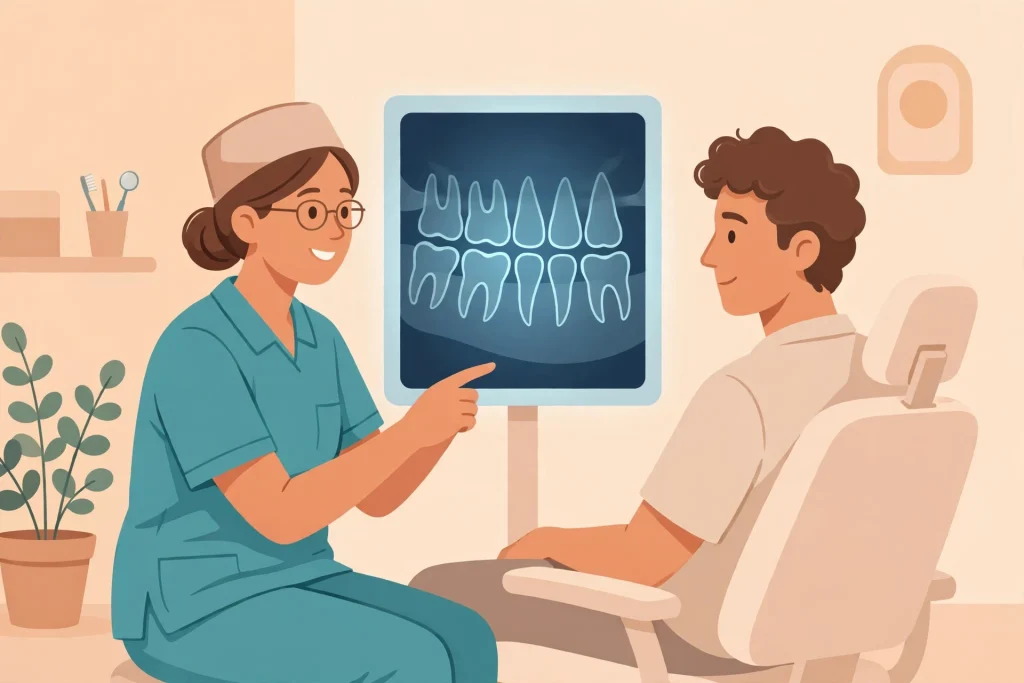
These are general considerations, not a self-diagnosis checklist. An impacted tooth can sometimes have disease without causing obvious pain. Your dentist may need an examination and dental X-rays to assess its position and surrounding structures.
When Wisdom Teeth Should Be Removed
Removal may be appropriate when a wisdom tooth is causing disease, has damaged another tooth, or presents a meaningful risk that cannot be managed more conservatively. Reasons to discuss extraction include:
- Repeated infection: Recurrent pericoronitis, an abscess, or another infection around the tooth.
- Significant tooth decay: A cavity that cannot be predictably restored or maintained.
- Gum disease: Periodontal damage around the wisdom tooth or the neighboring molar.
- Damage to the second molar: Decay, root damage, or other harm associated with the wisdom tooth’s position.
- Cyst or other pathology: An abnormal change around the tooth identified during examination or imaging.
- Other treatment needs: A tooth interfering with specific jaw surgery or another planned treatment.
Sometimes the dentist may recommend treating an infection or another problem first and then reassessing whether extraction is needed. The right plan depends on the cause, severity, and whether the tooth can be treated and kept healthy.

Is It Safe to Keep Impacted Wisdom Teeth?
Sometimes, but impacted teeth need careful assessment. An impacted wisdom tooth may remain beneath the gum or jawbone without causing symptoms, yet its position can make it difficult to monitor or may place the adjacent molar at risk. Other impacted teeth develop decay, gum inflammation, infection, root resorption, or less commonly a cyst.
If your dentist recommends keeping an impacted, disease-free tooth, ask what follow-up is appropriate. Monitoring generally involves a review of symptoms and dental history, a clinical examination, and X-rays when clinically indicated. There is no single imaging schedule that is right for every patient; the interval should be based on the findings and your dentist’s judgment.
Learn more about symptoms of impacted wisdom teeth and wisdom teeth growing sideways.
Does Having No Pain Mean Your Wisdom Teeth Are Healthy?
No. Pain is only one possible sign of a problem. Tooth decay, gum disease, and damage to the neighboring molar can sometimes develop with few or no symptoms at first. A wisdom tooth should not be considered healthy simply because it does not hurt.
Arrange a dental assessment if you notice pain, swelling, recurring bad taste, bleeding or inflamed gum tissue at the back of your mouth, difficulty chewing, or trouble opening your jaw. Seek urgent dental or medical care for fever with worsening facial swelling or signs of spreading infection. Difficulty breathing or swallowing, or rapidly spreading swelling of the face, jaw, or neck, requires emergency medical care.
Wisdom Teeth Removal vs. Keeping Them: A Quick Comparison
| Consideration | Keeping the tooth | Removing the tooth |
|---|---|---|
| Healthy, functional, easy to clean | May be reasonable with routine monitoring | May offer no clear benefit if there is no clinical indication |
| Active infection or repeated inflammation | May allow the problem to recur if the cause remains | May be recommended after clinical assessment |
| Restorable decay | Filling or other treatment may be possible | Considered if the tooth cannot be predictably restored or other factors apply |
| Damage to neighboring tooth | Requires monitoring and a plan to protect the second molar | May remove the source of ongoing damage |
| Impacted but disease-free | Can be considered with active professional surveillance | Decision should weigh individual future risk against surgical risk |
Questions to Ask Your Dentist Before Agreeing to Removal
If you have been told that your wisdom teeth should come out, ask for the reason for each tooth. Useful questions include:
- Is there a current problem, or is the recommendation preventive?
- What did the examination and X-rays show?
- Is the tooth affecting the neighboring second molar?
- Could the tooth be treated and monitored instead of removed?
- What are the specific surgical risks based on its position, including any nerve-related risk?
- If I keep it, what follow-up examinations or imaging will I need?
- What changes would make removal necessary later?
You can also ask for an explanation from an oral and maxillofacial surgeon if the tooth is deeply impacted, close to a nerve, or the treatment decision is complex. For background, see our guide to what happens during wisdom teeth removal.
Frequently Asked Questions
Are dentists changing their minds about wisdom teeth removal?
There is greater emphasis on individualized decisions and avoiding routine removal when there is no disease or clear indication. Professional organizations do not all frame the issue identically, and removal remains appropriate for many teeth that are diseased or likely to cause harm.
Do all impacted wisdom teeth need to be removed?
No. Some impacted, disease-free teeth may be monitored. Their position, relationship to nearby teeth, evidence of disease, and ability to receive ongoing follow-up all matter.
Can I keep my wisdom teeth forever?
Some people keep healthy wisdom teeth throughout life. This is possible when the teeth remain disease-free, functional, and cleanable. Regular dental care is still important because their condition can change.
Is it better to remove wisdom teeth at a younger age?
Surgery can be more straightforward in some younger patients, but age alone does not mean a healthy tooth must be removed. The decision should consider the tooth’s current condition, its likely future risks, and the risks of surgery at that time.
Can wisdom teeth cause crowding?
Wisdom teeth are often blamed for crowding of the front teeth, but evidence does not establish that removing them prevents or reliably treats late lower-incisor crowding. Orthodontic concerns should be assessed separately rather than assuming wisdom tooth extraction will solve them.
How often should retained wisdom teeth be checked?
Keep regular dental appointments and follow the examination and imaging schedule recommended for your specific teeth. The appropriate interval depends on whether the teeth are erupted or impacted and on any findings from previous visits.
Final Takeaway
Experts are not saying that wisdom teeth should never be removed. The important change is that healthy, disease-free wisdom teeth should not automatically be extracted just because they exist. Keeping them may be reasonable when they are functional, cleanable, and regularly monitored. Removal remains an important treatment when there is infection, decay that cannot be restored, damage to nearby teeth, or other pathology.
Ask your dentist to explain the findings for each wisdom tooth and compare the risks of monitoring with the risks and expected benefits of surgery. A personalized decision is safer and more useful than a one-size-fits-all rule.
Medical Sources
- Cochrane: Surgical removal versus retention for asymptomatic, disease-free impacted wisdom teeth
- NICE: Guidance on the extraction of wisdom teeth
- American Association of Oral and Maxillofacial Surgeons: Wisdom Teeth Management
- American Dental Association: Wisdom Teeth
This article is for general educational purposes and does not replace an examination or advice from a qualified dentist or oral and maxillofacial surgeon.