
Updated November 14, 2026
Quick answer
If you’ve ever typed “deep cleaning teeth at home” into a search bar, you probably had a specific feeling in mind. Maybe your teeth don’t feel as smooth as they do right after a dental visit. Maybe your gums bled a little when you flossed, and you wondered whether you could fix that yourself before …
If you’ve ever typed “deep cleaning teeth at home” into a search bar, you probably had a specific feeling in mind. Maybe your teeth don’t feel as smooth as they do right after a dental visit. Maybe your gums bled a little when you flossed, and you wondered whether you could fix that yourself before it turned into something bigger. Or maybe you just saw the price of a professional cleaning and thought — surely there’s a way to do most of this at home?
It’s a fair question. And the honest answer is a mixed one: you can do a lot at home, and the things you can do genuinely matter. But there is a hard line between home care and a real deep cleaning, and that line isn’t about effort or willpower. It’s about what your toothbrush and floss can physically reach — and what they can’t.
This article is about that line. Not about scraping tartar off your teeth at the bathroom mirror (we cover tartar in a separate guide), but about the idea of deep cleaning itself: what it is, what home care can and can’t replace, and how to get the most out of the tools you already own.

What “Deep Cleaning” Actually Means
Here’s the first thing worth clearing up, because the phrase gets used loosely online: when dentists say “deep cleaning,” they mean a specific clinical procedure called scaling and root planing. It is not a stronger version of brushing. It is a different thing entirely.
Scaling is the removal of plaque and tartar from below the gumline, from the surfaces of the tooth roots. Root planing is the smoothing of those root surfaces so that gums can reattach and bacteria have a harder time settling back in. Dentists and hygienists do this with ultrasonic instruments and fine hand tools, often under local anaesthetic, and they work in the pockets between your teeth and gums — the spaces you can’t see and can’t reach with a toothbrush.
Why does that matter? Because gum disease doesn’t start on the shiny part of your tooth. It starts in those pockets. When plaque builds up under the gumline, the gum pulls away from the tooth slightly, the pocket deepens, and more bacteria move in. At home, you can clean the visible surfaces beautifully. You cannot clean inside a deep pocket. No brush, rinse, or gadget sold for home use reaches there safely.
That doesn’t mean home care is pointless — far from it. It means home care and professional deep cleaning do different jobs. Home care is prevention and maintenance: it keeps healthy gums healthy and slows the build-up that leads to problems. A professional deep cleaning is treatment: it deals with the build-up that has already gone beyond the gumline.
At-Home Care vs. Professional Deep Cleaning
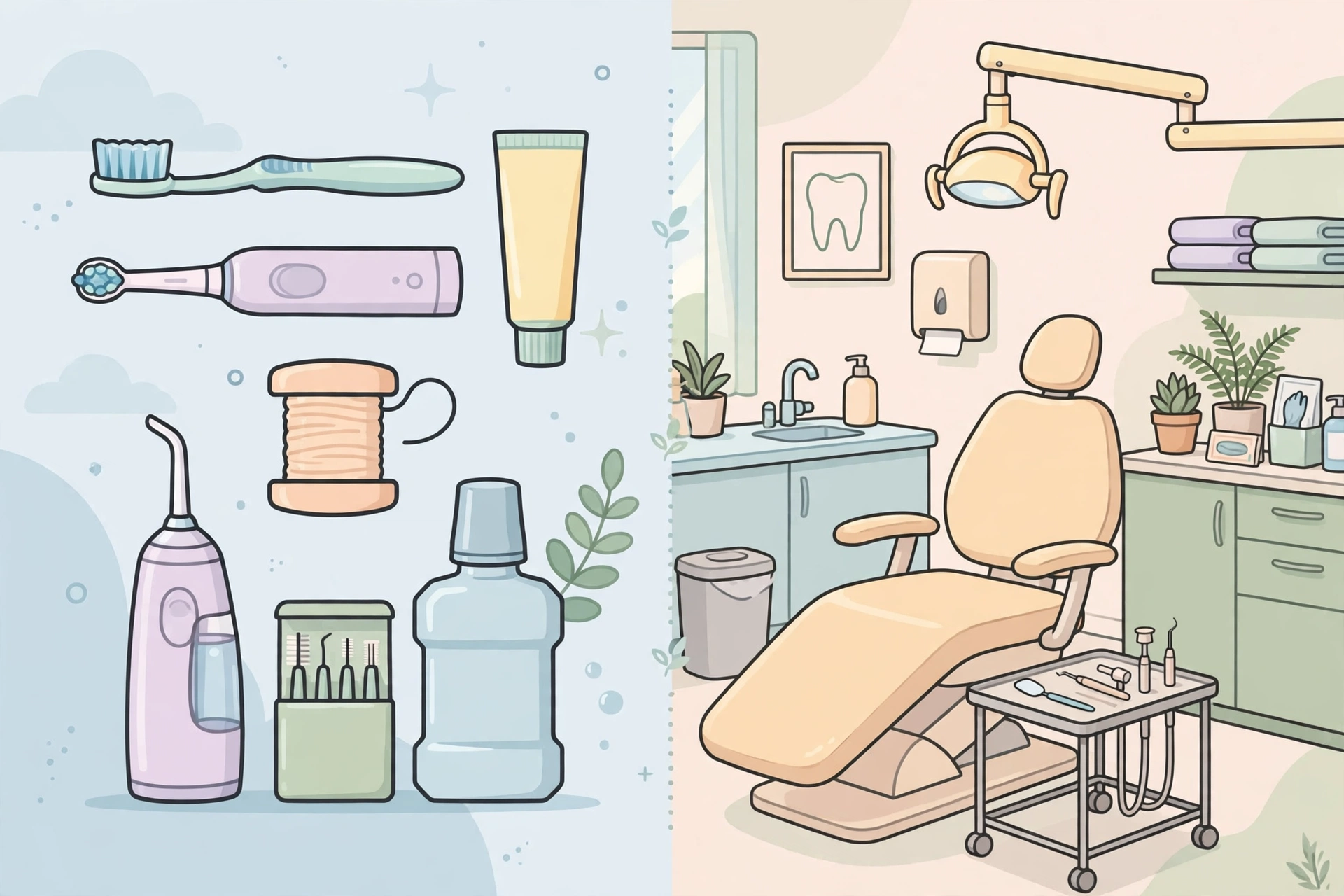
It helps to see the two side by side, because the internet tends to blur them. One is something you do every day. The other is something a trained professional does when the situation calls for it. Both matter, and neither is a substitute for the other.
| At-home care | Professional deep cleaning | |
|---|---|---|
| What it does | Removes plaque from visible tooth surfaces and just under the gum edge | Removes plaque and tartar from below the gumline and smooths tooth roots |
| Who does it | You, daily | Dentist or dental hygienist |
| Tools | Toothbrush, floss, interdental brushes, water flosser, fluoride toothpaste | Ultrasonic scaler, fine hand instruments, sometimes local anaesthetic |
| How often | Twice a day, every day | Only when diagnosed — often once, sometimes in a few sessions |
| What it fixes | Keeps healthy gums healthy; slows plaque build-up | Treats gum disease that has already developed below the gumline |
| What it can’t do | Reach inside deep gum pockets or remove hardened tartar | Replace your daily routine — without home care, the problem comes back |
Read that table again and notice the last row. The two sides need each other. A deep cleaning without good home care afterwards is a wasted effort, because plaque starts reforming within hours. And a perfect home routine can’t undo gum disease that has already taken hold under the gumline. People who do best with their gums long-term are the ones who take both seriously — the daily habit and the professional visit when it’s needed.
One more thing the table doesn’t show: cost and comfort. A professional deep cleaning can be expensive and, honestly, not much fun. That’s part of why the search for an at-home version is so popular. But pretending the home version exists doesn’t save money — it usually just delays the real treatment, and by the time someone finally goes in, the problem is bigger and the bill is too.
What Actually Helps at Home
So what can you do at home that genuinely makes a difference? Quite a lot, as it turns out. The unglamorous truth about gum health is that it is mostly won or lost in about four minutes a day. Here’s what those minutes should contain.
Brushing technique matters more than brushing harder. Most people brush too hard and too fast. A soft-bristled brush, held at a slight angle toward the gumline, with small gentle circles, does a better job than scrubbing back and forth with force. The gumline is where plaque collects, so that’s where the brush needs to spend its time. Two minutes, twice a day, is the baseline.
Cleaning between your teeth is not optional. This is the part most people skip, and it’s the part that matters most for deep-cleaning ambitions. Your toothbrush — any toothbrush — only reaches about 60% of your tooth surfaces. The rest is between your teeth, and that’s exactly where gum problems start. Floss works. Interdental brushes work, and for many people they work better, especially if the gaps between teeth are a little wider. Pick the one you’ll actually use every day, because the best interdental tool is the one that doesn’t sit in the drawer. If the back teeth are hard to reach, you’re not alone — getting to the molars takes a bit of practice, and we’ve written separately about cleaning your back teeth for exactly that reason.
A water flosser is a useful helper, not a replacement. Water flossers are good at flushing out food debris and disrupting plaque along the gumline, and they can be a real help for people with braces, bridges, or implants. What they don’t do is scrape plaque off the tooth the way floss or an interdental brush does. Think of a water flosser as a rinse with ambition, not as a substitute for something that physically touches the tooth surface. If you use one, use it as well as floss or interdental brushes, not instead of them.
Don’t forget your tongue. Your tongue carries a large share of the bacteria in your mouth. A quick, gentle pass with a tongue scraper or the back of your toothbrush takes seconds and makes a noticeable difference to breath and to the overall bacterial load in your mouth.
Fluoride toothpaste does quiet, important work. Fluoride strengthens enamel and helps reverse the very earliest stages of tooth decay. Use a fluoride toothpaste, spit rather than rinse after brushing, and let it sit on your teeth.
None of this is exciting. That’s the point. The home care that actually protects your gums isn’t a hack or a product — it’s a short, consistent routine, done properly, every day. If someone is selling you a shortcut to a deep clean, they’re selling you something that doesn’t exist.
What Doesn’t Work at Home
Now for the other side of the coin. The internet is full of deep-cleaning promises, and most of them range from useless to genuinely harmful. Here’s what to avoid.
Scraping tartar off yourself. Once plaque hardens into tartar, it bonds to the tooth. Removing it takes professional instruments and training — and, crucially, the ability to tell tartar from enamel, which look similar to an untrained eye. DIY scaling tools are sold online, and they are a bad idea. People who use them tend to scratch their enamel, cut their gums, and push bacteria deeper under the gumline, all while leaving most of the tartar in place. If tartar is your concern, read our guide on how to remove tartar from teeth at home to understand what you can and can’t do about it — the short version is that prevention is yours, removal is the dentist’s.
Harsh scrubs and abrasive pastes. Baking soda, charcoal powder, lemon juice, apple cider vinegar — these get recommended constantly as natural deep-cleaning solutions. The problem is that they work by being abrasive or acidic, which means they wear down enamel. Enamel doesn’t grow back. A paste that makes your teeth feel squeaky clean in the moment may be quietly thinning the very surface that protects them. Whitening is a separate question from cleaning, and if you’re interested in the safer side of it, our guide on how to polish teeth at home covers what helps without the damage.
“Detox” rinses and oil pulling as a cure. Rinsing with oil or a herbal mouthwash can feel pleasant, and some people find oil pulling helps their mouth feel fresher. But there is no good evidence that it removes tartar, reverses gum disease, or cleans below the gumline. As an addition to brushing and flossing, it’s harmless for most people. As a replacement for them, or for professional treatment, it’s a detour.
The pattern here is simple: anything that claims to do the dentist’s job at home either can’t do it or can do it badly enough to cause harm. Your home routine’s job is to keep things from getting to the point where deep cleaning is needed — and to keep them healthy after a professional cleaning. That is already a big, worthwhile job.
When to See a Dentist
This is the part people most often put off, so let’s make it concrete. You should book a dental visit — not someday, but soon — if any of these sound familiar:
- Your gums bleed regularly when you brush or floss, and it doesn’t improve after a couple of weeks of proper cleaning. A little bleeding when you first start flossing is common, but bleeding that keeps happening is a sign of inflammation.
- Your gums look red, swollen, or puffy, or they feel sore or tender to the touch.
- Your gums seem to be pulling back from your teeth, or your teeth look longer than they used to.
- You have persistent bad breath that doesn’t improve with brushing and tongue cleaning.
- A tooth feels loose, or your bite feels different when you close your mouth.
- You notice pus, a bad taste that won’t go away, or a sore spot on your gum that doesn’t heal.
None of these mean disaster. Most gum problems caught early are very treatable. But they all mean the same thing: the problem has gone past the point where home care alone can fix it, and a professional needs to look. A dentist can measure your gum pockets, tell you how deep they are, and say plainly whether you need a deep cleaning or whether a regular professional clean and a better home routine will do.
It’s also worth saying: if you haven’t seen a dentist in a long time, a routine check-up is the simplest way to find out where you stand. You don’t need to wait for a symptom.
Frequently Asked Questions
Can you do a deep cleaning at home?
No — not a real one. A professional deep cleaning (scaling and root planing) removes tartar from below the gumline and smooths the tooth roots, which requires instruments and training you can’t replicate at home. What you can do at home is excellent daily care: thorough brushing, cleaning between your teeth, and a water flosser. That routine prevents the problems a deep cleaning treats, and it keeps the results of a professional cleaning lasting longer.
How do I know if I need a deep cleaning?
Only a dentist can say for sure, because it depends on the depth of the pockets between your teeth and gums, which they measure with a small probe. Signs that suggest you might need one include gums that bleed regularly, red or swollen gums, receding gums, persistent bad breath, or teeth that feel loose. If any of those apply, book a check-up and ask directly.
Does a deep cleaning hurt?
It’s usually done with local anaesthetic, so you shouldn’t feel pain during the procedure, though you may feel pressure and vibration. Afterwards, some soreness and sensitivity are common for a few days, especially to hot and cold. Most people find it uncomfortable rather than painful, and it settles on its own.
How often do you need a deep cleaning?
For most people, never — if daily care and regular check-ups keep the gums healthy, a standard professional clean is enough. A deep cleaning is a treatment for gum disease, not a routine service. If you do need one, your dentist will tell you whether it’s a one-off or whether you’ll need follow-up maintenance cleanings more often than usual afterwards.
Can a water flosser replace a deep cleaning?
No. A water flosser is good at flushing debris and disturbing plaque along the gumline, but it doesn’t remove hardened tartar and it can’t clean inside deep gum pockets. It’s a useful addition to brushing and flossing, not a substitute for professional treatment. If you’ve been told you need a deep cleaning, a water flosser won’t change that — but using one afterwards will help the results last.
Is oil pulling a form of deep cleaning?
No. Oil pulling — swishing oil around your mouth for several minutes — may leave your mouth feeling fresh, but there is no good evidence that it removes tartar, cleans below the gumline, or reverses gum disease. It can be a pleasant addition to a proper routine, but it doesn’t replace brushing, cleaning between your teeth, or professional care.
What happens if I don’t get a deep cleaning when I need one?
Gum disease tends to get worse slowly and quietly. The pockets deepen, more bacteria settle in, and over time the bone that supports your teeth can be affected. That is how people end up losing teeth that otherwise looked fine. The good news is that gum disease caught early is very treatable, and a deep cleaning plus better home care stops most cases in their tracks.
A Short, Honest Summary
Deep cleaning your teeth at home is a bit of a contradiction — the “deep” part is precisely the part you can’t reach from your bathroom. What you can do at home is real and important: brush properly, clean between your teeth every day, use a water flosser as a helper, and keep up the routine even when it feels boring. That is what keeps healthy gums healthy.
And when your gums tell you something is wrong — bleeding that won’t stop, swelling, receding gums, bad breath that lingers — that’s not a failure of your home routine. It’s a signal to let a professional take over for a while. The best results come from both sides working together: your daily care, and a dentist’s when it’s needed.
This article is general education, not medical advice. If you have symptoms or concerns about your gums, please see a dentist for an examination and advice suited to you.